

 Français (France)
  Nederlands (nl-NL)
 Map of videos including a monument related to the theme featured on this page
• Use the markers to explore the content •
This collection highlights Islamic funerary art through a selection of mausoleums and commemorative complexes built between the 10th and 17th centuries across India, Central Asia, and Egypt. Despite differences in geography, history, and ruling dynasties, these structures share a common purpose: to preserve the memory of a sovereign, a saint, or a scholar.
Whether rooted in Mughal, Timurid, Mamluk, or Sufi traditions, these monuments reflect a shared intention to blend spirituality, power, and artistic refinement. The unity of the theme lies in the tomb as a political, architectural, and symbolic statement-bridging sacred devotion and worldly prestige.
From the Taj Mahal to Mevlana’s tomb, from Shah-i-Zindah necropolis to the shrines of Bukhara, each site embodies a deep reverence for memory, expressed through domes, Quranic inscriptions, gardens, and tilework in various regional styles.
Grouped here, these monuments illustrate the depth and diversity of Islamic traditions in honoring the dead-where architecture becomes both spiritual expression and enduring cultural legacy.
Funerary Architecture, Authority, and Memory in the Islamic World
Tombs shaped by multiple traditions
The Islamic mausoleum is a funerary structure created to preserve the memory of a ruler, dignitary, religious teacher, or other prominent figure. Its development took place in widely differing contexts, from medieval Egypt and Timurid Central Asia to the Indian sultanates and the Mughal Empire. The selected monuments therefore do not represent a uniform architectural type. They belong instead to a broad tradition linking burial, commemoration, religious practice, and social representation.
Some tombs are independent buildings, such as the Samanid Mausoleum in Bukhara and Shish Gumbad in Delhi. Others form part of extensive foundations incorporating mosques, madrasas, hospitals, courtyards, and service buildings. The Qalawun Complex in Cairo and the Baha-ud-Din Naqshband complex near Bukhara demonstrate this integration. In such ensembles, the tomb becomes the nucleus of a religious and urban institution whose role extends well beyond burial.
The dome as an architectural marker
The dome is one of the elements most frequently associated with Islamic mausoleums. Visible from a distance, it indicates the presence of a tomb and organises the interior around a central axis. Hoshang Shah’s Tomb at Mandu, the Gur-e-Amir at Samarkand, and the Qutb Shahi Tombs at Hyderabad show different interpretations of this principle. Their domes may be hemispherical, bulbous, ribbed, or raised on tall drums.
Covering a square chamber with a circular dome requires specific structural solutions, including squinches, pendentives, and superimposed arches. These transitional features often become decorative surfaces in their own right. At the Gur-e-Amir, the tall drum and fluted outer dome emphasise verticality, while the funerary chamber follows a centralised arrangement. In Mughal architecture, the dome dominates more symmetrical compositions, as seen at the Taj Mahal and Bibi Ka Maqbara.
Dynastic authority and political representation
Royal mausoleums contributed to the visual representation of political power. The Gur-e-Amir, associated with Timur and his descendants, transformed a dynastic burial place into an influential reference for later Timurid architecture. At Hyderabad, the Qutb Shahi Tombs form a necropolis that records the continuity of a ruling house within the landscape of its former capital. The Samanid Mausoleum performs a related function at Bukhara on a smaller scale, using patterned brickwork to produce its architectural decoration.
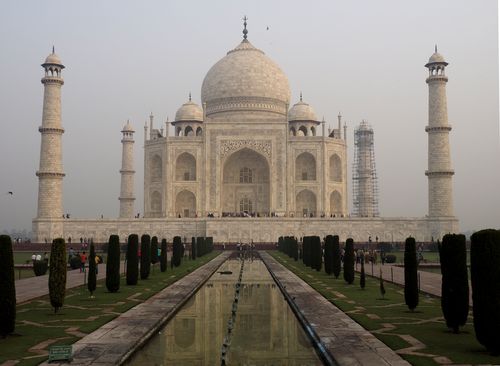
In India, the Taj Mahal represents the most elaborate development of the Mughal garden tomb. Built by Shah Jahan for Mumtaz Mahal, it combines a mausoleum, mosque, subsidiary buildings, monumental gateway, and formally arranged garden. Bibi Ka Maqbara at Aurangabad employs a related composition in a different political and material context. Comparison between the two shows how a shared dynastic language could be adapted to available resources and individual forms of patronage.
Sainthood, pilgrimage, and collective practice
Not all funerary monuments commemorate political authority. The tombs of Sufi teachers became places of visitation, prayer, and communal gathering. At Konya, the Mausoleum of Mevlana preserves the memory of Jalal al-Din Rumi and stands at the centre of a complex associated with the Mevlevi tradition. The shrine of Baha-ud-Din Naqshband near Bukhara performs a comparable role in the history of the Naqshbandi order.
At Khiva, the Mausoleum of Pakhlavan Makhmoud links the memory of a revered poet, craftsman, and local patron with that of the khans later buried in the complex. At Nakodar, the tombs of Haji Jamal and Muhammad Momin reflect Mughal-period funerary traditions, while Dera Baba Murad Shah Ji represents a contemporary culture of shared devotional practice. These sites demonstrate how a mausoleum can remain an active religious institution rather than becoming solely a historical monument.
Materials, colour, and surface decoration
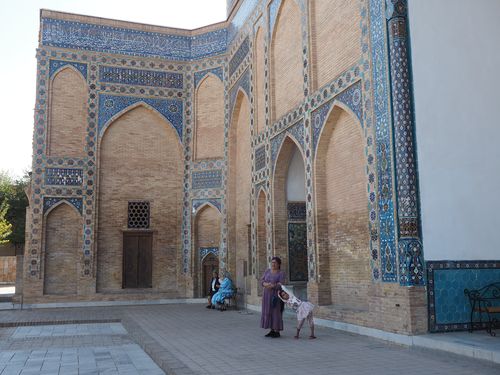
Building materials distinguish the principal regional traditions. Brick forms the structure of the Samanid Mausoleum and many Central Asian monuments. It may remain exposed and create geometric decoration through variations in its arrangement. At Samarkand, blue, turquoise, and white ceramics transform the façades of the Gur-e-Amir and the mausoleums of Shah-i-Zindah into compositions of mosaics, inscriptions, and vegetal or geometric patterns.
White marble dominates the Taj Mahal and Hoshang Shah’s Tomb, producing clearly defined volumes and reflective surfaces. Other buildings combine stone, plaster, glazed tiles, and painted decoration. In Cairo, carved masonry, inscriptions, marble, and geometric ornament are integrated into complex urban façades. These materials are not merely decorative: they protect the underlying structures while communicating the status of the deceased and the religious importance of the site.
Monuments within cities and landscapes
The setting of a mausoleum contributes directly to its meaning. Mughal garden tombs organise their surroundings through axes, waterways, and geometric divisions associated with images of the garden of paradise. The necropolises of Shah-i-Zindah and the Q Qutb Shahi rulers instead contain groups of structures erected over successive generations. Their architectural variety records the gradual formation of collective dynastic and religious memory.
Several selected complexes also include buildings whose principal purpose is not funerary. The Bibi Khanym Mosque at Samarkand, Bolo Khaouz Mosque at Bukhara, and Hazrati Imam ensemble in Tashkent place mausoleums within wider settings devoted to worship, teaching, pilgrimage, and the preservation of religious texts. From the independent tomb to the extensive urban foundation, these monuments connect remembrance of the dead with the political and religious practices of living communities.


A Survey of Islamic Funerary Architecture
Egypt
Cairo • Qalawun Complex Built in the thirteenth century on al-Muizz Street, this Mamluk complex combines a mausoleum, madrasa, and hospital. Sultan Qalawun’s tomb is distinguished by a domed central space, monumental arches, and elaborate decoration in stone, marble, mosaic, and wood, integrating commemoration with religious and charitable functions.
Cairo • Al-Salih Mausoleum The mausoleum of the Ayyubid sultan Al-Salih Najm al-Din Ayyub belongs to a medieval funerary and educational complex. Constructed in the thirteenth century, it was among the earliest sovereign mausoleums attached to a madrasa in Egypt and anticipated the development of later Mamluk foundations.
India
Delhi (NCT), Delhi • Shish Gumbad Located in the Lodi Gardens, Shish Gumbad is a fifteenth-century tomb whose occupants have not been identified with certainty. Its name, meaning “glass dome,” refers to the glazed tiles that once decorated its exterior. The compact structure combines stone masonry, arched openings, plasterwork, and interior ornament.
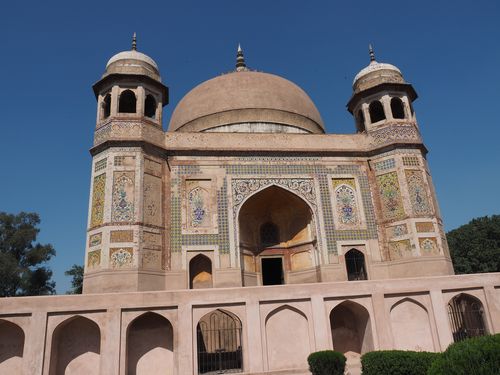
Madhya Pradesh, Mandu • Hoshang Shah’s Tomb This fifteenth-century mausoleum contains the tomb of Hoshang Shah, ruler of Malwa. Clad largely in white marble, it has a symmetrical composition dominated by a central dome and smaller corner elements. It represents an early monumental use of marble in Indo-Islamic funerary architecture.
Maharashtra, Aurangabad • Bibi Ka Maqbara Constructed in the seventeenth century for Dilras Banu Begum, wife of the Mughal emperor Aurangzeb, Bibi Ka Maqbara follows the garden-tomb model. An axial plan, pools, formal gardens, and four minarets frame the mausoleum. Its more restricted use of marble distinguishes it from the Taj Mahal.
Punjab, Nakodar • Dera Baba Murad Shah Ji This contemporary shrine in Nakodar is dedicated to Baba Murad Shah and belongs to a regional tradition of venerating spiritual teachers. Visited by people from different religious communities, it combines a burial place with devotional practices, music, charitable activities, and large communal gatherings.
Punjab, Nakodar • Tombs of Haji Jamal and Muhammad Momin These two Mughal-period tombs stand in separate enclosures at Nakodar. Their architecture incorporates domes, ordered façades, arched openings, and surviving painted or glazed decoration. Together, they demonstrate how elaborate Islamic funerary forms were adopted in regional centres of Punjab beyond the principal imperial capitals.
Telangana, Hyderabad • Qutb Shahi Tombs The Qutb Shahi necropolis contains the mausoleums of the rulers of Golconda and members of their families. Built mainly during the sixteenth and seventeenth centuries, the tombs combine domes, arcaded galleries, and stucco decoration. Their concentration in one landscape records the continuity of a ruling dynasty.
Uttar Pradesh, Agra • Taj Mahal Built in the seventeenth century by Emperor Shah Jahan for Mumtaz Mahal, the Taj Mahal comprises a mausoleum, garden, mosque, gateway, and subsidiary buildings. The white marble tomb, crowned by a prominent dome and flanked by minarets, combines strict symmetry with carved and inlaid decoration.
Turkey
Konya • Mausoleum of Mevlana The tomb of Jalal al-Din Rumi stands at the centre of a former dervish complex in Konya. Recognisable by its tall conical dome faced with turquoise tiles, it is closely associated with the Mevlevi tradition. The site combines a mausoleum, museum, pilgrimage destination, and memorial to Anatolian Sufism.
Uzbekistan
Bukhara • Baha-ud-Din Naqshband Complex Located near Bukhara, this complex surrounds the tomb of Baha-ud-Din Naqshband, a fourteenth-century Sufi teacher associated with the Naqshbandi order. Mausoleums, mosques, courtyards, and visitor facilities form an active pilgrimage centre that has been repeatedly expanded and restored under successive governments.
Bukhara • Chashma-Ayub Mausoleum The Chashma-Ayub Mausoleum, whose name means “Spring of Job,” stands near the Samanid Mausoleum. Its separate sections result from building campaigns extending from the twelfth to the sixteenth century. Several domes cover the structure, including an unusual conical form raised on a tall cylindrical drum.
Bukhara • Samanid Mausoleum Constructed during the ninth and tenth centuries, this dynastic tomb is among the oldest surviving monuments of Islamic architecture in Central Asia. Its square plan and dome are built entirely of baked brick. Varied brick arrangements create geometric patterns whose appearance changes according to the light.
Bukhara • Bolo Khaouz Mosque Built opposite the Ark fortress, Bolo Khaouz is a mosque rather than a mausoleum. Its inclusion places Bukhara’s funerary monuments within a broader religious landscape. The complex is particularly recognisable by its pool and its open portico, whose painted ceiling is supported by tall, slender wooden columns.
Khiva • Pakhlavan Makhmoud Mausoleum This mausoleum commemorates Pakhlavan Makhmoud, a craftsman, poet, and revered figure regarded as the traditional protector of Khiva. Later enlarged to contain the tombs of local khans, the complex is distinguished by turquoise domes and richly decorated interiors covered with glazed tiles and inscriptions.
Samarkand • Mausoleum of Timur, Gur-e-Amir The Gur-e-Amir contains the tombs of Timur and several members of the Timurid dynasty. Completed in the early fifteenth century, it is dominated by a fluted dome rising above a tall drum. Mosaics, inscriptions, and coloured tilework emphasise its function as a dynastic burial monument.
Samarkand • Bibi Khanym Mosque and Mausoleum The ensemble associated with Bibi Khanym includes the monumental congregational mosque commissioned by Timur and a separate mausoleum connected with women of the imperial family. Its immense portals, domed volumes, and ceramic revetments express the architectural ambitions of Samarkand during the Timurid period.
Samarkand • Shah-i-Zindah Necropolis Shah-i-Zindah is a group of mausoleums arranged along a narrow processional passage and constructed mainly between the eleventh and fifteenth centuries. The tombs are associated with members of the ruling elite and Qutham ibn Abbas. Their façades display an extensive variety of glazed ceramic decoration.
Tashkent • Hazrati Imam Architectural Complex This religious ensemble developed around the tomb of the scholar Abu Bakr Kaffal Shashi. It brings together mausoleums, mosques, and educational institutions dating from different periods. Later reconstruction and restoration demonstrate the continuing role and contemporary reinterpretation of Islamic architectural heritage in Uzbekistan.