

 Français (France)
  Nederlands (nl-NL)
 The Samanid Mausoleum is a funerary monument located in Bukhara, Uzbekistan. Built between the late ninth and early tenth centuries, it is associated with the Samanid dynasty, which ruled large parts of Central Asia and eastern Iran. Originally intended as a dynastic burial site, the structure reflects the development of funerary traditions within the medieval Islamic world. Today, the monument forms part of the Historic Centre of Bukhara, a UNESCO World Heritage Site. Its preservation provides insight into the political, cultural and religious history of the region during a period that played a significant role in the formation of Central Asian societies.
Monument profile
Samanid Mausoleum
Monument category: Mausoleum
Monument family: Tomb, Necropolis, Mausoleum or Cenotaph
Monument genre: Funerary
Cultural heritage: Islamic
Geographic location: Bukhara • Uzbekistan
Construction period: 9th century AD
This monument in Bukhara is inscribed on the UNESCO World Heritage List since 1993 and is part of the serial property "Historic Centre of Bukhara".See the UNESCO monuments featured on this site
• Links to •
• This monument illustrates the following theme •
Architecture • Mausoleums : Muslim Mausoleums
• List of videos about Bukhara on this site •
Bukhara, oasis on the silk road • Uzbekistan
• References •
Wikipedia FR: Mausolée des Samanides
UNESCO: Historic Centre of Bukhara
The Samanid Mausoleum and Dynastic Memory in Bukhara
Foundation and Dynastic Purpose
The Samanid Mausoleum was constructed in Bukhara between the late ninth and early tenth centuries during the rule of the Samanid dynasty. The building is generally associated with Ismail Samani, the ruler who consolidated Samanid authority and transformed Bukhara into a major political center of the dynasty. Unlike religious institutions intended for communal worship, the monument was conceived as a dynastic mausoleum dedicated to the burial of members of the ruling family.
Historical evidence indicates that the structure served as the burial place of Ismail Samani and several of his relatives. Its construction fulfilled both commemorative and political functions. By establishing a permanent funerary monument for the dynasty, the Samanids created a visible symbol of continuity and legitimacy. The mausoleum linked the memory of the ruling family to the capital city and reinforced the prestige of the dynasty within its own territories.
The choice of a monumental masonry tomb was significant in the context of Samanid state formation. The building was intended to preserve dynastic memory across generations while expressing the authority of a ruling house that governed extensive territories from Bukhara.
From Dynastic Mausoleum to Historic Monument
The decline and eventual disappearance of Samanid political power at the end of the tenth century altered the original context of the mausoleum. Although the building retained its funerary character, it no longer served an active role in supporting a ruling dynasty. Successive governments that controlled Bukhara inherited the structure as a historical remnant of an earlier political era.
The monument survived periods of political instability that affected the city. During the Mongol invasion of Central Asia in the early thirteenth century, many urban structures suffered severe damage. The mausoleum, however, escaped destruction. One factor that contributed to its survival was its gradual burial beneath layers of earth and sand. Over time, much of the structure became partially concealed, reducing its exposure to both human intervention and environmental deterioration.
As centuries passed, the building remained present in local memory but lost much of its former visibility within the urban landscape. The absence of major rebuilding campaigns or extensive modifications helped preserve many original features. Unlike monuments that underwent repeated reconstruction, the mausoleum retained a substantial portion of its early fabric.
Rediscovery, Research and Restoration
Interest in the monument increased during the late nineteenth century, when scholars and administrators began documenting the historic monuments of Central Asia. The unusual age and preservation of the mausoleum attracted particular attention. Archaeological investigations and surveys revealed the importance of the structure for understanding the early history of Islamic Central Asia.
Excavation work undertaken during the early twentieth century gradually exposed the building from the accumulated deposits that had surrounded it. The clearing of the site allowed researchers to examine its original form and condition. These investigations demonstrated that the monument had survived with relatively limited structural alteration.
During the Soviet period, the mausoleum was protected as a historical and architectural monument. Conservation programs focused on stabilizing the masonry, repairing damaged sections, and preserving original construction materials whenever possible. The monument was no longer associated with dynastic functions but became an object of historical study and cultural heritage management.
After the independence of Uzbekistan in 1991, the mausoleum acquired renewed significance as part of the country’s historical identity. Additional conservation efforts were undertaken to ensure its long-term preservation. The monument also became a prominent destination for visitors interested in the history of Bukhara and the Samanid period.
The Mausoleum in Its Contemporary World
The construction of the mausoleum took place during a period of major political and cultural developments across Eurasia. The Abbasid Caliphate remained an influential center of the Islamic world from Baghdad. In Western Europe, political authority was divided among successor states that emerged after the fragmentation of the Carolingian Empire. In China, the Tang dynasty was approaching its final decades. Across the Indian subcontinent, regional dynasties controlled important commercial and political centers.
Cultural Role and Heritage Preservation
Today, the Samanid Mausoleum forms part of the UNESCO World Heritage property known as the Historic Centre of Bukhara, inscribed on the World Heritage List in 1993. This designation recognizes the monument as an integral component of the historic urban fabric of the city.
The building no longer functions as a dynastic burial site in the political sense for which it was created. Instead, it serves as a historical landmark associated with the memory of the Samanid dynasty and the development of medieval Bukhara. Its significance derives from both its historical role and its exceptional state of preservation.
Conservation programs continue to monitor the condition of the structure. Preservation efforts focus on protecting the masonry from environmental stress, controlling moisture-related deterioration, and managing the impact of visitor activity. The monument remains one of the most complete surviving testimonies to the Samanid period and provides valuable evidence for the study of early medieval Central Asian history.
Architectural Composition of the Samanid Mausoleum in Bukhara
Site Layout and Geometric Organization
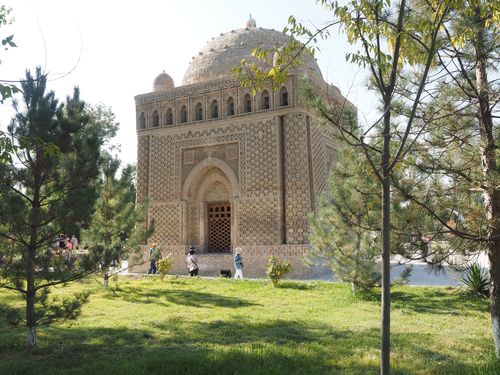
The Samanid Mausoleum stands within a landscaped area of central Bukhara and is organized around a remarkably compact and symmetrical plan. The building consists of a nearly perfect cube surmounted by a dome, creating a composition based on balanced geometric relationships. Each façade is treated almost identically, giving the structure a sense of visual unity regardless of the viewing angle.
The plan is square, with sides measuring approximately ten meters. The internal chamber occupies the center of the building and is enclosed by thick load-bearing walls. Openings are positioned on the principal axes, reinforcing the monument’s symmetry. The structure is neither part of a larger architectural complex nor attached to subsidiary buildings, allowing its geometry to remain fully legible.
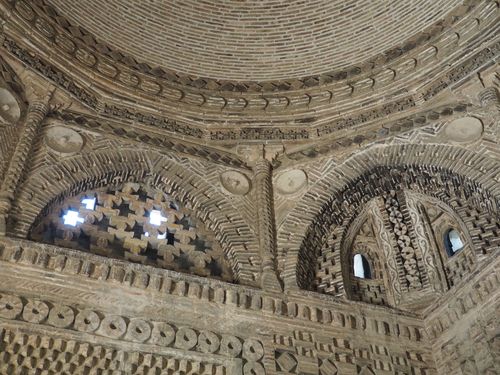
The transition from the square base to the circular dome is achieved through carefully integrated architectural devices within the upper corners of the interior. This arrangement creates a gradual transformation of forms while preserving the clarity of the overall composition.
Brick Construction and Structural Techniques
The mausoleum is constructed almost entirely of baked brick. Rather than relying on carved stone, stucco revetments, or applied decorative panels, its architectural character is generated through the arrangement of masonry itself. Structural and decorative functions are closely integrated throughout the monument.
The walls are exceptionally thick in relation to the building’s dimensions, providing both stability and thermal protection. The masonry was laid with a high degree of precision, allowing complex decorative effects to emerge directly from the placement of individual bricks. Horizontal, vertical, diagonal, and interwoven patterns create a constantly changing surface texture.
The dome rests on a system that distributes loads evenly toward the supporting walls. The compact proportions of the building contribute significantly to its structural stability. The monument has survived numerous centuries with relatively limited alteration, demonstrating the effectiveness of its original engineering.
Corner buttress-like elements reinforce the exterior mass and visually frame the cubic volume. These features strengthen the building’s silhouette while contributing to the distribution of structural loads.
Exterior Elevations and Decorative Treatment
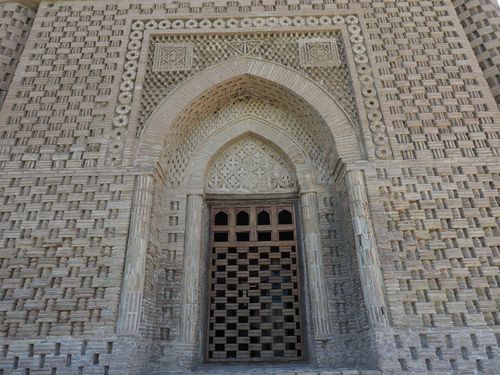
Each façade is organized around a large central arch set within a rectangular frame. This arrangement establishes a clear hierarchy while maintaining the symmetry of the monument. The arches are not deeply recessed but form an integral part of the wall composition.
The decorative program is entirely executed in brickwork. Numerous geometric motifs appear across the façades, including interlaced patterns, basket-weave effects, checkerboard arrangements, and circular compositions. The absence of glazed tiles focuses attention on the texture, color, and craftsmanship of the masonry.
Light plays a major role in the visual appearance of the monument. The relief created by projecting and recessed bricks produces changing shadows throughout the day. As sunlight shifts across the façades, decorative details become alternately emphasized and softened.
Small openings placed within the upper sections of the walls provide ventilation and natural illumination. Their careful integration prevents disruption of the overall geometric order. Decorative brick screens further enrich the façades while allowing controlled airflow.
The dome rises above a low drum and remains visually proportional to the cubic base. Its profile contributes to the monument’s balanced silhouette rather than dominating the composition. The resulting massing creates a strong sense of architectural cohesion.
Interior Space and Architectural Detailing
The interior consists of a single chamber covered by the dome. Despite the limited dimensions, the space conveys a sense of height and spatial complexity through the progression of architectural forms toward the ceiling.
Arched niches are incorporated into the walls, creating rhythm and reducing the visual weight of the masonry. These recesses also generate subtle variations in light and shadow across the interior surfaces. The arrangement of niches follows the monument’s symmetrical organization and reinforces its geometric coherence.
The transition from the square chamber to the circular dome is achieved through a sequence of intermediate forms placed in the upper corners. This structural solution softens the shift between geometries and contributes to the visual continuity of the interior.
Brick remains the dominant material throughout the chamber. Decorative effects arise from pattern, proportion, and construction technique rather than from contrasting materials. The restrained palette emphasizes the monument’s architectural logic and craftsmanship.
Natural light enters through small openings positioned high in the structure. The limited number of apertures creates a subdued interior atmosphere while highlighting the texture of the masonry. The lighting conditions change throughout the day, revealing different aspects of the brick patterns and structural forms.
Architectural Preservation and Later Interventions
One of the most unusual aspects of the mausoleum’s preservation is its long period of partial burial beneath accumulated earth and sand. This circumstance protected large portions of the structure from weathering, modification, and reuse. As a result, many original architectural features survived with relatively little alteration.
Excavation and restoration campaigns carried out during the twentieth century focused on stabilizing the masonry and removing later accumulations surrounding the building. Conservation efforts prioritized the preservation of original brickwork and avoided extensive reconstruction.
Current preservation work concentrates on monitoring the condition of the masonry, controlling moisture infiltration, and managing the effects of environmental exposure. Because the monument’s architectural significance is closely linked to the integrity of its brick construction, conservation strategies place particular emphasis on maintaining original materials and traditional repair techniques.
The Samanid Mausoleum remains notable for the clarity of its geometric design, the sophistication of its brick craftsmanship, and the exceptional survival of its original architectural fabric. Its compact form and highly integrated decorative system continue to provide valuable evidence of early medieval construction techniques in Central Asia.