

 Français (France)
  Nederlands (nl-NL)
 Raj Ghat is a memorial dedicated to Mahatma Gandhi, located in Delhi, India. It marks the site of his cremation, which took place on January 31, 1948, following his assassination. The monument consists of a simple black marble platform set amidst a carefully maintained garden. An eternal flame burns at one end of the platform, symbolizing Gandhi’s lifelong commitment to nonviolence and social justice. The site is open to visitors and is often attended by both national and international dignitaries. It stands as a place of remembrance and reflection on Gandhi’s enduring influence on modern Indian and global history.
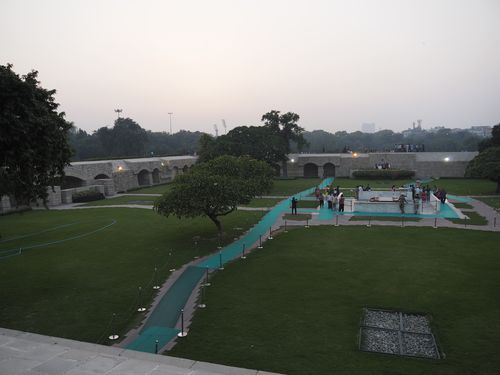
Delhi • Raj Ghat (Gandhi Memorial)
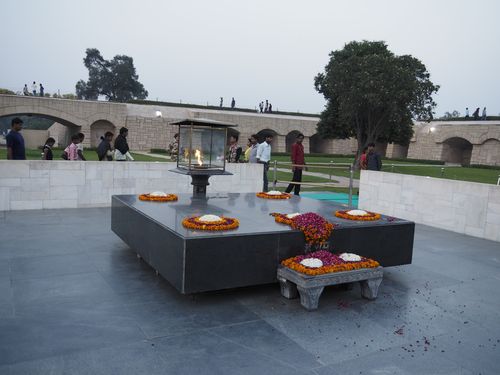
Delhi • Raj Ghat (Gandhi Memorial)
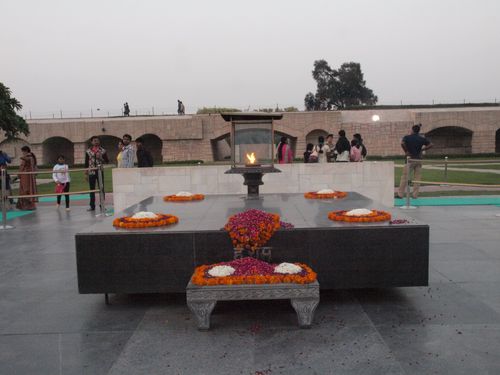
Delhi • Raj Ghat (Gandhi Memorial)
Monument profile
Raj Ghat (Gandhi Memorial)
Monument category: Memoral
Monument family: Monument for cultural purposes
Monument genre: Cultural or scientific
Geographic location: Delhi • Delhi (NTC) • India
Construction period: 20th century AD
• Links to •
• Dynasties that contributed to the construction of the monument •

• List of videos about Delhi on this site •
Delhi • Capital of Empires and Spiritualities • India
• References •
Wikipedia EN: Raj Ghat and associated memorials
Historical Overview of Raj Ghat (Gandhi Memorial), Delhi
Political and Social Context of Its Construction
Raj Ghat was conceived as a national memorial to Mahatma Gandhi, following his assassination on January 30, 1948. His cremation took place the following day on the banks of the Yamuna River in Delhi, on an open ground that would later become a symbol of collective mourning and civic remembrance. The decision to construct a permanent memorial was not merely a gesture of respect toward the leader of Indian independence, but also a politically significant act aimed at unifying a country newly freed from colonial rule and grappling with the traumas of Partition.
The early years of Indian independence were marked by communal violence, refugee crises, and the need to forge a secular national identity. Honoring Gandhi’s memory through a monument accessible to all faiths and devoid of sectarian symbolism aligned with the ideals of the Indian republic. The government of Prime Minister Jawaharlal Nehru, which oversaw the project, aimed to create a space that reflected the values of peace, simplicity, and moral authority that Gandhi embodied. There was also an implicit objective to consolidate Gandhi's symbolic authority within the framework of a modern, democratic, and secular India.
Major Historical Events Associated with the Site
The site has never been the focus of military conflict or dynastic struggle, but its transformation into a space of national pilgrimage has paralleled India's own post-independence development. The land itself, before being converted into a memorial, was part of an open cremation ground historically used for Hindu last rites. After Gandhi's cremation, the ashes were divided and dispersed in various parts of India and the world, but the cremation spot remained sacred.
Over the decades, Raj Ghat has served as the site for annual commemorations attended by Indian presidents, prime ministers, and foreign dignitaries. During the 1970s and 1980s, as India underwent political turbulence, including the Emergency (1975–77), the monument remained a stable site of national reflection. It has also witnessed protests, silent marches, and public tributes, particularly on Gandhi Jayanti (October 2) and Martyrs' Day (January 30).
Global Context at the Time of Construction
The post-World War II period witnessed a global wave of decolonization. Countries emerging from colonial rule sought to establish new symbols of identity, often centered around revolutionary or independence leaders. Monuments such as the Ho Chi Minh Mausoleum in Vietnam or the Kwame Nkrumah Memorial in Ghana similarly enshrined political figures whose ideas transcended their national boundaries. Raj Ghat fits into this broader pattern of mid-20th-century memorial architecture, not by monumental grandeur, but by its distinctive austerity and moral symbolism.
Transformations of the Monument
Since its inauguration, Raj Ghat has undergone subtle architectural modifications. The initial platform was later complemented with a permanent flame, added in the 1970s to represent the enduring legacy of Gandhi's philosophy. Paved paths and landscaped gardens were introduced to manage visitor flow and preserve the dignity of the space.
Additional memorials have been constructed in the vicinity to honor other Indian leaders such as Jawaharlal Nehru, Indira Gandhi, and Rajiv Gandhi, transforming the larger complex into a necropolis of Indian political history. Despite these additions, the central space around Gandhi's cremation site has remained structurally unaltered in its core design.
The site has also adapted to modern needs, with surveillance systems, informational panels, and visitor facilities being added over the decades. Yet its visual and symbolic coherence has been carefully preserved.
Current Role and Cultural Importance
Raj Ghat functions today as both a national monument and a civic space. It is not a religious site but is treated with the solemnity of one. Indian citizens and foreign tourists alike visit to pay their respects. The design encourages silent contemplation rather than ritual observance.
It also plays a role in India’s diplomatic culture. Visiting heads of state often lay wreaths at the site, echoing the practices followed at similar global memorials. These visits serve not only as tributes but as gestures of alignment with Gandhi's ideals of peace and nonviolence.
In Indian civil society, Raj Ghat remains a powerful symbol. Educational institutions, activist groups, and political parties continue to use the site as a point of departure for marches, fasts, and public statements, especially those that seek moral or ethical legitimacy. Its continued relevance is testimony to the enduring place of Gandhi in India's national consciousness.
Conservation Status and Preservation Challenges
Raj Ghat is classified as a protected monument under Indian heritage laws and is maintained by the Raj Ghat Samadhi Committee, a government-appointed body. Its preservation involves both horticultural upkeep and material conservation of the platform and flame housing.
Challenges include pollution levels in Delhi, which affect the marble and landscaping, and the high volume of foot traffic which places continuous strain on the site infrastructure. Efforts are made to balance accessibility with preservation, especially during high-attendance events.
The site is not currently listed as a UNESCO World Heritage site, but its national significance is undisputed. Its integration into Delhi’s green corridor and proximity to the Yamuna River have led to additional scrutiny regarding environmental sustainability.
Raj Ghat remains a model of civic architecture in India, demonstrating that national memory can be conveyed through simplicity, moral clarity, and spatial openness rather than grandiosity.
Architectural Analysis of Raj Ghat (Gandhi Memorial) in Delhi, India
The Raj Ghat in Delhi stands as one of the most symbolically charged architectural sites in modern India. As the official memorial to Mahatma Gandhi, it departs from grandiose or ornate forms often associated with commemorative architecture. Instead, it reflects a deliberate minimalism that embodies the values of simplicity, humility, and introspection. Its architectural conception, materials, and layout were selected with great care to reinforce the ideological legacy of the man it commemorates.
Architectural Intent and Design Philosophy
Constructed shortly after Gandhi’s assassination in 1948 and inaugurated in 1951, the memorial was designed by Vanu G. Bhuta. The approach to its architecture was guided by Gandhi’s own principles, especially his advocacy of non-violence, austerity, and truth. The absence of embellishment, the horizontal design, and the openness of the site form an intentional contrast with vertical or monumental traditions.
The design avoids hierarchy. Visitors approach the monument via a wide, gently descending ramp rather than a dominating staircase. The spatial composition encourages silence and reflection. Its openness to the sky symbolizes Gandhi’s transparency and connection with the people.
Materials and Construction Techniques
Raj Ghat is primarily constructed from black marble, a choice that deviates from the white or red stones traditionally used in Indian monuments. The material was chosen for its gravitas, and its dark hue reflects solemnity and mourning. The platform marks the exact spot where Gandhi was cremated on January 31, 1948, a day after his assassination.
The simplicity of the marble slab, unadorned except for an eternal flame at one end and the inscription “हे राम” (“Hey Ram”)—his supposed last words—demonstrates a minimalistic approach. The construction relied on traditional stonemasonry rather than industrial materials, reinforcing a connection to craft and heritage.
While the black marble dominates, the surrounding spaces employ red sandstone for pathways and boundary elements, creating a harmonious but visually grounded transition. The use of natural materials also allows the site to age gracefully and integrate with its landscaped surroundings.
Layout and Spatial Organization
The central element is a square platform measuring approximately 12 feet on each side, raised slightly above ground level. This platform is set within a walled garden measuring several hectares, enclosed by stone walls and lined with trees. The simplicity of the plan emphasizes symmetry and clarity of access.
Flanking the cremation platform, open lawns and reflection pools contribute to a meditative atmosphere. Pathways direct movement in a way that does not interrupt the solemn tone of the space. Unlike many mausoleums or memorials, Raj Ghat is devoid of vertical emphasis; the spatial hierarchy lies in the experience, not in elevation.
A modest but elegant pavilion for visitors provides shelter and integrates seamlessly into the landscape. There is no dome, minaret, or elaborate decorative program. Instead, the architectural focus is on empty space, echoing the Gandhian philosophy of presence through absence.
Symbolism and Artistic Influences
The use of emptiness and restraint draws from both Indian and international traditions. Influences may be seen in elements of Buddhist architecture, particularly the idea of circumambulation (pradakshina), as visitors walk around the central slab in a symbolic gesture of respect.
The use of flame as a perpetual marker is also deeply rooted in Indian funerary customs, where the fire signifies continuity, purity, and spiritual presence. Yet the choice to isolate the flame within such a stark setting reflects a modernist language, comparable in mood to 20th-century memorials found in Europe and the United States.
Raj Ghat is thus a rare example of a post-independence Indian structure that merges Gandhian ideology with a universal architectural vocabulary. Its silence and openness are integral to its aesthetic identity.
Notable Dimensions and Features
The black marble slab lies on a platform that rests exactly at the cremation spot, marked in official records. While the monument is not large in scale, its integration into a 44-acre garden ensures it retains a monumental presence.
An inscription in gold lettering is the only text on the slab. There are no barriers or prohibitive markers, maintaining an egalitarian spirit. The flame is fed by a constant gas supply and maintained discreetly to preserve the visual austerity.
Several national and foreign dignitaries traditionally lay wreaths here on Gandhi’s birth anniversary (October 2) and death anniversary (January 30), a practice that reinforces its ceremonial role without transforming it into a state-dominated structure.
Integration in the Urban Landscape and Recognition
Raj Ghat occupies a prominent space on the banks of the Yamuna River, within a broader zone of national memorials in Delhi. Its proximity to other leaders’ samadhis, such as those of Nehru and Indira Gandhi, positions it within a larger memorial ecosystem. Yet, its architectural language remains uniquely understated.
The site is maintained by the Government of India, with the Central Public Works Department (CPWD) responsible for its upkeep. Its landscaped setting is monitored to ensure tranquility amid increasing urban encroachment and tourist activity.
Although Raj Ghat is not listed as a UNESCO World Heritage Site, its symbolic and national significance is uncontested. It remains one of the most visited places in Delhi by both domestic and international visitors, particularly school groups and foreign delegations.
Architectural Legacy and Conservation Challenges
From an architectural standpoint, Raj Ghat helped set a precedent for post-independence memorial architecture in India. It proved that solemnity could be expressed without monumentality and that spiritual presence did not require structural elaboration.
However, conservation challenges persist. Delhi’s growing pollution and climate variability impact the longevity of both marble and sandstone. Managing foot traffic while preserving the meditative atmosphere is also a delicate balance. Maintenance policies must address both infrastructural needs and the site’s intangible heritage value.
Efforts are made periodically to restore the stone elements, clean the flame’s structure, and maintain the gardens. The flame itself requires uninterrupted fuel, posing logistical needs during energy crises or special security events.
Conclusion
The Raj Ghat stands as a powerful architectural embodiment of Gandhi’s legacy. Its strength lies not in physical mass but in symbolic resonance. Through a carefully restrained use of materials, a meditative layout, and an absence of ornament, it translates a life of extraordinary moral clarity into architectural form. In doing so, it becomes a touchstone not only of national memory but of a global architectural ethic rooted in simplicity and meaning.