

 Français (France)
  Nederlands (nl-NL)
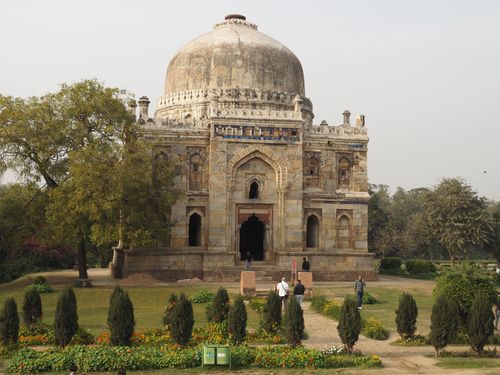
 Shish Gumbad is a funerary monument from the Lodi period in Delhi and reflects architectural tendencies that preceded the Mughal era. Located within today’s Lodhi Garden, it highlights the role of commemorative structures in the urban landscape of the capital. Its solid massing, partially preserved ornamentation and position within a wider historical setting make it a notable reference for understanding the political and social environment of the late sultanate. Shish Gumbad demonstrates a moment of transition, marked by Afghan influences, that would shape subsequent developments in Delhi’s architectural and cultural history.
Monument profile
Shish Gumbad
Monument category: Mausoleum
Monument family: Tomb, Necropolis, Mausoleum or Cenotaph
Monument genre: Funerary
Cultural heritage: Islamic
Geographic location: Delhi • Delhi (NTC) • India
Construction period: 15th century AD
• Links to •
• Dynasties that contributed to the construction of the monument •

• This monument illustrates the following theme •
Architecture • Mausoleums : Muslim Mausoleums
• List of videos about Delhi on this site •
Delhi • Capital of Empires and Spiritualities • India
• References •
Wikipedia EN: Shish Gumbad
UNESCO: Humayun's Tomb, Delhi
History of the Shish Gumbad in Delhi: Power, Identity and Transformations Across Centuries
The Shish Gumbad, located within today’s Lodhi Garden in Delhi, is one of the most representative monuments of the late Delhi Sultanate and a key witness to the political transitions that shaped North India in the fifteenth and early sixteenth centuries. Although frequently perceived as a modest funerary structure, its history reveals a complex interplay of authority, identity and urban development. The monument embodies the ambitions of the Lodi rulers, the shifting balances of power before the Mughal conquest, and the continuous reappropriation of funerary landscapes in one of South Asia’s most historically layered capitals. Understanding its evolution requires examining not only the local political context, but also broader global developments, waves of restoration, and its transformation into a heritage landmark with contemporary cultural significance.
Political and Social Context of Construction
The Shish Gumbad was built during the Lodi period, most likely under the rule of Bahlul Lodi or his successor Sikandar Lodi. These Afghan-origin rulers governed a fragmented polity in which local chiefs, military elites and established urban notables constantly negotiated their influence. The authority of the sultanate depended on visible assertions of legitimacy, and architecture was a primary instrument of political communication. Funerary structures played a particularly important role: they anchored elite lineages in the urban landscape, demonstrated loyalty to ruling factions, and projected continuity during times of uncertainty.
The construction of Shish Gumbad must therefore be understood within this competitive environment. The Lodi dynasty sought to consolidate Delhi as a seat of power after a long period of instability involving the Sayyid dynasty, regional insurgencies and economic disruptions. Patronage of monumental tombs in the area that now forms Lodhi Garden served to reaffirm the dynasty’s presence and prestige. Although the monument’s occupant is not definitively identified, it likely belonged to a high-ranking figure tied to the royal household or to a powerful administrative or military faction. The tomb’s scale and position suggest ambitions to rival earlier structures built by the Sayyids and to strengthen alliances among the Afghan nobles who formed the backbone of Lodi authority.
Rivalries between Afghan clans, as well as tensions between established urban elites and newcomers from the northwest, influenced architectural choices and led to the development of distinctive funerary ensembles. Shish Gumbad thus reflects a political landscape in which authority was contested and needed constant reinforcement through durable, visible markers of commemoration.
Major Historical Events Affecting the Monument
Shish Gumbad survived the tumultuous final decades of the sultanate when Babur, founder of the Mughal Empire, defeated Ibrahim Lodi at the First Battle of Panipat in 1526. The Mughal takeover brought significant administrative changes but did not result in wholesale destruction of Lodi funerary structures. Instead, many of these monuments, including Shish Gumbad, entered a phase of relative neglect. Their significance shifted as political priorities reoriented toward Agra and later toward Shahjahanabad.
Over the centuries, Delhi experienced invasions, internal rebellions and urban reconstructions. While Shish Gumbad was not the direct target of military action, the region around it underwent several cycles of abandonment and revival. During the eighteenth century, repeated conflicts between Mughal successors, Maratha forces and Afghan invaders contributed to the deterioration of older structures. By the nineteenth century, when the British initiated urban and landscape projects in Delhi, the area around the tomb was transformed from a dispersed funerary zone into a curated garden space. Restoration during this period focused on stabilizing walls, clearing debris and integrating the monument into a redesigned public park. Such interventions redefined the monument’s role, shifting it from an active burial site to a historical centerpiece within an emerging colonial vision of heritage.
The twentieth century brought additional preservation efforts as Delhi modernized and expanded. Under Indian administration after independence, conservation policies recognized the tomb as part of the capital’s pre-Mughal heritage, leading to improved protection and periodic maintenance.
Global Context at the Time of Construction
When Shish Gumbad was built, the world was experiencing broad architectural and political transformations. In Central Asia, Timurid architecture flourished with monumental domed mausoleums, combining decorative tilework and complex geometric planning. The influence of these traditions reached India through artisans, merchants and political contacts. In the Middle East, the rise of the Ottoman Empire brought new architectural expressions emphasizing imperial legitimacy through large-scale religious and funerary complexes. Meanwhile, Iran’s emerging Safavid entities experimented with artistic forms that would become iconic in later centuries.
Against this backdrop, the Lodi architectural program can be seen as part of a global pattern in which new or consolidating dynasties used monumental tombs to assert identity and demonstrate cultural authority. Shish Gumbad belongs to this interregional continuum, adapting imported ideas to the materials, climate and urban environment of Delhi.
Transformations and Shifts in Use Over Time
Throughout its history, Shish Gumbad underwent several transformations. Portions of its decorative tilework disappeared due to weathering, looting or structural decay. Interior surfaces that once displayed painted or incised ornamentation gradually faded. The monument may also have shifted in function following the Mughal period, perhaps serving as a gathering point for devotional practices or as a landmark for local communities.
The most dramatic transformation occurred in the twentieth century when the British redesign of the area created the modern Lodhi Garden. The tomb was liberated from encroaching vegetation and informal structures, framed by lawns and pathways, and incorporated into a curated historical landscape. Such interventions changed how the monument was perceived: from a decaying tomb in an old cemetery, it became a central feature of a recreational and commemorative park. Later Indian restoration efforts aimed to balance structural conservation with the maintenance of the garden’s cultural role.
The expanding city around the garden has also shaped how the monument is approached. Once located in a peripheral burial ground, Shish Gumbad now stands within an affluent neighborhood, integrated into daily activities ranging from exercise to leisure and educational visits.
Contemporary Role and Cultural Importance
Today, Shish Gumbad is recognized as a key element of Delhi’s multi-layered heritage. It forms part of a cohesive ensemble with nearby monuments such as Bara Gumbad and the tomb of Sikandar Lodi, offering insight into pre-Mughal architectural traditions. Its location in Lodhi Garden gives it a dual function: a historical marker and a site of public engagement. The monument attracts visitors interested in architecture, local residents who frequent the park, and students exploring the evolution of Delhi’s urban and political landscape.
Although no major religious rituals are associated with it today, the tomb remains a place of informal reverence. Its presence reinforces a broader sense of Delhi as a city shaped by successive cultural influences. It also contributes to the national narrative that recognizes the diversity of architectural traditions predating the Mughal period.
State of Conservation and Modern Preservation Challenges
Shish Gumbad faces contemporary preservation challenges common to many monuments in Delhi. Air pollution accelerates the deterioration of stone surfaces, while fluctuating temperatures can cause microcracks in the masonry. Humidity during the monsoon season stresses joints and interior plaster. The site must also withstand the pressures of daily foot traffic in a popular public garden.
Conservation authorities periodically stabilize the structure, reinforce weakened masonry and clean surfaces to mitigate the effects of pollution. The monument is protected at the national level, ensuring oversight and limiting unauthorized alterations. While not part of the World Heritage List, it plays a significant role in discussions on safeguarding Delhi’s broader historical landscapes. Preservation efforts aim to ensure that the monument’s architectural and historical value remains accessible despite environmental and urban pressures.
Architectural Analysis of Shish Gumbad in Delhi
Shish Gumbad, located in today’s Lodhi Garden in Delhi, is a key example of late Sultanate funerary architecture under the Lodi dynasty. Its compact yet monumental form, technical robustness and restrained ornamentation illustrate a mature phase of Indo-Islamic design before the arrival of the Mughals. The monument condenses a series of architectural choices concerning structure, materials, spatial organisation and decorative language that reflect both regional traditions and wider transregional exchanges.
Technological and Architectural Innovations
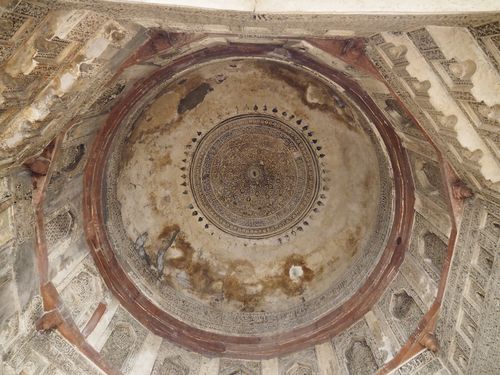
The period of the Lodi rulers saw the consolidation rather than the invention of structural devices, but Shish Gumbad demonstrates a confident and systematic use of techniques that had evolved across earlier Sultanate phases. The central innovation lies in the controlled translation of a square plan into a domed volume through a carefully orchestrated system of squinches and pendentives. This transition, well known in the Islamic world, is here applied with considerable thickness of masonry and generous bearing surfaces, optimised for local materials and climatic conditions.
The designers paid particular attention to stability. The walls are unusually thick in relation to the internal space, and the dome is relatively low and broad rather than tall and slender. This reduces horizontal thrust and limits the risk of cracking at the drum. The corners of the structure are reinforced by slightly projecting masses that help distribute loads, while the openings are concentrated in the upper portions of the walls to preserve the continuity of the lower masonry.
Ventilation and interior comfort were also considered. High-level openings and perforated screens allow hot air to escape and provide cross-ventilation, which is essential in Delhi’s hot, humid climate. The chamber benefits from controlled natural light entering through these apertures, producing a diffused luminosity appropriate to a funerary space while reducing direct solar gain. In urban terms, the tomb was once part of a larger necropolis and aligned with circulation routes, making it legible within a network of commemorative structures and pathways.
Materials and Construction Methods
Shish Gumbad employs a combination of locally available stone and brick, bound with lime mortar. The core of the walls consists of rubble masonry, a mixture of irregular stones set in thick mortar beds, which provides mass and stability at relatively low cost. The external surfaces were originally faced with dressed stone and decorated panels, some of which survive, though often weathered.
One of the most distinctive aspects of the monument is the use of glazed tiles, which likely gave rise to the name “Shish Gumbad” (often associated with glass or glazed surfaces). These tiles, in shades of blue and sometimes turquoise, were set into geometric and calligraphic patterns on selected portions of the façade. Technically, their production required kilns capable of achieving stable glazes and artisans familiar with tile cutting and fitting. The application of glazed tiles on a robust stone shell reflects an interplay between structural necessity and aesthetic refinement.
Lime plaster was used on interior surfaces, sometimes burnished to a smooth finish, sometimes painted or incised with decorative motifs. The mortar itself, enriched with lime, contributed to the flexibility of the structure, allowing it to accommodate minor movements without systematic failure. For its time, this combination of thick masonry, robust mortar and selective use of decorative surfaces represented an effective and durable construction method, well adapted to the monsoon climate.
Architectural and Artistic Influences
The architecture of Shish Gumbad illustrates a synthesis of Afghan, Persian and local North Indian traditions. The overall massing and the compact dome over a square base recall forms that circulated through Afghanistan and Central Asia, while the detailing and material palette are rooted in the building culture of Delhi and its surroundings.
The use of blue glazed tiles is clearly tied to wider Islamic artistic traditions, especially those of Iran and Central Asia, where tiled façades were prominent in religious and funerary architecture. At Shish Gumbad, however, the application is more sparing, functioning as accent rather than full cladding. This selective use points to both the cost and technical demands of tilework and to a local preference for the visual weight of stone facades relieved by zones of colour.
Geometric and calligraphic motifs, though partly lost, underline the Islamic character of the monument while respecting the aniconic conventions of funerary contexts. At the same time, certain mouldings, the profile of arches and the handling of brackets and niches betray the hand of craftsmen who also worked on Hindu and Jain buildings. This cross-pollination is one of the defining features of Indo-Islamic architecture and situates Shish Gumbad firmly within the broader cultural landscape of the region.
Spatial Organisation and Structural Layout
The plan of Shish Gumbad is essentially square, with each side articulated by a central entrance or blind arch. The western side, traditionally oriented toward Mecca, occupies a privileged position and presents the most pronounced doorway. The other façades balance this emphasis, creating an overall impression of symmetry and equilibrium.
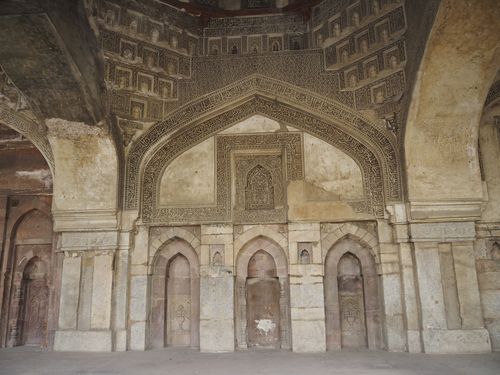
Inside, the tomb comprises a single large chamber. The interior walls are divided into recessed panels and blind arches, providing visual rhythm and offering surfaces for inscriptions or ornamental treatment. Above eye level, the transition from square to dome is managed by a ring of squinches or pendentives that gradually transform the geometry. The dome rests on this transitional zone, supported by the continuous mass of the walls rather than on a slender drum.
There are no minarets or attached mosque structures, which sets Shish Gumbad apart from later Mughal complexes that often integrate multiple functions. Instead, it operates as a self-contained funerary unit, originally set within a wider cemetery. The lack of subsidiary chambers or verandas accentuates the compactness and unity of the design. Compared to other contemporaneous Lodi tombs, its proportions and the presence of significant glazing elements make it a particularly striking example within a relatively standard typology.
Dimensions, Statistics and Anecdotal Elements
Exact measurements vary in published surveys, but the tomb is generally described as standing around 20 metres high, with a footprint roughly in the order of 20 to 25 metres on each side. These dimensions give it a prominent presence within Lodhi Garden without overwhelming the surrounding landscape.
An often-cited anecdote concerns the origin of its name. “Shish” is commonly interpreted as referring to glass or glazed tiles, suggesting that the structure once displayed more extensive reflective surfaces than are visible today. Some local accounts have associated the shimmering quality of these tiles with light effects at particular times of day, though these descriptions are difficult to verify in the absence of early visual documentation. The identity of the person or persons buried inside remains uncertain, which has encouraged a modest body of local speculation but no firmly established legend comparable to those surrounding later, more famous mausoleums.
International Recognition and Conservation Issues
Architecturally, Shish Gumbad contributes significantly to the understanding of pre-Mughal funerary design in North India. It serves as a reference point for the development of domed square-plan tombs and for the integration of tilework within a predominantly stone architecture. Although it is not individually inscribed on the World Heritage List, it forms part of a broader ensemble of monuments in Delhi that feature prominently in discussions about the city’s historic urban landscape.
In conservation terms, the monument faces challenges typical of Delhi’s heritage sites. Atmospheric pollution accelerates the erosion of stone and the degradation of lime-based mortars and plaster. Seasonal humidity and fluctuating temperatures can induce cracking and salt efflorescence. The location within a popular urban park generates constant footfall, which demands careful management of visitor routes, surface wear and informal uses.
Restoration efforts have concentrated on structural stabilisation, re-pointing joints, repairing or consolidating remaining tilework and managing vegetation around the foundations. The aim has been to preserve as much original fabric as possible while ensuring the monument remains accessible and legible to visitors. As Delhi continues to grow and densify, Shish Gumbad stands as both a fragile relic and a resilient architectural statement, linking the city’s present to a crucial phase in its architectural and political history.