

 Français (France)
  Nederlands (nl-NL)
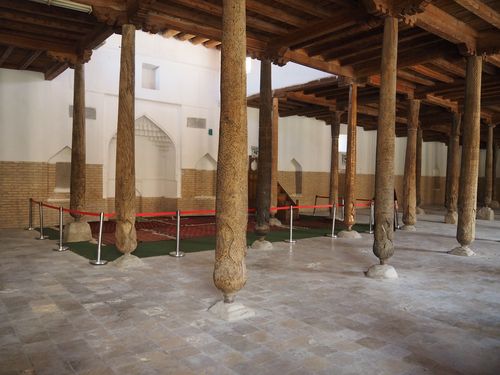
 The Juma Mosque in Khiva, Uzbekistan, is a prominent structure known for its distinctive design. Constructed mainly of wood and brick, it features 213 intricately carved wooden columns, creating a monumental and timeless atmosphere. Serving as both a place of worship and a community hub, it highlights the architectural ingenuity of the region and the richness of Uzbek craftsmanship.


Monument profile
Juma Mosque
Monument category: Mosque
Monument family: Mosque, Minaret or Madrasa
Monument genre: Religious
Cultural heritage: Islamic
Geographic location: Khiva • Uzbekistan
Construction period: 10th century AD
This monument in Khiva is inscribed on the UNESCO World Heritage List since 1990 and is part of the serial property "Itchan Kala".See the UNESCO monuments featured on this site
• Links to •
• List of videos about Khiva on this site •
Khiva, open-air museum • Uzbekistan (EN)
• References •
UNESCO: Itchan Kala
The Juma Mosque in Khiva: Political Ambitions, Historical Transformations, and Cultural Legacy
The Juma Mosque in Khiva, Uzbekistan, stands as a testament to the city’s historical significance as a political, social, and cultural hub. Constructed in its current form in the 18th century, it reflects the ambitions of the Khiva Khanate to establish itself as a center of Islamic learning and governance. Over centuries, the mosque has been shaped by historical events and shifting powers, making it a vital piece of Central Asia's architectural and cultural heritage.
Political and Social Motivations for Its Construction
The construction of the Juma Mosque was deeply rooted in the political and social aspirations of the Khiva Khanate. As a center of trade and governance on the Silk Road, Khiva sought to solidify its status as a spiritual and cultural hub. The mosque, with its vast open prayer hall supported by 213 wooden columns, symbolized the unification of the local Muslim community and the Khanate's dedication to Islamic principles.
Beyond its religious function, the mosque served as a communal space where social and political matters were discussed, reflecting its role in fostering a cohesive and engaged society. The design—simple yet monumental—underscored the Khanate's focus on functionality and inclusivity, ensuring the mosque could accommodate large gatherings.
Historical Events and Regional Influence
The Juma Mosque has witnessed pivotal moments in Khiva's history. During the height of the Khanate in the 18th and 19th centuries, the mosque played a central role in the spiritual and political life of the city. Its structure incorporated columns from earlier periods, dating as far back as the 10th century, symbolizing continuity and respect for the region's cultural heritage.
The Russian conquest of Khiva in 1873 marked a turning point. Although the Khanate's political autonomy diminished, the mosque retained its spiritual significance. During the Soviet era, while religious activities were suppressed, the Juma Mosque was preserved as a historical monument, reflecting its enduring cultural value.
Global Context and Comparisons
The construction of the Juma Mosque occurred during a period of significant global change. In the 18th century, Central Asia was a crossroads for trade and cultural exchange, while European powers expanded their colonial empires, and the Islamic world saw the flourishing of architecture in regions such as the Ottoman Empire and Mughal India.
Unlike the ornate mosques of Istanbul or Agra, the Juma Mosque’s design prioritized simplicity and functionality. Its flat roof supported by a forest of intricately carved wooden columns set it apart as an architectural anomaly, blending local craftsmanship with Islamic traditions.
Transformations Over the Centuries
The mosque has undergone several transformations that reflect changing power dynamics and cultural influences. While its original function as a religious space has remained intact, its role as a community center evolved over time. During Soviet rule, the mosque was repurposed as a museum, ensuring its preservation even as religious practices were restricted.
Restorations in the 20th and 21st centuries have focused on preserving the wooden columns, many of which exhibit unique carvings with geometric and floral patterns. These designs showcase a blend of Persian and local artistic influences, highlighting the cultural exchange that defined Khiva’s history.
Cultural Significance and Current State
Today, the Juma Mosque is a symbol of Khiva’s rich history and cultural resilience. It is part of the Ichan-Kala inner city, a UNESCO World Heritage Site since 1990. This recognition has elevated its status as a global cultural landmark, attracting visitors from around the world and highlighting the ingenuity of Central Asian architecture.
The mosque is well-preserved, with ongoing efforts to maintain its structural and artistic integrity. The wooden columns, each a masterpiece of craftsmanship, remain the focal point of conservation initiatives, ensuring the site retains its historical authenticity.
Challenges to Preservation
Preserving the Juma Mosque poses several challenges. The wooden columns are particularly vulnerable to environmental factors such as humidity, temperature fluctuations, and insect infestations. Additionally, increased tourism places stress on the structure, necessitating careful management to prevent wear and tear.
Efforts to address these challenges include the use of traditional preservation techniques alongside modern technologies like 3D scanning to monitor structural stability. Public awareness campaigns aim to educate locals and visitors about the mosque’s significance, fostering a sense of collective responsibility for its protection.
Conclusion
The Juma Mosque in Khiva stands as a remarkable example of architectural innovation and cultural endurance. Its construction reflected the political and social aspirations of the Khiva Khanate, while its design highlights the region’s unique blend of traditions and influences. Despite the challenges of modern preservation, the mosque continues to inspire and educate, serving as a symbol of Central Asia’s rich history and its ongoing dialogue with the world.
The Juma Mosque in Khiva: Architectural Innovation and the Fusion of Traditions
The Juma Mosque in Khiva, Uzbekistan, is a unique example of architectural ingenuity and cultural synthesis. Built in its current form during the 18th century on earlier foundations, this mosque stands out for its simplicity, innovative use of materials, and design that integrates local and foreign artistic influences. Its structure and motifs highlight the technical expertise and cultural depth of the era, making it a globally recognized symbol of Central Asian heritage.
Materials and Construction Techniques: A Testament to Ingenuity
The Juma Mosque is primarily constructed from wood and baked bricks, materials that were both locally available and well-suited to the region’s arid climate. The roof, a flat structure supported by 213 intricately carved wooden columns, is the most striking feature of the mosque. These columns, sourced from earlier buildings and some dating back to the 10th century, are decorated with geometric and floral carvings that showcase the craftsmanship of local artisans.
The integration of wooden columns into a large, open-plan mosque demonstrates technical innovation. The columns were carefully arranged to support the roof while allowing ample space for worshippers. This design also facilitates natural ventilation and lighting, creating a functional yet serene environment.
The baked bricks used for the walls and the adjacent minaret provide structural stability and blend seamlessly with the surrounding architecture of Ichan-Kala, the historic inner city of Khiva.
Architectural Features: A Blend of Regional and Foreign Traditions
The architecture of the Juma Mosque reflects a unique fusion of regional styles and influences from Persia and the broader Islamic world. The flat roof and columned hall diverge from the typical domed structures of Islamic architecture, reflecting a practical adaptation to the local climate and traditions.
The carved columns are a defining feature, each displaying unique motifs that incorporate geometric patterns, floral designs, and stylized calligraphy. These elements reflect influences from Persian art while maintaining a distinctly local aesthetic. The minimalist exterior contrasts with the intricate interior details, emphasizing the mosque’s role as a functional and spiritual space.
Notable Structure and Layout
The mosque’s layout is simple yet impactful. The rectangular plan is dominated by the large prayer hall, which is open on three sides, creating a sense of connection with the surrounding environment. The flat roof, supported by the forest of wooden columns, is punctuated by skylights that allow natural light to filter through, enhancing the tranquil atmosphere.
The adjacent minaret, constructed from baked bricks, is another prominent feature. Its cylindrical shape and decorative brick patterns complement the simplicity of the mosque while serving as a visual marker within the city.
Anecdotes and Facts
Some of the wooden columns in the mosque are over 1,000 years old, having been repurposed from older structures. This reuse of materials highlights the sustainable practices of the time.
The uniformity of the columns is an illusion; each column is uniquely carved, reflecting the individuality of the artisans who created them.
The mosque’s design facilitates acoustics that allow the voice of the imam to reach all corners of the prayer hall without amplification, an impressive feat of architectural planning.
UNESCO Recognition and International Importance
The Juma Mosque, as part of Khiva’s Ichan-Kala, was inscribed as a UNESCO World Heritage Site in 1990. This recognition underscores its architectural and cultural significance as a well-preserved example of Islamic architecture in Central Asia. The designation has elevated the mosque’s global profile, attracting researchers, historians, and tourists.
The inclusion on the UNESCO list has also mobilized efforts to preserve the mosque. Conservation initiatives have focused on maintaining the structural integrity of the wooden columns and the brickwork, ensuring that the mosque continues to serve as a living testament to the ingenuity of its creators.
Modern Preservation Challenges
Preserving the Juma Mosque presents several challenges. The wooden columns are particularly vulnerable to environmental factors such as humidity, temperature fluctuations, and insect infestations. The increasing number of visitors poses additional risks, as foot traffic can accelerate wear on the structure.
Efforts to mitigate these issues include the use of traditional preservation techniques alongside modern technologies, such as 3D scanning, to monitor the mosque’s condition. Sustainable tourism practices and awareness campaigns are also being implemented to balance preservation with public access.
Conclusion
The Juma Mosque in Khiva is a remarkable example of architectural innovation and cultural synthesis. Its unique design, use of materials, and artistic details reflect the ingenuity of its builders and the rich cultural exchanges that shaped its construction. Recognized globally for its historical and architectural significance, the mosque remains a symbol of Central Asia’s enduring heritage. Continued preservation efforts will ensure that this extraordinary monument continues to inspire future generations.