

 Français (France)
  Nederlands (nl-NL)
 The Kunya-Ark Citadel is located in Khiva, Uzbekistan, within the historic walled city of Itchan Kala. Built in the seventeenth century, it served as the political center of the Khiva khans and functioned as both an official residence and an administrative headquarters. The complex included spaces for public audiences, governmental activities, and the life of the royal court. Today the citadel stands as an important component of Khiva’s architectural and historical heritage. It reflects the political significance of the city within the khanates of Central Asia and illustrates how authority and governance were organized in the region during the pre-modern period.


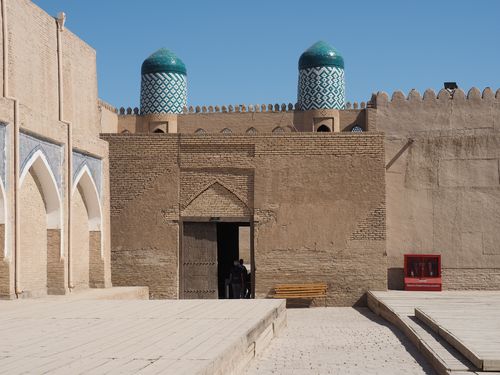
Monument profile
Kunya-Ark Citadel
Monument category: Citadel
Monument family: Fort, Fortifications or Citadel
Monument genre: Military
Cultural heritage: Islamic
Geographic location: Khiva • Uzbekistan
Construction period: 12th century AD
This monument in Khiva is inscribed on the UNESCO World Heritage List since 1990 and is part of the serial property "Itchan Kala".See the UNESCO monuments featured on this site
• Links to •
• List of videos about Khiva on this site •
Khiva, open-air museum • Uzbekistan (EN)
• Sources •
Internet Sources
Books and Publications
- Allworth, Edward. Central Asia: 130 Years of Russian Dominance, A Historical Overview. Duke University Press, 1994.
- Starr, S. Frederick. Lost Enlightenment: Central Asia's Golden Age from the Arab Conquest to Tamerlane. Princeton University Press, 2015.
Kunya-Ark Citadel: Historical Development of the Khans’ Residence in Khiva
Foundation and Establishment of the Khans’ Residence
The Kunya-Ark Citadel forms one of the earliest political complexes within the fortified city of Khiva in present-day Uzbekistan. Its construction dates to the late seventeenth century, during the reign of the khan Arang Khan, around 1686. The complex was conceived as the official residence of the ruler of the Khiva Khanate and as the administrative center from which the khan exercised authority. The citadel was established along the western sector of the walled city of Itchan Kala, where it functioned as a controlled enclave reserved for the activities of the ruling court.
From its inception, Kunya-Ark served both residential and governmental purposes. The khan’s court operated from within its walls, and the complex housed the principal institutions connected to the administration of the khanate. Spaces within the citadel were used for political deliberation, the reception of envoys, and the conduct of state affairs. The arrangement of these functions within a single enclosed complex reflected the concentration of political authority in the person of the khan.
The establishment of Kunya-Ark also corresponded to efforts to consolidate the administrative structure of the Khiva Khanate during the seventeenth century. By creating a permanent seat of power within the capital, the khans strengthened their control over regional governance and ensured that political decision-making remained closely tied to the royal court.
Political and Administrative Functions of the Citadel
Throughout the eighteenth century, the Kunya-Ark Citadel became the principal center of government within Khiva. The complex accommodated the ceremonial and administrative activities of the khans and served as the primary location where official audiences were held. Delegations, tribal leaders, and foreign representatives were received in designated audience spaces within the citadel, reinforcing its role as the focal point of diplomatic and political interaction.
Within the citadel, administrative functions were closely integrated with the residential life of the ruling court. Officials responsible for transmitting orders, collecting information from provincial authorities, and managing internal political matters operated in buildings located near the audience halls. The spatial proximity of these offices to the khan’s residence facilitated direct oversight of governmental activities.
The citadel also contained spaces used for judicial proceedings. Matters concerning political authority or disputes among influential groups could be brought before the khan within the complex. These judicial functions strengthened the symbolic role of the citadel as the location where the ruler exercised both political leadership and legal authority.
The concentration of these functions within Kunya-Ark made the citadel an institutional center where administrative decisions, ceremonial practices, and political negotiations were conducted simultaneously.
Architectural Expansion and Adaptation under Later Khans
During the eighteenth and nineteenth centuries, the citadel underwent several phases of modification initiated by successive rulers of the Khiva Khanate. These interventions aimed to adapt the complex to the evolving needs of the court and to reinforce its role as the administrative nucleus of the state. Additional buildings were constructed within the citadel’s enclosure, and existing structures were altered to accommodate expanded governmental functions.
One of the most significant periods of development occurred during the early nineteenth century under Muhammad Rahim Khan I. Architectural modifications introduced during this period reorganized certain areas of the complex and expanded spaces used for official ceremonies and judicial activity. These changes reflected efforts to formalize the operation of the court and to accommodate the growing administrative apparatus of the khanate.
Further adjustments were carried out under later rulers during the nineteenth century. Some structures were repaired or rebuilt following structural deterioration, while other sections were reorganized to accommodate specific institutional activities. Despite these alterations, the core function of Kunya-Ark remained consistent. The citadel continued to serve as the primary seat of political authority within Khiva and remained closely associated with the daily operation of the khanate’s government.
Global Historical Context at the Time of Construction
When the Kunya-Ark Citadel was constructed in the late seventeenth century, the Ottoman Empire controlled large territories across the Middle East and southeastern Europe. In Western Europe, the French monarchy was undergoing administrative consolidation under the reign of Louis XIV. In China, the Qing dynasty had recently replaced the Ming dynasty and was consolidating imperial rule. At the same time, the Mughal Empire exercised authority over much of the Indian subcontinent. These developments illustrate the presence of powerful centralized states in several regions of the world during the same period.
Decline of Khanate Authority and Present Status of the Citadel
The political role of the Kunya-Ark Citadel changed significantly during the late nineteenth century as the Khiva Khanate came under increasing influence from the Russian Empire. Following the Russian military campaign of 1873, Khiva became a protectorate of the empire. Although the khans retained formal authority, their political autonomy was reduced, and the administrative importance of the citadel gradually diminished.
Despite this shift, Kunya-Ark continued to function as the official residence of the khans until the early twentieth century. Court activities and ceremonial functions were still held within the complex, although the broader political environment had changed. The final dissolution of the khanate occurred in the early 1920s following the establishment of Soviet power in the region. With the disappearance of the khanate, the citadel lost its governmental role.
Today, the Kunya-Ark Citadel forms part of the historic walled city of Itchan Kala, which was inscribed on the UNESCO World Heritage List in 1990 under the official designation “Itchan Kala.” The citadel is preserved as one of the principal historical structures within the site and provides material evidence of the political organization of the Khiva Khanate. Conservation efforts focus on maintaining the integrity of the buildings that once served as the residence and administrative center of the khans.
Architecture of the Kunya-Ark Citadel in Khiva
Site Placement and Overall Spatial Configuration
The Kunya-Ark Citadel occupies the western sector of the walled city of Itchan Kala in Khiva. The complex stands directly against the inner defensive wall, forming a boundary between the citadel and the surrounding urban fabric. Its position allowed the ruling authority to control access while remaining integrated within the fortified city. The citadel forms a distinct architectural enclosure separated from nearby residential quarters by its own internal walls and gates.
The layout is organized around interconnected courtyards surrounded by the principal buildings. These courtyards define spatial zones associated with administrative, ceremonial, and residential functions. The first courtyard encountered after entering the complex functions as the main distribution space, providing access to audience areas and administrative structures. Circulation through this sequence establishes a progression from public reception spaces to more restricted sections of the complex.
The plan does not follow a strict axial composition but reflects successive construction phases that gradually expanded the citadel. Buildings were added around existing courtyards rather than reorganizing the entire complex according to a single geometric scheme. The resulting architectural composition consists of volumes of varying proportions connected by porticoes, corridors, and transitional spaces, creating a compact yet functionally differentiated ensemble.
Within the enclosure, buildings are typically positioned along the perimeter of the courtyards while the central areas remain open. This arrangement provides natural lighting and ventilation for interior rooms while preserving a protected internal environment. The courtyards also function as transitional spaces between ceremonial areas and administrative rooms.
Construction Techniques and Structural Systems
The construction of the Kunya-Ark Citadel relies primarily on load-bearing masonry walls composed of sun-dried mud bricks reinforced with baked bricks in structurally sensitive areas. These walls are notably thick, providing structural stability as well as thermal mass. They support flat roofs constructed on timber beam frameworks that distribute loads across the masonry structure.
Wooden beams form the main horizontal structural elements in many buildings. Spanning interior rooms, they support layered roof systems composed of wooden slats, compacted earth, and protective finishing layers. The roofs are generally flat and accessible, facilitating maintenance while contributing to the compact profile of the complex.
Arched openings built with baked bricks appear in entrances and corridors where additional structural reinforcement is required. These arches distribute loads efficiently and permit wider openings than simple lintel construction. In certain areas, arcades form covered passageways linking adjacent rooms and courtyards.
The structural system also incorporates timber columns supporting porticoes and reception spaces. These columns rest on stone bases that prevent direct contact between wood and ground moisture. Their placement supports projecting roof structures that shade exterior areas while maintaining wide openings toward the courtyards. Column spacing distributes structural loads while preserving visual openness in ceremonial spaces.
Together, thick masonry walls, timber beam frameworks, and column-supported porticoes create a structural system capable of supporting large reception spaces while maintaining stability under the climatic conditions of Khiva.
Materials and Surface Treatments
Mud brick constitutes the principal building material throughout the citadel. Its extensive use reflects both local availability and its capacity to regulate interior temperatures. Exterior walls are usually coated with protective plaster layers that reduce erosion caused by wind and seasonal moisture, producing the uniform earthen appearance characteristic of the complex.
Baked bricks are employed selectively in areas subject to greater structural stress or environmental exposure. Portals, arch frames, and certain decorative panels incorporate these more durable bricks, reinforcing key structural elements while articulating façades.
Wood plays a significant architectural role within the citadel. Carved wooden columns support many of the porticoes associated with ceremonial spaces. Their shafts are decorated with geometric and vegetal patterns, creating a vertical rhythm along the edges of courtyards and emphasizing the architectural importance of these transitional spaces.
Stone elements appear mainly in column bases and selected structural foundations. Their use protects wooden components from ground humidity and stabilizes load-bearing points of the porticoes. Although stone is not widely used throughout the complex, its strategic placement increases structural durability.
Glazed ceramic tiles appear in limited decorative zones, particularly around entrance portals and certain ceremonial structures. These tiles introduce color and geometric pattern that contrast with the earthen surfaces of the walls. Decorative elements remain concentrated in architecturally prominent areas rather than spread throughout the complex.
Spatial Organization of Key Architectural Components
The architectural composition of the Kunya-Ark Citadel includes several buildings arranged around the principal courtyards. One of the most prominent structures is the kurinishkhana, the audience hall used by the khans for official receptions. This space includes a raised platform reserved for the ruler beneath a roofed portico supported by carved wooden columns. The elevated platform establishes a clear spatial hierarchy between the khan and the visitors gathered in the courtyard.
The audience hall faces an open courtyard that served as the assembly area for officials and delegations. The design allows large numbers of people to gather before the portico while maintaining direct visual contact with the ruler’s elevated position. The arrangement of columns and the projecting roof defines a shaded transitional space between the ruler’s platform and the open courtyard.
Adjacent to this ceremonial structure are buildings associated with administrative functions. These rooms are generally smaller and arranged along the courtyard edges. Their doorways open directly onto circulation areas, facilitating movement between administrative offices and reception spaces.
Another significant component of the citadel is the mint building where coins of the khanate were produced. Its architectural design reflects this specialized activity. Rooms enclosed by thick walls contain limited openings, creating stable interior conditions suitable for metalworking and storage. Several chambers arranged sequentially accommodated the different stages of coin production.
The residential sector includes the harem complex located in a more secluded part of the enclosure. This section contains a series of rooms organized around a smaller courtyard. The arrangement of entrances and passages restricts direct visibility from administrative spaces, reflecting the private nature of this residential area.
Stairways throughout the citadel provide access to roof terraces and upper sections of certain buildings. These staircases are typically integrated into the thickness of walls or placed in corner areas to avoid interfering with interior rooms.
Architectural Transformations and Preservation
The architectural configuration of the Kunya-Ark Citadel evolved through successive modifications during the eighteenth and nineteenth centuries. Certain reception spaces were enlarged to accommodate larger ceremonial gatherings, while additional porticoes and galleries were introduced to provide sheltered circulation between buildings.
Structural reinforcement also occurred during these phases. Masonry walls were repaired or partially rebuilt in sections affected by weathering or structural fatigue. Wooden columns supporting porticoes were replaced or restored when deterioration occurred. These interventions preserved the functionality of the principal ceremonial structures.
In the nineteenth century, further adjustments were made to accommodate administrative activities within the citadel. Some interior rooms were subdivided, and additional walls created smaller offices within previously larger spaces. Despite these modifications, the overall organization of the complex continued to revolve around its courtyards and principal reception areas.
During the twentieth century, preservation campaigns concentrated on stabilizing the mud-brick architecture and restoring damaged structural elements. Conservation work included reinforcing walls, reconstructing deteriorated roof systems, and restoring carved wooden columns in the porticoes. Particular attention was devoted to the audience hall and other prominent structures.
Today the citadel forms part of the protected architectural ensemble of Itchan Kala. Conservation measures focus on preserving original structural materials and preventing erosion of mud-brick walls. Maintenance of wooden architectural elements and protective plaster coatings contributes to the long-term stability of the complex, whose preserved structures maintain the spatial organization and architectural features of the former residence and administrative center of the Khiva khans.