

 Français (France)
  Nederlands (nl-NL)
 The city walls of Khiva are among the most recognizable features of this historic city in Uzbekistan. They define the protected historic area and reflect the defensive, urban, and symbolic role of fortified enclosures in Central Asian caravan cities. With their continuous outline, monumental gates, and earthen silhouette, the walls strongly shape the urban landscape. They also contribute to the visual identity of Khiva, widely known for its well-preserved old quarter. Today, the walls remain a major landmark for visitors and an important testimony to the traditional urban organization of the region.
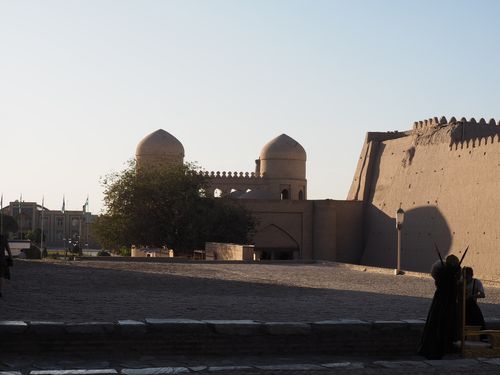
Khiva • City walls

Khiva • City walls
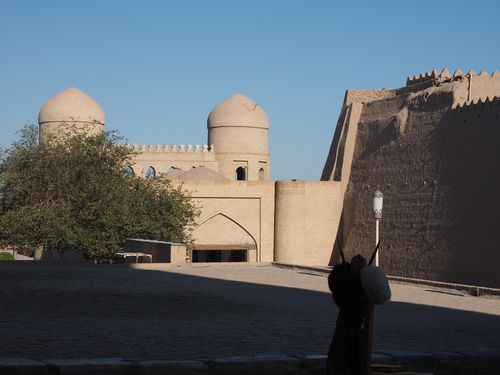
Khiva • City walls
Monument profile
City walls
Monument category: City walls
Monument family: Fort, Fortifications or Citadel
Monument genre: Military
Cultural heritage: Islamic
Geographic location: Khiva • Uzbekistan
Construction period: 10th century AD
This monument in Khiva is inscribed on the UNESCO World Heritage List since 1990 and is part of the serial property "Itchan Kala".See the UNESCO monuments featured on this site
• Links to •
• List of videos about Khiva on this site •
Khiva, open-air museum • Uzbekistan (EN)
• References •
UNESCO: Itchan Kala
The City Walls of Khiva: Historical Development, Uses, and Preservation
Formation of the Enclosed City
The city walls of Khiva surround Itchan Kala, the historic inner town that formed the political and administrative core of the oasis settlement. Although Khiva has older origins, the surviving fortifications largely reflect rebuilding and enlargement carried out between the seventeenth and nineteenth centuries, when the city served as the capital of the Khiva Khanate. Earlier defensive lines were repeatedly repaired or replaced as earthen structures deteriorated and urban needs changed.
The enclosure separated the governed urban center from surrounding suburbs, cultivated land, and desert approaches. Its construction answered practical concerns: defense against raids, control of movement, and protection of markets, workshops, mosques, and state institutions concentrated inside the walls.
Political Functions and Urban Control
The walls played a direct role in the administration of the khanate. Gates regulated entry of merchants, caravans, envoys, and local inhabitants. Customs duties and other controls could be imposed at these access points, giving the fortifications an economic function as well as a military one.
Their presence also reinforced dynastic authority. Monumental gates and continuous walls expressed the capacity of the ruling elite to mobilize labor, maintain infrastructure, and secure the capital. During periods of instability, the enclosed city offered a defensible refuge for officials, troops, and residents linked to the central institutions of Khiva.
Nineteenth- and Twentieth-Century Changes
After the Russian conquest of Khiva in 1873, the walls gradually lost much of their strategic military importance. Modern artillery and new political conditions reduced the effectiveness of traditional earthen fortifications. Nevertheless, the enclosure remained essential to the city’s physical identity and continued to mark the distinction between the old core and expanding outer districts.
During the Soviet period, conservation campaigns stabilized vulnerable sections damaged by erosion, neglect, or urban pressure. Some repairs involved reconstruction of parapets, towers, and surfaces in order to preserve the recognizable historic silhouette. Residential, administrative, and heritage uses increasingly replaced defensive functions within the enclosed area.
Global Historical Context
During major rebuilding phases in the seventeenth and eighteenth centuries, the Mughal Empire still ruled large parts of South Asia. In Europe, centralized monarchies and expanding maritime powers were reshaping political balances. In China, the Qing dynasty consolidated imperial rule. Across Eurasia, caravan and maritime trade networks continued to connect regional economies.
UNESCO Status and Present Role
Itchan Kala was inscribed on the UNESCO World Heritage List in 1990 under the official name Itchan Kala. The city walls are one of the defining components of that designation because they preserve the historic limits and spatial coherence of the inner city.
Today the fortifications serve primarily cultural, educational, and touristic purposes. Their conservation requires constant maintenance of earthen fabric exposed to wind, rain, and temperature variation. The walls remain the principal visual symbol of historic Khiva and one of the most significant surviving urban enclosures in Uzbekistan.
Spatial Layout and Construction Systems of the City Walls of Khiva
Urban Setting and Overall Plan
The city walls of Khiva enclose Itchan Kala, the historic inner city whose perimeter remains clearly legible within the broader urban fabric. The enceinte forms an almost rectangular plan with slight irregularities caused by successive building phases and local adjustments rather than strict geometric design. On the flat terrain of the oasis, the walls create a sharply defined boundary that separates the compact historic core from later outer districts.
This perimeter is reinforced by four principal gates placed roughly in relation to the cardinal directions. Their position links exterior approach roads with the main internal circulation routes. Because the walls and gates still determine how visitors enter and read the old city, the defensive circuit also functions as a lasting urban planning framework.
Earthen Construction and Structural Logic
The walls are built primarily of mud brick and compacted earth, with areas repaired or strengthened in fired brick during later interventions. These materials were locally available and well suited to the dry climate, while also allowing rapid rebuilding when erosion or damage occurred. Their warm ochre coloration gives the fortifications their characteristic visual unity.
Considerable wall thickness is a key structural feature. The mass of the earthen body provides stability, thermal inertia, and resistance to impact. Exterior faces commonly display a battered profile, widening toward the base. This inclination reduces visual slenderness, improves resistance to collapse, and helps rainwater descend away from vulnerable upper edges. Protective clay renders historically covered exposed surfaces and required periodic renewal. Without such maintenance, wind and moisture could rapidly degrade the fabric.
Towers, Parapets, and Defensive Features
At regular intervals, projecting semi-cylindrical or rounded towers animate the long curtain walls. Their rhythm breaks the continuity of the perimeter and creates repeated vantage points from which defenders could observe adjacent stretches of wall and the surrounding approaches. The towers are generally solid or only minimally hollowed, emphasizing mass rather than interior occupation.
Walkways once ran along the top of the walls behind parapets. Merlons and crenellated outlines visible today are partly the result of restoration, yet they reflect the original logic of protected surveillance and movement. The upper line of towers, parapets, and wall crests creates the most recognizable silhouette of historic Khiva. Openings in the curtain walls are intentionally limited outside the gates, preserving continuity and strength.
Gate Complexes and Internal Connections
The gates are more substantial architectural compositions than simple breaches in the walls. Each occupies a thickened section of the enceinte, where passageways cross the wall mass through vaulted or covered corridors. Side chambers historically served guard, storage, or control functions.
Exterior gate fronts are often more articulated than ordinary wall sections, marking the ceremonial importance of entry into the protected city. Internally, each gate connects directly to streets leading toward markets, religious buildings, and administrative compounds. The walls therefore operate not only as perimeter defenses but as mechanisms organizing circulation and thresholds.
Restoration Challenges and Architectural Preservation
Because earthen architecture is vulnerable to rain, salt migration, temperature fluctuation, and visitor pressure, the walls require continuous conservation. Many sections have undergone stabilization, surface renewal, partial rebuilding of towers, and reinforcement of parapets. The principal challenge lies in preserving historical forms while limiting excessive replacement of original material.
Modern interventions also address drainage at the foot of the walls and erosion caused by nearby movement. Despite these necessary repairs, the enceinte retains strong material coherence and remains the dominant architectural element in the perception of historic Khiva.