Français (France)
  Nederlands (nl-NL)
 00:00 • intro | 00:20 • the mausoleum seen from the outside | 01:50 • inside the mausoleum | 02:44 • facades of the mausoleum
Personal creation from visual material collected during my trip India - Kumbh Mela • Madhya Pradesh • Maharashtra • Goa (2018)
Map of places or practices in Aurangabad on this site
• Use the markers to explore the content •
Bibi Ka Maqbara, the Mughal Memorial of the Deccan
A Landmark of Aurangabad and Maharashtra
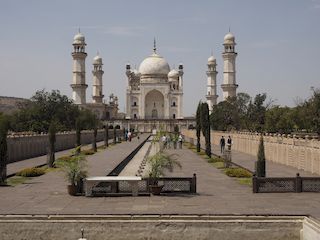
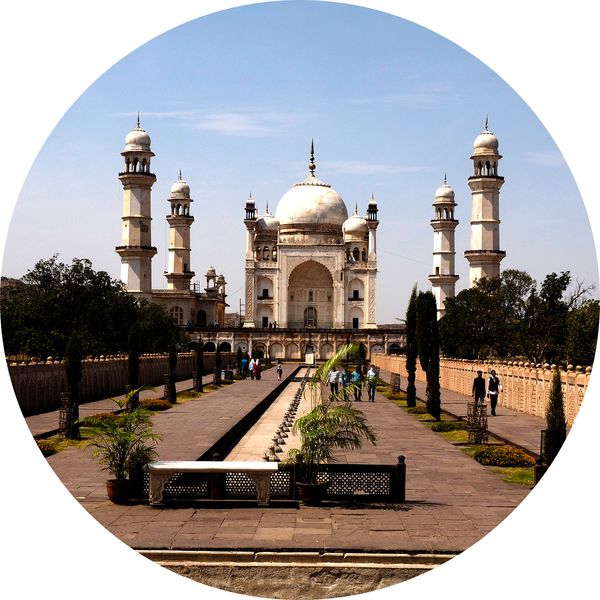
Bibi Ka Maqbara is one of the best-known historic monuments of Aurangabad, in the Indian state of Maharashtra. Often described as the “mini Taj Mahal,” it recalls the famous mausoleum of Agra through its balanced composition, domed silhouette and formal garden setting. Yet the monument deserves to be appreciated on its own terms. It belongs to a different political moment, a different regional context, and a distinct phase of Mughal architecture.
The video offers a clear introduction to the site through exterior views, interior spaces and close attention to the façades. It reveals not only the central tomb structure, but also the carefully planned environment around it. Gardens, pathways, water channels and changing perspectives all contribute to the experience of the monument. As the views progress, the building emerges as both a memorial and an architectural statement.
The Main Elements Seen in the Video
One of the strongest features of Bibi Ka Maqbara is its overall symmetry. The mausoleum stands at the centre of a formal garden laid out according to geometric principles long favoured in Islamic and Mughal design. Straight axes guide the eye toward the tomb, while open space around the structure enhances its presence.
The main building rises on a platform, giving it visual authority. Slender corner towers frame the composition and lead attention upward toward the large dome. This vertical emphasis is balanced by the horizontal order of terraces, garden paths and enclosing walls. The result is a monument that feels disciplined, harmonious and ceremonial.
The façades are especially important. Recessed arches, decorative niches, mouldings and repeated patterns create refinement without excessive ornament. The monument is more restrained than the Taj Mahal, yet it preserves the elegance associated with imperial Mughal design. Interior views then shift the atmosphere from public grandeur to private remembrance. The enclosed central chamber, filtered light and quieter spatial rhythm underline the funerary purpose of the site.
Historical and Architectural Background
Bibi Ka Maqbara was built in the late seventeenth century in memory of Dilras Banu Begum, wife of the Mughal emperor Aurangzeb. The project is generally linked to their son, Prince Azam Shah. Its construction belongs to a period when the Mughal Empire remained powerful but had different priorities from the era of Shah Jahan, whose reign produced some of the empire’s most lavish monuments.
This context helps explain both the similarities and differences between Bibi Ka Maqbara and the Taj Mahal. The monument adopts prestigious imperial forms such as the central tomb, symmetrical garden layout and dominant dome. However, the decoration is more measured, and the resources devoted to the project were more limited. Rather than being a copy, it is better understood as a reinterpretation shaped by another time and another court culture.
Its location is equally significant. Aurangabad was an important Mughal centre in the Deccan, a region that played a major role in the later history of the empire. The monument therefore reflects the extension of Mughal artistic traditions beyond northern India into a wider political landscape.
What These Videos Make Especially Clear
Videos built largely from carefully selected and animated photographs are particularly effective for architectural sites such as this one. They allow the viewer to observe composition slowly and clearly, without the distractions of hurried movement. The alignment of paths, the rise of the platform, the proportions of the dome and towers, and the changing relation between foreground and background become easier to understand.
Close framing can also highlight details that are often missed during a short visit: carved surfaces, shadow patterns, transitions between open garden and enclosed chamber, or the rhythm of repeated arches across the façades. Step by step, the viewer gains a more coherent reading of the monument.
This format is especially useful for places based on perspective and spatial order. Bibi Ka Maqbara was designed to be approached, seen from multiple distances, and gradually understood. The visual sequence helps recreate that intended experience.
A Monument Worth Discovering in Its Own Right
Bibi Ka Maqbara is more than a monument compared to another monument. It is an important testimony to Mughal memory culture, architectural discipline and the history of the Deccan. The video offers an accessible way to appreciate its design and atmosphere, while the related detailed pages provide further insight into the monument and its wider historical setting.


Audio Commentary Transcript
This is not the Taj Mahal, although the resemblance is undeniable. Sometimes called Mini Taj-Mahal or Taj Mahal of the poor, Bibi Ka Maqbara is a mausoleum built around 1668 by Azam Shah, son of Aurangzeb in memory of his mother Rabia-ud-Daurani.
Bibi Ka Maqbara means "Tomb of the Lady".
Music:
- - YouTube video library - Clouds
Disclaimer: Despite its appropriateness, copyright issues prevent the use of indian traditional music in "Bibi Ka Maqbara, mini Taj Mahal • Maharashtra, India", hence the use of royalty-free music. Despite our careful selection, some might regret this decision, which is necessary to avoid potential lawsuits. Although difficult, this decision is the only viable solution.