

 Français (France)
  Nederlands (nl-NL)
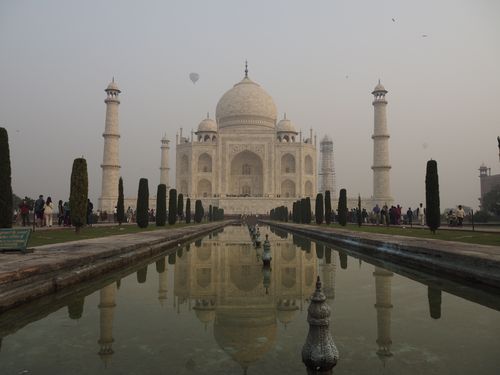
 The Taj Mahal is a monumental mausoleum located in Agra in the state of Uttar Pradesh, India. Built in the seventeenth century during the reign of the Mughal emperor Shah Jahan, it is one of the most widely recognized monuments of the Indian subcontinent. The complex includes the central tomb, several auxiliary buildings and extensive formal gardens arranged according to a geometric plan. The ensemble reflects the role of imperial architecture in expressing the authority and prestige of the Mughal rulers. Because of its historical and artistic significance, the Taj Mahal is regarded as one of the most important cultural landmarks of India and attracts large numbers of visitors every year.
Monument profile
Taj Mahal
Monument category: Mausoleum
Monument family: Tomb, Necropolis, Mausoleum or Cenotaph
Monument genre: Funerary
Cultural heritage: Islamic
Geographic location: Agra • Uttar Pradesh • India
Construction period: 17th century AD
This monument in Agra is inscribed on the UNESCO World Heritage List under the name Taj Mahal since 1983.See the UNESCO monuments featured on this site
• Links to •
• Dynasties that contributed to the construction of the monument •

• This monument illustrates the following theme •
Architecture • Mausoleums : Muslim Mausoleums
• List of videos about Agra on this site •
Agra, Taj Mahal and Agra Red Fort • Uttar Pradesh , India
Agra • Fort d'Agra
Agra • Taj Mahal
Agra • Itimad-ud-Daula (Baby Taj)
• References •
Wikipedia FR: Taj Mahal
UNESCO: Le Taj Mahal
Britannica: Taj Mahal
• Sources •
- UNESCO - World Heritage Report: Taj Mahal
- Encyclopædia Britannica - Taj Mahal
- History.com - Taj Mahal: History & Facts
- Architectural Digest - Studies in Mughal Architecture
- Indian Government Archives - Taj Mahal Conservation Efforts
History of the Taj Mahal
Political and social context of construction
The Taj Mahal was commissioned in the seventeenth century by the Mughal emperor Shah Jahan, one of the most powerful rulers of the Mughal dynasty. Construction began in 1632 following the death of his wife Mumtaz Mahal in 1631 during childbirth. The monument was conceived as a dynastic mausoleum that would preserve her memory while also demonstrating the prestige and authority of the Mughal Empire. Within the political culture of the Mughal court, monumental architecture played an essential role in expressing imperial legitimacy and reinforcing the symbolic power of the ruling dynasty.
At the time of the Taj Mahal’s construction, the Mughal Empire controlled much of the Indian subcontinent and possessed a highly organized administrative system. The empire benefited from agricultural taxation, extensive trade networks, and a sophisticated bureaucratic structure. Shah Jahan’s reign is often associated with a period of relative political stability and economic prosperity, which made possible large-scale architectural programs throughout the empire.
The construction of the Taj Mahal must also be understood within the broader ambitions of Shah Jahan’s rule. The emperor sought to strengthen the prestige of the Mughal dynasty through monumental architecture and urban transformation. Several imperial cities were redesigned or expanded during this period, and royal patronage supported the construction of mosques, palaces, and gardens. The Taj Mahal represented the culmination of this architectural vision, combining funerary symbolism with imperial grandeur.
The Mughal court was characterized by a complex network of alliances among various aristocratic groups, including Persian nobles, Central Asian elites, and Indian regional rulers integrated into imperial administration. The building project required the mobilization of skilled artisans, engineers, and architects from across these cultural spheres. As such, the monument reflected the cosmopolitan character of the Mughal Empire and its capacity to coordinate large-scale artistic and technical enterprises.
Major historical events associated with the monument
The construction of the Taj Mahal extended over more than two decades. Work on the central mausoleum was largely completed by around 1643, while the surrounding structures and garden complex continued to develop until approximately 1653. The building project involved thousands of craftsmen and laborers, making it one of the largest architectural undertakings of the Mughal period.
However, the history of the Taj Mahal soon became linked to political upheaval within the Mughal dynasty. In 1658 a war of succession erupted among Shah Jahan’s sons. Aurangzeb eventually seized power after defeating his brothers in a series of military conflicts. Shah Jahan was subsequently deposed and confined in Agra Fort. According to historical accounts, he spent the final years of his life there before being buried beside Mumtaz Mahal in the Taj Mahal after his death in 1666.
During the eighteenth century the decline of Mughal authority led to political instability across northern India. Agra changed hands several times as regional powers, including the Marathas, extended their influence in the region. During these periods of conflict and economic decline, parts of the Taj Mahal complex suffered neglect and occasional damage. Decorative objects and precious materials were sometimes removed from the site.
In 1803 the city of Agra was captured by the British East India Company during military campaigns against the Marathas. Under British colonial administration the Taj Mahal attracted the attention of officials and scholars interested in the preservation of India’s historical monuments. Early restoration efforts began during the nineteenth century, although some interventions altered aspects of the original landscape design.
Global context during the period of construction
The Taj Mahal was constructed during a period of global political transformation marked by the consolidation of powerful empires. Across the seventeenth century, rulers in various parts of the world used monumental architecture as a means of expressing political authority and dynastic prestige.
In the Ottoman Empire, imperial patronage continued to produce grand architectural projects that reshaped cities such as Istanbul. In Europe, centralized monarchies were developing elaborate palace complexes and ceremonial spaces that emphasized the authority of the state. Monumental building programs became an important feature of early modern political culture.
Within this broader context, the Taj Mahal can be seen as part of a global phenomenon in which rulers used architecture to convey stability, legitimacy, and cultural refinement. The Mughal Empire participated actively in the exchange of artistic ideas across Asia and the Islamic world, and the Taj Mahal reflects this interconnected cultural environment.
Transformations of the monument over time
Over the centuries the Taj Mahal experienced periods of maintenance, decline, and restoration. During the later Mughal period, financial resources available to the imperial court gradually diminished, reducing the capacity to maintain large architectural complexes. As a result, certain parts of the garden and auxiliary structures deteriorated over time.
During British colonial rule the monument began to receive greater attention as a historical and artistic landmark. In the late nineteenth century restoration programs were implemented to stabilize the structures and repair damaged surfaces. The gardens were redesigned according to European landscaping principles, emphasizing lawns and symmetrical paths rather than the more traditional Mughal garden arrangement.
Later conservation efforts sought to restore aspects of the original design, recognizing the historical significance of Mughal garden traditions. The twentieth century brought additional preservation initiatives, particularly after India gained independence in 1947. Government institutions and archaeological authorities began to implement systematic conservation policies aimed at protecting the monument.
Urban development in Agra also influenced the environment surrounding the Taj Mahal. As the city expanded and tourism increased, the site became part of a broader heritage landscape that included several other Mughal monuments along the Yamuna River.
Cultural significance and modern role
Today the Taj Mahal is widely regarded as one of the most recognizable monuments in the world. It serves as a powerful symbol of India’s cultural heritage and of the artistic achievements of the Mughal period. The monument represents both a historical legacy and an important component of contemporary national identity.
The site attracts millions of visitors each year, making it one of the most significant tourist destinations in South Asia. Tourism associated with the Taj Mahal plays an important role in the local economy of Agra and contributes to international awareness of India’s historical monuments.
Beyond tourism, the Taj Mahal has become deeply embedded in cultural and artistic representations of the Mughal past. It appears frequently in literature, visual arts, and educational contexts, reinforcing its status as an iconic symbol of historical architecture.
Conservation and contemporary challenges
The Taj Mahal was inscribed on the UNESCO World Heritage List in 1983 in recognition of its outstanding historical and architectural significance. This designation emphasizes the monument’s universal value and the importance of preserving it for future generations.
Despite its protected status, the monument faces several conservation challenges. Air pollution from nearby industries and urban traffic has raised concerns about the long-term effects on the marble surfaces of the mausoleum. Environmental protection measures have therefore been implemented in the surrounding region to reduce pollutant emissions.
Tourism also presents management challenges. Large numbers of visitors require careful regulation to prevent damage to the monument’s delicate decorative elements and structural surfaces. Conservation authorities have introduced monitoring programs and visitor management strategies aimed at balancing preservation with public access.
Through ongoing restoration and conservation initiatives, the Taj Mahal continues to be preserved as one of the most important historical monuments of the Mughal Empire. Its enduring presence reflects the architectural ambitions, cultural sophistication, and political power of one of the most influential dynasties in the history of South Asia.
Architecture of the Taj Mahal
Architectural conception and spatial planning
The Taj Mahal represents one of the most refined architectural achievements of the Mughal Empire. Commissioned in the seventeenth century by Emperor Shah Jahan, the complex was conceived as a monumental funerary ensemble integrating architecture, landscape design, and symbolic spatial organization. Rather than functioning solely as a mausoleum, the Taj Mahal forms part of a carefully planned architectural composition in which every element contributes to a coherent visual and symbolic structure.
The complex occupies a large rectangular site aligned along a north–south axis on the right bank of the Yamuna River in Agra. Its organization reflects the classical Mughal interpretation of the Persian charbagh garden concept, in which the landscape is divided into four quadrants by water channels. These channels intersect at a central reflecting pool aligned with the main axis of the complex, reinforcing the visual perspective toward the mausoleum.
Unlike many earlier Mughal garden tombs where the mausoleum stands at the center of the garden, the Taj Mahal is placed at the northern edge of the garden on an elevated marble platform overlooking the river. This architectural decision creates a dramatic visual termination of the garden axis and enhances the monument’s dominance within the landscape. The spatial sequence guiding visitors through the complex—from the monumental gateway to the garden and finally to the mausoleum—was designed to intensify the perception of symmetry and grandeur.
Engineering innovations and structural solutions
The construction of the Taj Mahal required advanced engineering techniques adapted to the environmental conditions of the Yamuna riverbank. The soil near the river consists largely of alluvial deposits that are susceptible to shifting and moisture. To ensure the stability of the structure, the builders created a sophisticated foundation system composed of deep wells filled with stone and reinforced with timber. This method distributed the enormous weight of the monument across a stable base.
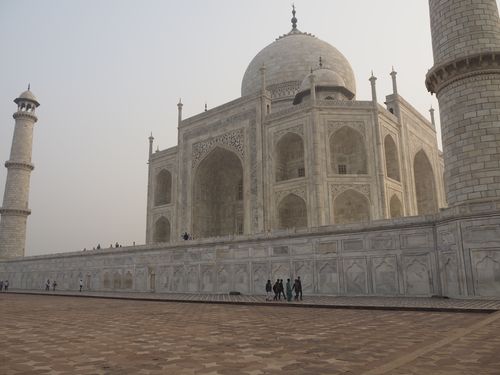
The mausoleum itself stands on a massive marble terrace approximately seven meters high. This raised platform protects the building from potential flooding and establishes a monumental podium that visually separates the structure from the surrounding garden.
One of the most significant structural achievements of the Taj Mahal is its large double dome. The interior dome defines the height of the burial chamber, while the outer dome rises above it to create the monumental external silhouette. This dual structure allowed architects to maintain harmonious interior proportions while achieving a striking exterior profile.
The four minarets positioned at the corners of the platform demonstrate careful structural planning. Each minaret rises to a height of about forty meters and is slightly inclined outward. This subtle inclination was designed as a precaution against seismic activity, ensuring that the towers would fall away from the central mausoleum in the event of structural collapse.
The design also incorporates elements that regulate light and airflow. Large recessed arches and perforated marble screens allow natural ventilation and diffuse daylight within the interior spaces. These features contribute both to the comfort of the interior environment and to the aesthetic atmosphere of the monument.
Materials and construction techniques
The most distinctive material used in the Taj Mahal is white marble sourced primarily from the Makrana quarries in present-day Rajasthan. This marble was selected for its durability, fine grain, and luminous qualities. Its polished surface reflects varying tones depending on the time of day and atmospheric conditions, producing subtle shifts in color that contribute to the monument’s visual impact.
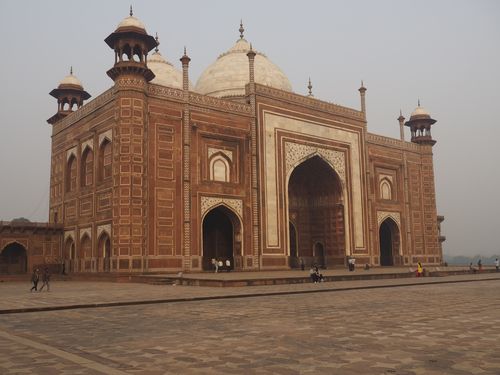
While the mausoleum itself is constructed entirely of marble, many of the surrounding structures—including the mosque and the jawab building—are built from red sandstone. This contrast between white marble and red sandstone was a deliberate aesthetic choice reflecting Mughal architectural traditions established during earlier reigns. The red structures frame the central mausoleum, emphasizing its symbolic and visual prominence.
The decorative surfaces of the Taj Mahal employ a highly refined technique known as pietra dura, or stone inlay. In this process, semi-precious stones such as jasper, carnelian, lapis lazuli, jade, and turquoise are cut into intricate shapes and inserted into the marble to create detailed floral patterns. This technique required exceptional craftsmanship and precise cutting tools to achieve seamless integration between the inlaid stones and the marble background.
Another prominent decorative element is the use of calligraphy carved into the marble surfaces. Quranic inscriptions frame the main arches and entrances of the mausoleum. The calligraphy was designed with careful attention to perspective: the size of the letters gradually increases as they rise higher on the façade, creating the illusion of uniform scale when viewed from ground level.
Architectural influences and stylistic synthesis
The architecture of the Taj Mahal reflects the synthesis of several cultural traditions that converged within the Mughal Empire. Persian architectural concepts played a central role in shaping the design of the complex. The use of symmetrical garden layouts, monumental gateways, and axial planning derives directly from Persian and Timurid precedents.
Central Asian influences are evident in the monumental scale of the dome and the formal organization of the mausoleum. The Mughal dynasty itself traced its heritage to the Timurid rulers of Central Asia, and this cultural lineage shaped many aspects of imperial architectural patronage.
At the same time, the Taj Mahal incorporates elements derived from Indian architectural traditions. The small domed pavilions known as chhatris, positioned on the roof of the mausoleum and along the surrounding structures, are characteristic features of Rajput architecture. These elements contribute to the vertical articulation of the building while linking the monument to regional architectural vocabulary.
The decorative motifs of the Taj Mahal also reflect a fusion of influences. Many of the floral designs carved into the marble panels display naturalistic forms inspired by botanical observation. These motifs suggest the influence of artistic exchanges between Mughal India and other regions connected through trade and diplomatic contact.
Spatial organization and architectural elements
The central mausoleum is built on a square plan measuring approximately fifty-five meters on each side. Each façade features a large recessed arch known as a pishtaq, framed by slender columns and decorative panels. These arches create deep shadowed recesses that emphasize the monument’s vertical proportions.
Inside the mausoleum lies the main burial chamber, surrounded by a series of smaller rooms arranged symmetrically around the central space. The cenotaphs of Mumtaz Mahal and Shah Jahan occupy the central chamber, while the actual graves are located in a crypt below the main floor.
Surrounding the cenotaphs is an intricately carved marble screen known as a jali, composed of delicate geometric patterns. This screen forms an enclosure around the tombs while allowing light to filter through the marble lattice.
The four minarets placed at the corners of the terrace frame the mausoleum and reinforce the symmetrical composition of the complex. Their balconies and domed pavilions add vertical rhythm to the architectural ensemble.
The broader complex includes several important structures aligned along the main axis. The monumental gateway at the southern entrance establishes the ceremonial approach to the mausoleum. Beyond the garden, the mosque on the western side provides a functional religious space, while a matching structure on the eastern side balances the composition architecturally.
Dimensions and notable characteristics
The Taj Mahal rises to a height of approximately seventy-three meters from the base platform to the finial at the top of the dome. The minarets reach about forty meters, creating a balanced proportional relationship between the vertical elements of the complex.
The entire architectural ensemble covers roughly seventeen hectares. The marble platform alone measures nearly one hundred meters on each side, providing a monumental base for the mausoleum and the surrounding towers.
Historical accounts indicate that the construction involved thousands of artisans, including stonecutters, calligraphers, inlay specialists, and engineers. The diversity of these crafts contributed to the extraordinary refinement of the finished monument.
Several legends have developed around the construction of the Taj Mahal. One persistent story suggests that Shah Jahan intended to build a second mausoleum of black marble on the opposite bank of the Yamuna. Although archaeological evidence for this plan remains debated, the narrative illustrates the powerful imagination that the monument has inspired for centuries.
Architectural significance and preservation
The architecture of the Taj Mahal represents the culmination of Mughal architectural development. Its combination of structural sophistication, decorative refinement, and spatial harmony illustrates the peak of imperial architectural patronage during the reign of Shah Jahan.
The monument’s architectural significance extends beyond the Indian subcontinent. The Taj Mahal is widely recognized as one of the most accomplished examples of funerary architecture in world history. Its balanced proportions, luminous materials, and precise symmetry have influenced architectural appreciation across cultures.
The complex was designated a UNESCO World Heritage Site in 1983, acknowledging its universal cultural value. This recognition emphasizes the importance of protecting the monument as part of the shared heritage of humanity.
However, the preservation of the Taj Mahal presents ongoing challenges. Environmental pollution from nearby urban and industrial activity has raised concerns about discoloration and chemical deterioration of the marble surfaces. Conservation authorities have implemented protective measures in the surrounding region to limit harmful emissions.
The large number of visitors also requires careful management to prevent structural stress and damage to delicate decorative elements. Conservation programs therefore combine scientific monitoring, restoration work, and visitor regulation to ensure the long-term preservation of the monument.
Despite these challenges, the Taj Mahal continues to stand as one of the most remarkable architectural achievements of the early modern world, embodying the artistic ambition, technical expertise, and cultural synthesis that characterized Mughal imperial architecture.