

 Français (France)
  Nederlands (nl-NL)
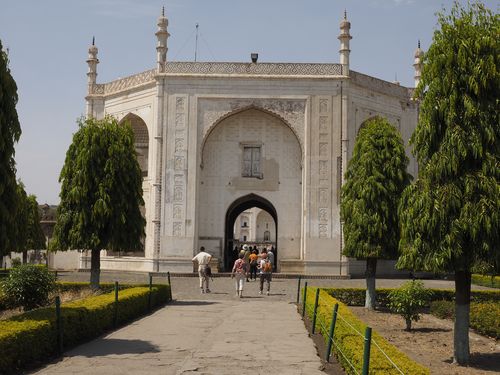
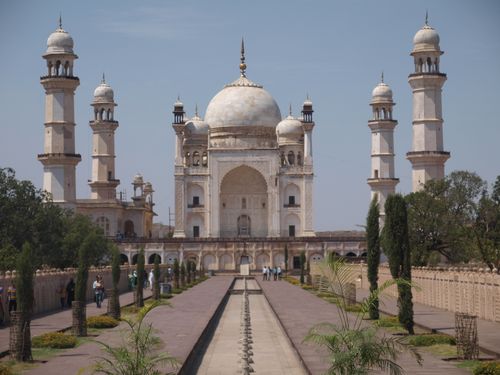
 The Bibi Ka Maqbara is a mausoleum located in Aurangabad, Maharashtra, India. It was built in the 17th century by the Mughal emperor Aurangzeb in memory of his wife, Dilras Banu Begum. Often referred to as the "Taj of the Deccan," this monument bears architectural similarities to the iconic Taj Mahal, though it is of a smaller scale. The structure is surrounded by beautiful gardens, enhancing its serene and elegant atmosphere. Today, the Bibi Ka Maqbara is a popular destination for visitors due to its historical significance and remarkable aesthetic appeal.
Monument profile
Bibi Ka Maqbara
Monument category: Mausoleum
Monument family: Tomb, Necropolis, Mausoleum or Cenotaph
Monument genre: Funerary
Cultural heritage: Islamic
Geographic location: Aurangabad • Maharashtra • India
Construction period: 17th century AD
• Links to •
• Dynasties that contributed to the construction of the monument •

• This monument illustrates the following theme •
Architecture • Mausoleums : Muslim Mausoleums
• List of videos about Aurangabad on this site •
Bibi Ka Maqbara, mini Taj Mahal • Maharashtra, India
• References •
Wikipedia EN: Bibi Ka Maqbara
Archeologic Survey India: Bibi-Ka-Maqbara, Aurangabad
The Bibi Ka Maqbara: Political and Social Motivations, Historical Significance, and Conservation Challenges
Political and Social Motivations Behind the Construction
The Bibi Ka Maqbara, built in 1660 by the Mughal Emperor Aurangzeb in Aurangabad, Maharashtra, was erected in memory of his wife, Dilras Banu Begum. The construction of such a grand mausoleum served both personal and political purposes. On the personal side, it was a tribute to Aurangzeb's deep love for his wife, mirroring similar sentiments behind the construction of the Taj Mahal. Politically, the monument was a statement of Mughal power in the Deccan region, which was vital for the expansion and consolidation of the empire. By commissioning a structure that resembled the famed Taj Mahal, Aurangzeb also reinforced the connection between the northern heartlands of the Mughal Empire and its southern territories.
At the time, the Deccan was a politically contested region, with frequent conflicts between the Mughals and local powers such as the Marathas. By building the Bibi Ka Maqbara in Aurangabad, Aurangzeb sought to cement Mughal influence in the south, projecting imperial authority through architecture, which was a common strategy among rulers in India and beyond.
Historical Events and Their Influence on the Region
Following the construction of the Bibi Ka Maqbara, several significant historical events unfolded, shaping both the monument's fate and the political landscape of the region. After Aurangzeb’s death in 1707, the Mughal Empire entered a period of decline, and the Deccan saw increased Maratha influence. Aurangabad, once a flourishing center under Mughal rule, gradually lost its prominence. However, the city and the Bibi Ka Maqbara remained symbols of Mughal grandeur.
The Deccan region was also influenced by British colonialism in the 19th century. During this time, many Mughal monuments, including the Bibi Ka Maqbara, were subject to neglect as the British focused their attention on controlling key cities like Mumbai and Kolkata. However, British interest in India's architectural heritage eventually led to restoration efforts during the latter part of the colonial period.
The Global Context of the Seventeenth Century
The mid-17th century was a time of monumental changes across the world. In Europe, the Thirty Years' War had recently ended (1648), leading to a reconfiguration of power among European states. The French monarchy, under Louis XIV, was asserting itself with the construction of the Palace of Versailles, using architecture to project authority. Similarly, in the Ottoman Empire, monumental architecture such as the Blue Mosque symbolized the Sultan’s divine rule. The Bibi Ka Maqbara fits into this global pattern, where rulers employed grand architectural projects to demonstrate political power, divine right, and cultural influence.
Transformations and Cultural Influences Over the Centuries
Over the centuries, the Bibi Ka Maqbara has undergone various transformations. In the late Mughal period, the monument was neglected as the empire lost control of the region. Under British rule, efforts were made to restore the site, though some architectural features were altered or modified. The monument also experienced structural wear due to natural weathering, which led to further restoration efforts in the 20th century by the Indian government.
The design of the Bibi Ka Maqbara reflects a blend of regional artistic traditions and foreign influences. Its resemblance to the Taj Mahal, with the central dome and symmetrical layout, showcases the influence of Persian architecture. However, the use of local materials, such as basalt, gives the structure a distinctive Deccan character. The decorative elements, including floral motifs and intricate carvings, illustrate the rich cultural syncretism that defined Mughal art, drawing from Persian, Indian, and Central Asian traditions.
Cultural Importance and Current State of Conservation
The Bibi Ka Maqbara remains an important cultural symbol in the region. While it does not have the global fame of the Taj Mahal, it is an important site for the local population and a significant tourist destination. Its design and historical significance have earned it recognition as one of the key monuments of the Mughal period in the Deccan.
In recent years, the Indian government has undertaken multiple restoration projects to preserve the site, improving the structure's stability and appearance. However, unlike other globally recognized monuments such as the Taj Mahal, the Bibi Ka Maqbara has not been inscribed as a UNESCO World Heritage site, which has limited international attention and funding for its preservation.
Conservation Challenges and Modern Threats
Despite restoration efforts, the Bibi Ka Maqbara faces several challenges in maintaining its historical integrity. Urbanization in Aurangabad has led to increased pollution and environmental degradation, which poses a threat to the monument’s structural integrity. Additionally, the growing number of visitors places pressure on the site, making the balance between preservation and public access a complex issue.
Tourism management, pollution control, and continuous maintenance are crucial to ensuring the monument’s future. Initiatives to promote the monument internationally could help secure more funding and attention for its conservation. In the face of modern threats, the Bibi Ka Maqbara stands as a testament to the Mughal Empire’s architectural and cultural legacy, requiring ongoing efforts to preserve its historical grandeur.
Conclusion
The Bibi Ka Maqbara is a reflection of the Mughal Empire’s political ambitions, technological advances, and cultural achievements. Its construction in the 17th century served as both a personal tribute and a political statement, while its architecture symbolizes a unique fusion of regional and foreign influences. Although it has undergone significant transformations over the centuries, it remains an enduring symbol of Mughal power and cultural heritage. However, preserving its legacy in the face of modern challenges remains an ongoing task, requiring both local and international efforts.
The Architectural Brilliance of Bibi Ka Maqbara: Technological Innovation and Cultural Fusion in the Mughal Era
Technological Innovation and Materials Used in Construction
Bibi Ka Maqbara, constructed in 1660 in Aurangabad, India, stands as a testament to the technological and architectural advancements of the Mughal era. The Mughals were known for pushing the boundaries of construction techniques, combining both aesthetics and engineering brilliance. The structure of Bibi Ka Maqbara, often referred to as the "Taj of the Deccan," demonstrates the use of advanced geometric planning and precise symmetry, which were hallmarks of Mughal architecture.
The primary materials used in the construction of the mausoleum include marble, sourced from Jaipur, and basalt, which was locally available. While the dome of the mausoleum is made of marble, the rest of the structure is built with basalt. The contrast between the pristine white marble and the darker basalt creates a striking visual effect that enhances the grandeur of the monument. The use of these materials illustrates the Mughals' expertise in sourcing and utilizing high-quality resources for their architectural endeavors.
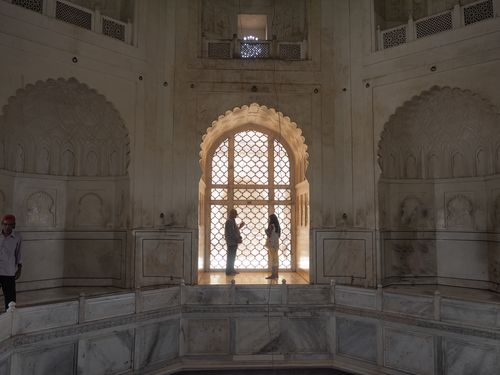
The intricate pietra dura work, a decorative technique that involved the inlaying of semi-precious stones into marble, further highlights the sophistication of Mughal craftsmanship. Though less extensive than in the Taj Mahal, the floral and geometric motifs at Bibi Ka Maqbara reflect a high level of precision and artistry, illustrating the advanced techniques that were characteristic of Mughal architecture during this period.
Architectural Features: A Fusion of Regional and Foreign Traditions
Bibi Ka Maqbara's architectural design reflects a unique blend of regional Deccan styles and Persian-Islamic influences, which were prominent in the Mughal architectural tradition. The monument’s layout follows the Mughal tradition of symmetry, featuring a central dome surrounded by four smaller minarets, akin to the Taj Mahal. However, the use of local materials and techniques distinguishes it from its northern counterpart, adding a distinct Deccan flavor to its design.
The structure is built on a raised platform, with a series of steps leading to the main mausoleum. The use of chhatris (small domed kiosks) on the minarets and around the central dome is a characteristic feature of Rajput architecture, which had a significant influence on Mughal design during this period. The large, formal gardens surrounding the mausoleum are laid out in the charbagh style, a Persian garden design divided into quadrants, representing the four rivers of paradise.
This fusion of artistic traditions—from the Persian-inspired arches and domes to the local Deccan and Rajput elements—underscores the Mughals' ability to integrate diverse cultural influences into a cohesive and grand architectural expression.
Notable Structure and Layout
The layout of Bibi Ka Maqbara follows the classic Mughal template of a central domed mausoleum surrounded by four minarets, forming a symmetrical and balanced design. The central dome, which rises majestically above the structure, is one of the most striking features, symbolizing the heavenly realm in Islamic architecture.
The monument is surrounded by vast, beautifully manicured gardens, with walkways and water channels, enhancing the overall sense of serenity and grandeur. This garden layout, known as the charbagh, was not only an aesthetic choice but also a symbolic one, representing the Mughal rulers' desire to recreate paradise on earth.
Anecdotes and Construction Statistics
One notable anecdote regarding Bibi Ka Maqbara is its comparison to the Taj Mahal, often leading to its nickname as the "Taj of the Deccan." However, the cost of building Bibi Ka Maqbara was a fraction of that of the Taj Mahal. It is said that the construction cost around 700,000 rupees, compared to the estimated 32 million rupees spent on the Taj Mahal. This disparity in costs is evident in the scale and use of materials, with the Bibi Ka Maqbara being a smaller, more restrained version of its northern counterpart.
Interestingly, it is believed that Aurangzeb, known for his frugality, was critical of the extravagant costs associated with the Taj Mahal. As a result, the construction of Bibi Ka Maqbara, overseen by his son Azam Shah, reflected a more modest approach while still maintaining the grandeur of Mughal architecture.
International Recognition and UNESCO Status
While the Bibi Ka Maqbara has not been officially inscribed as a UNESCO World Heritage Site, it holds considerable national significance and attracts a large number of tourists every year. The architectural beauty and historical importance of the monument have contributed to its recognition as a key symbol of Mughal heritage in southern India.
The lack of UNESCO status means that international attention and funding for conservation efforts have been limited. However, the Indian government has undertaken various restoration projects to preserve the structure, focusing on maintaining the integrity of its original design and materials. The recognition of the monument, both nationally and internationally, continues to grow, thanks to its historical significance and architectural uniqueness.
Challenges to Preservation in the Modern Era
The preservation of Bibi Ka Maqbara faces several challenges in the modern era. Urbanization in and around Aurangabad has led to increased pollution, which threatens the monument’s marble surfaces. The wear and tear caused by exposure to environmental factors such as acid rain and fluctuating temperatures are also a concern. Furthermore, the increasing number of visitors poses a risk to the structural integrity of the site, as the pathways and delicate decorative elements endure heavy foot traffic.
Efforts to combat these issues include government-led initiatives to clean and restore the marble surfaces, improve visitor management, and control pollution levels in the area. However, without international recognition, these efforts remain underfunded, and the monument’s long-term preservation continues to face hurdles.
Conclusion
Bibi Ka Maqbara is not just a monument to Mughal grandeur; it is a symbol of the architectural innovation and cultural fusion that defined the empire. Through its use of advanced construction techniques, locally sourced materials, and diverse artistic influences, the monument showcases the technological prowess and aesthetic refinement of the Mughal era. Although it remains less famous than the Taj Mahal, Bibi Ka Maqbara holds a special place in India’s architectural history. Its preservation in the face of modern threats is essential for future generations to appreciate the grandeur of Mughal innovation and the cultural synthesis it represents.