

 Français (France)
  Nederlands (nl-NL)
 00:00 • intro | 00:40 • Fronts of Havelis | 01:30 • Junagarh Fort
Personal creation from visual material collected during my trip India • Rajasthan and Varanasi (2015)
Map of places or practices in Bikaner on this site
• Use the markers to explore the content •
Bikaner, the Red City of Rajasthan
A Historic Desert City with a Distinct Identity
Bikaner occupies a special place in the urban landscape of Rajasthan. Located on the edge of the Thar Desert, this former princely capital developed in a demanding environment where water management, caravan trade and territorial defence were long essential to survival and prosperity. Its nickname, the “Red City,” refers to the warm tones of sandstone used in many buildings, but also to the visual unity created by walls, palaces and richly decorated town houses.
The video highlights two major aspects of Bikaner’s heritage: the façades of its havelis and the imposing Junagarh Fort. Together, these landmarks reveal a city shaped by royal authority, merchant wealth and skilled craftsmanship. They also show how architecture in Rajasthan often combines practical responses to climate with strong artistic expression.
Haveli Streets and the Power of Junagarh Fort
The havelis of Bikaner are among the city’s most memorable features. These urban mansions, built for prosperous merchant families, display façades of remarkable refinement. Projecting balconies, carved brackets, screened windows, decorated doorways and ornamental bands give many streets a rich architectural rhythm. Behind these façades are often internal courtyards designed to provide privacy, shade and air circulation in the desert climate.
Seen in the video, these houses demonstrate how domestic architecture could become a statement of status and identity. Wealth was expressed not only through size, but through craftsmanship visible from the street. Stone carving, painted details and carefully proportioned openings turned everyday residences into symbols of social prestige.
Junagarh Fort presents another side of Bikaner. Unlike many Rajput forts built on hills, this one stands on the plain, making it architecturally distinctive. Its massive walls, bastions and gateways reflect military needs, while the interiors reveal the refined life of a princely court. Palaces, audience halls, decorated chambers and courtyards contrast with the austere defensive exterior. This balance between strength and elegance is central to the monument’s character.
Historical and Cultural Background
Bikaner was founded in the late fifteenth century by Rao Bika, a Rajput prince of the Rathore lineage connected with Jodhpur. Establishing a new capital in this desert region had clear strategic value. It allowed control over routes linking north-western India with other trading zones and created a stable centre of power in a challenging landscape.
Junagarh Fort was mainly developed from the late sixteenth century onward, during a period when relations between Rajput states and the Mughal Empire influenced politics and artistic styles across northern India. As a result, parts of the fort combine Rajput traditions with Mughal decorative elements, visible in certain halls, gardens and ornamental details.
The havelis reflect the growth of mercantile communities whose activities helped enrich the city. Bikaner was therefore more than a military outpost or royal residence. It was also a commercial centre where traders, artisans and administrators contributed to an active urban culture.
Architecture Shaped by Climate and Prestige
The built heritage of Bikaner cannot be understood without considering the desert environment. Thick walls help regulate heat, inner courtyards improve ventilation, and screened openings reduce glare while allowing airflow. Stone from the region provided durable construction material and gave the city much of its characteristic colour.
Decoration also served several purposes. It conveyed rank and wealth, protected surfaces, and created changing effects of light and shadow throughout the day. In both havelis and palace spaces, utility and beauty were often closely linked. This combination is one of the defining strengths of traditional architecture in Rajasthan.
What These Videos Make Especially Clear
Videos created from carefully selected and animated photographs are particularly effective for a place like Bikaner. They allow viewers to pause visually on carved façades, compare details from one street to another, and then shift smoothly to the larger scale of the fort and its defensive structures.
This format also makes spatial relationships easier to understand. Narrow urban streets, inward-looking mansions and monumental palace complexes can be seen as parts of one coherent city rather than isolated attractions. Textures, depth, architectural layering and the contrast between public and private spaces become clearer through gradual visual sequencing.
A City of Character Worth Exploring
Bikaner brings together the elegance of merchant mansions and the authority of a fortified princely capital at the edge of the desert. The video offers a clear introduction to this distinctive urban heritage, while the related detailed pages provide further insight into the monuments, history and architectural traditions of Rajasthan’s Red City.
Links to related pages


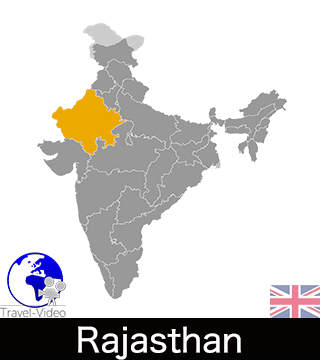

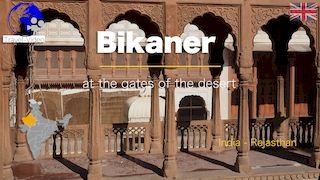











Audio Commentary Transcript
The city of Bikaner was founded in 1448 by Raho Bika, to whom it owes its name. It has nearly 700,000 inhabitants. Located in the Thar Desert and on one of the Silk Roads, it offers tourist interest, in addition to the facades of the havelis, as the traditional residences of prosperous merchants in the region are called, including the magnificent Junagarh Fort.
These women's hands molded on the walls of the Junagarh fort recall an old tradition, fortunately disappeared nowadays, which wanted the wives of high dignitaries to immolate themselves on the stake of their deceased husband, often killed in battle.

Music:
- (Inde) - Les Musiciens du Désert - Raga Soratha (Papaiya Pyara Ré), Ocora (558523)


