Français (France)
  Nederlands (nl-NL)
 00:00 • intro | 00:42 • the camel market | 02:27 • traditional musicians | 05:05 • dromedaries | 08:18 • cows and horses | 11:21 • Kalbeliya musicians and dancers
Personal creation from visual material collected during my trip India • Rajasthan and Varanasi (2015)
Map of places or practices in Pushkar on this site
• Use the markers to explore the content •
Pushkar, Camel Fair and Nomadic Traditions of Rajasthan
A Major Cultural Gathering in the Rajasthan Desert
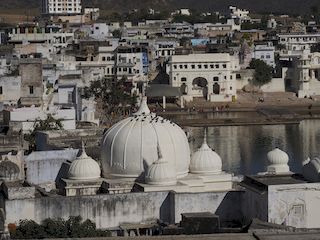
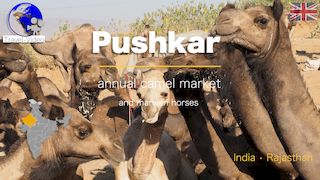
Located on the edge of a sacred lake in Rajasthan, Pushkar is known both as an important Hindu pilgrimage town and as the site of one of India’s most famous animal fairs. Each year, traders, herders, pilgrims, musicians and performers gather here from different regions of northwestern India. The video explores several dimensions of this event, where commercial activities, pastoral traditions and cultural performances come together within the semi-arid landscapes of Rajasthan.
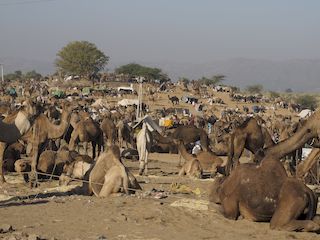
The images reveal a vast environment animated by moving herds, temporary camps and open-air performances. Decorated camels, Marwari horses and livestock illustrate the historical importance of animal breeding and caravan traditions in the desert regions of western India.
The video also captures the distinctive atmosphere of the fair. Markets, musicians and gatherings around the campsites show that Pushkar is far more than a commercial event. It is also a social and cultural meeting point where rural traditions, religious practices and popular entertainment remain closely connected.
Camels, Marwari Horses and Traditional Performances
The camel fair itself forms one of the most recognizable aspects of Pushkar. During certain periods, thousands of animals may be gathered in the sandy plains surrounding the town, making the event one of the largest livestock fairs in Rajasthan. The video highlights the long silhouettes of camels crossing the desert environment as well as the decorative ornaments and equipment used by traders and breeders.
Marwari horses also occupy an important place in the film. This distinctive breed from Rajasthan is especially recognizable by its inward-curving ears. Historically associated with Rajput cavalry traditions, the Marwari horse still carries strong symbolic and cultural significance within the region.
The sequences devoted to traditional musicians introduce another essential dimension of the fair. String instruments, percussion and vocal performances accompany gatherings and contribute to the characteristic soundscape of Rajasthan. These performances reflect the importance of oral traditions and traveling entertainers in the cultural life of western India.
The video also focuses on Kalbeliya musicians and dancers, a community often associated with nomadic traditions of Rajasthan. The rapid movements of the dancers, their black embroidered costumes and the rhythmic music create a striking contrast with the scenes of animal trading and desert camps. Today, Kalbeliya dance is widely recognized as an important part of Rajasthan’s cultural heritage.
Between Trade, Pilgrimage and Desert Traditions
The origins of the Pushkar fair are linked both to animal trading and to religious gatherings associated with the sacred lake and the Brahma temple. For centuries, breeders from desert regions traveled here to buy, sell and exchange animals used for transport, agriculture and military activities.
Camels once played a central role in movement across the arid landscapes of Rajasthan. Although their economic importance has declined with modern transportation, they remain strongly associated with the identity and imagery of the Indian desert.
The musical and dance traditions visible in the video also reflect the diversity of Rajasthan’s communities. The Kalbeliya people, historically connected to itinerant lifestyles, developed artistic forms centered on music, dance and public performance. Their cultural expressions continue to occupy an important place in regional fairs and festivals.
What These Videos Make Easier to Observe
The videos on travel-video.info rely heavily on carefully animated photographs that allow viewers to observe details of costumes, instruments, animals and market scenes with greater precision. This approach encourages a slower and more progressive reading of the spaces and activities visible during the fair.
Gradual transitions between wide views and close details make camel decorations, horse equipment, musicians’ gestures and the movements of Kalbeliya dancers easier to appreciate. The photographs also help reveal the relationships between camps, marketplaces and performance areas.
This visual construction encourages a more attentive observation of textures, colors and gestures that contribute to the distinctive atmosphere of the Pushkar fair.
A Living Expression of Rajasthan’s Cultural Heritage
The Pushkar fair remains one of the best-known cultural events in Rajasthan. Combining livestock trading, music, dance and religious traditions, it offers a particularly rich introduction to the pastoral and nomadic cultures of northwestern India. The detailed pages dedicated to the associated traditions provide further insight into the cultural heritage and community practices that continue to shape this unique gathering in the Rajasthan desert.
Links to related pages


Audio Commentary Transcript
The musicians are Pabu Ram (ravanhatta player and singer) and his wife Menghi (singer). They belong to the Nayak Bhopa tribe. Thanks to Hugues Graseli for this valuable information.
These musicians are kalbeliya, at the very bottom of the social scale, another tribe living in particular from their art in Rajasthan: music (pongal and dhol), dance and song. The dancers wear beautiful costumes. Some groups are very famous and perform as far as the West.

Music:
- - YouTube video library - Butterflies in Love
- - YouTube video library - Crusade - Video Classica, (© Crusade - Video Classica by Kevin MacLeod is licensed under a Creative Commons Attribution 4.0 license. https://creativecommons.org/licenses/by/4.0/
- Source: http://incompetech.com/music/royalty-free/index.html?isrc=USUAN1100884
- Artist: http://incompetech.com/)
- - YouTube video library - Desert Catharsis
Disclaimer: Despite its appropriateness, copyright issues prevent the use of indian traditional music in "Pushkar, camel and Marwari horse market • Gypsy dances and music • Rajasthan, India ", hence the use of royalty-free music. Despite our careful selection, some might regret this decision, which is necessary to avoid potential lawsuits. Although difficult, this decision is the only viable solution.