

 Français (France)
  Nederlands (nl-NL)
 00:00 • intro | 00:31 • chairlift to the stupa | 00:50 • the surroundings of the stupa | 01:53 • the peace pagoda, VIshwa Shanti Stupa
Personal creation from visual material collected during my trip Buddhist India • Sikkim • Bihar • West Bengal (2017)
Map of places or practices in Rajgir on this site
• Use the markers to explore the content •
Rajgir, Sacred Hills and the Peace Pagoda of Bihar
An Ancient City Shaped by Faith and Landscape
Rajgir holds a distinctive place in the cultural history of India. Surrounded by a ring of hills, this historic town in Bihar was once an important political centre and later became one of the major sacred landscapes of Buddhism and Jainism. The video presents a site where geography, memory and religious tradition remain closely connected.
The surrounding hills are not a secondary backdrop. They define the identity of Rajgir and explain why monasteries, retreats and sacred places were established on elevated ground. The landscape itself has long been part of the spiritual meaning of the city.
The Chairlift and the Ascent to the Summit
One of the most memorable sequences follows the chairlift rising toward the hilltop stupa. This ascent offers a progressive reading of Rajgir: the plain recedes, the ridges become clearer, and the white monument gradually appears above the slopes. The journey helps visitors understand why hilltop locations were often chosen for meditation and contemplation.
From above, Rajgir can also be seen as a settlement enclosed by natural barriers. In earlier periods, this geography offered both protection and symbolic prestige.
The Peace Pagoda and Vishwa Shanti Stupa
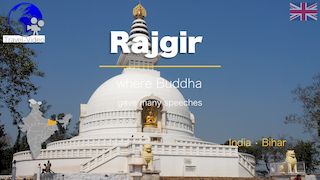
At the summit stands the Vishwa Shanti Stupa, or World Peace Pagoda, now one of Rajgir’s most recognizable landmarks. Its bright white dome contrasts strongly with the earthy tones of the hills and vegetation. Built in the twentieth century as part of the international Peace Pagoda movement, the monument was intended to express non-violence and spiritual harmony.
Its architecture is based on clear forms: a raised platform, a rounded dome and a vertical crown. This restrained composition gives the structure visual strength without excessive ornament. The surrounding terraces provide broad views across the valley, reinforcing the calm atmosphere of the site.
Historical Layers of Rajgir
Rajgir is associated with important episodes in Buddhist tradition, including visits by the Buddha and the presence of early monastic communities. It was also linked to the ancient kingdom of Magadha, one of the major powers of early northern India. Because of this long history, a modern monument such as the Vishwa Shanti Stupa fits naturally into an already meaningful setting.
The city therefore combines ancient remains, sacred memory and modern religious architecture. Few places illustrate such continuity so clearly.
What the Video Makes Easier to Understand
Videos built from carefully animated photographs are especially effective here. They clarify the changing perspectives between valley and summit, the geometry of the stupa, and the relationship between monument and landscape. Slow transitions between images help viewers observe slopes, terraces and the proportions of the structure.
This format also makes the ascent itself easier to appreciate as part of the site experience, rather than merely a means of transport.
A Living Sacred Destination
Rajgir remains today a place of pilgrimage, reflection and cultural interest. Its hills, historical associations and modern Peace Pagoda show how an ancient sacred city can continue to evolve. For those wishing to explore further, the detailed pages linked to the monument provide valuable additional context.
Links to related pages





Audio Commentary Transcript
If India is in its majority of Hindu religion, the Buddhist places of worship are not rare, especially in the North of India.
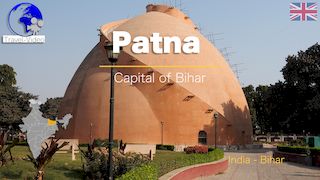
Located south of the Himalayas (Nepal, Bhutan and the Indian state of Sikkim) Bihar is the cradle of some of the main religions of the world including Buddhism and Jainism).
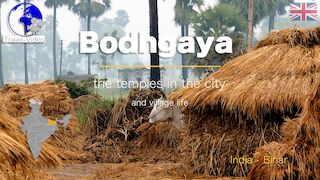
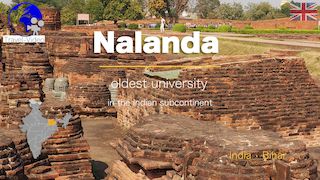
Some high places of Buddhism in the state of Bihar are Bodhgaya where Buddha attained enlightenment, the great ancient Buddhist university of Nalanda and Rajgir where Buddha spent several years of his life and pronounced many sermons.
Rajgir means "House of the King" which reminds us that this small town was once the capital of Magadh Mahajanpad.

Music:
- - YouTube video library - A Fallen Cowboy
Disclaimer: Despite its appropriateness, copyright issues prevent the use of indian traditional music in "Rajgir, sacred city • Bihar, India ", hence the use of royalty-free music. Despite our careful selection, some might regret this decision, which is necessary to avoid potential lawsuits. Although difficult, this decision is the only viable solution.


