

 Français (France)
  Nederlands (nl-NL)
 00:00 • intro | 00:40 • Nalanda, the oldest Buddhist university in India
Personal creation from visual material collected during my trip Buddhist India • Sikkim • Bihar • West Bengal (2017)
Map of places or practices in Nalanda on this site
• Use the markers to explore the content •
Nalanda, One of the Great Buddhist Universities of Ancient India
A Major Intellectual Center of the Buddhist World
Located in the Indian state of Bihar, Nalanda occupies a unique place in the history of Buddhism and higher learning in Asia. For several centuries, this vast monastic and educational complex was one of the most important centers of Buddhist scholarship in the world. Monks, teachers and students from many parts of Asia traveled to Nalanda to study philosophy, religious texts, logic, medicine and other disciplines within a highly organized academic environment.
The video explores the archaeological remains of this former Mahavihara, now recognized as a UNESCO World Heritage Site. Although only ruins survive today, the scale of the structures still reflects the extraordinary importance of Nalanda in the intellectual and religious history of Asia. The site also illustrates the role played by India in the transmission of Buddhist knowledge toward Tibet, China, Central Asia and Southeast Asia.
The Monastic Complex and Its Architectural Layout
The main focus of the video is the extensive brick-built monastic complex that formed the heart of ancient Nalanda. The ruins reveal a carefully planned architectural organization composed of monasteries, temples, courtyards and residential areas aligned along a central axis.
Each monastery was generally arranged around an interior courtyard surrounded by monks’ cells and study spaces. Opposite these residential structures stood temples and devotional buildings that once contained Buddhist images and ritual spaces. Even in their present fragmented condition, these remains provide valuable insight into the functioning of one of the largest Buddhist institutions in ancient India.
The red brick architecture visible throughout the site is characteristic of eastern India during the Gupta and post-Gupta periods. Decorative fragments, sculptural remains and elevated temple platforms demonstrate the artistic refinement associated with Nalanda during its period of prosperity.
Historical Development and Cultural Influence
Nalanda was probably founded during the Gupta period between the fifth and sixth centuries and later expanded under several dynasties that ruled parts of Bihar and Bengal. Royal patronage played a central role in maintaining the monasteries, supporting scholars and financing the development of new buildings.
The university became renowned throughout Asia. Chinese pilgrims such as Xuanzang and Yijing described Nalanda in detail, emphasizing both the intellectual prestige of the institution and the vast scale of its libraries and teaching activities. Thousands of students and teachers are believed to have lived and studied there during its peak.
Nalanda was not exclusively a religious institution. Alongside Buddhist philosophy and theology, scholars also studied grammar, astronomy, medicine and logic. The site therefore functioned both as a monastic center and as a major center of higher education.
The decline of Nalanda began gradually during the late medieval period, in a context of political instability and military conflicts affecting northern India. Eventually abandoned, the site remained buried for centuries before being rediscovered and excavated during the colonial period.
What the Videos on This Site Make Easier to Observe
The videos presented on travel-video.info are largely constructed from carefully selected and animated photographs. This approach allows viewers to observe architectural details and spatial relationships more clearly than in rapidly edited moving footage.
At Nalanda, the progressive transitions between images make it easier to understand the organization of the monastic courtyards, the scale of the temples and the arrangement of the residential structures. The slow visual rhythm also highlights textures, brickwork and sculptural remains that are essential for understanding the architectural identity of the site.
This method of presentation encourages a gradual reading of the ruins and helps viewers better appreciate the monumental character of the former university complex.
A Lasting Symbol of Buddhist Scholarship
Through its monasteries, temples and archaeological remains, Nalanda preserves the memory of one of the most influential intellectual centers of the ancient Buddhist world. The site remains an important testimony to the circulation of knowledge, religious traditions and cultural exchanges across Asia. The detailed pages associated with the video provide additional information about the Mahavihara and the broader historical context of this exceptional heritage site.







Audio Commentary Transcript
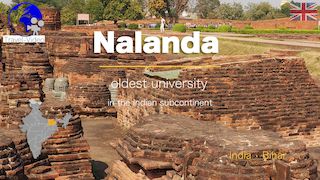
The archaeological remains of Nalanda are those of the oldest university in the Indian subcontinent. It is a monastic institution which was in continuous operation for over 800 years spanning the period from the 3rd century BC to around the year 1300.
Nalanda was sacked by an army of the Sultan of Delhi's Mamluk dynasty and was abandoned following this invasion. The ruins remained underground until the beginning of the 20th century.
Nalanda in Bihar, India was an ancient Mahavihara, an important Buddhist monastery of great renown from the 5th to 13th centuries CE.

Music:
- - YouTube video library - People Watching
Disclaimer: Despite its appropriateness, copyright issues prevent the use of indian traditional music in "Nalanda, ancient buddhist university • Bihar, India", hence the use of royalty-free music. Despite our careful selection, some might regret this decision, which is necessary to avoid potential lawsuits. Although difficult, this decision is the only viable solution.