Français (France)
  Nederlands (nl-NL)
 The Nalanda Mahavihara, located in Nalanda in the state of Bihar, India, refers to a major monastic and academic complex of the Buddhist world. It functioned as a center for teaching, research, and the transmission of religious and philosophical knowledge. The site reflects an organized system combining monastic life and scholarly activity. Today, it remains a key reference for understanding intellectual traditions of ancient India and an important component of cultural heritage linked to Buddhism.


Monument profile
Mahavihara
Monument categories: Monastery, Historical university, Archaelogic site
Monument families: Monastery • Historic University or Observatory • Archaeological
Monument genres: Religious, Cultural or scientific, Archaeological site
Cultural heritage: Buddhist
Geographic location: Nalanda • Bihar • India
Construction period: 3rd century BC
This monument in Nalanda is inscribed on the UNESCO World Heritage List since 2016 and is part of the serial property "Archaeological Site of Nalanda Mahavihara at Nalanda, Bihar".See the UNESCO monuments featured on this site
• Links to •
• Dynasties that contributed to the construction of the monument •


• List of videos about Nalanda on this site •
Nalanda, ancient Buddhist university • Bihar, India
• References •
UNESCO: Archaeological Site of Nalanda Mahavihara at Nalanda, Bihar
• Sources •
Sources
Books and Publications
Nalanda Mahavihara: foundation, institutional development and historical transformation
Foundation and institutional framework
The Nalanda Mahavihara was established in the 5th century in the region of Nalanda, within present-day Bihar in India. Its foundation is associated with the patronage of rulers connected to the Gupta dynasty, who supported the development of structured monastic institutions. The site was conceived as a residential and scholarly complex intended to accommodate a community of monks engaged in study and teaching.
The institutional framework relied on sustained endowments, including land grants and financial support provided by royal authority and private donors. These resources ensured the continuity of the establishment and allowed the formation of a stable monastic population. The Mahavihara functioned from its early phases as an organized institution with defined administrative and educational structures.
Expansion and academic organization
From the 6th century onward, the Mahavihara underwent continuous expansion, reflected in the increase in resident scholars and the diversification of intellectual activities. The institution developed into a recognized center of higher learning, attracting students and teachers from various regions across Asia. Admission procedures are reported to have been selective, indicating a regulated academic environment.
The curriculum included Buddhist philosophy, logic, grammar, and related fields of knowledge. Instruction was delivered within a structured hierarchy, with senior scholars overseeing the transmission of doctrinal and analytical traditions. The coexistence of monastic discipline and academic training defined the operational model of the Mahavihara. This combination contributed to the dissemination of knowledge beyond the Indian subcontinent.
Peak activity and institutional consolidation
Between the 7th and 9th centuries, the Mahavihara reached a phase of sustained activity under the patronage of the Pala dynasty. This period is characterized by the consolidation of infrastructure and the intensification of scholarly exchange. The site accommodated a large number of monks and students, reflecting its capacity as a major institutional center.
Foreign scholars and pilgrims, particularly from East and Central Asia, are documented as having resided and studied at the Mahavihara. Their presence contributed to the circulation of intellectual traditions and reinforced the institution’s international dimension. Architectural expansions during this phase corresponded to the growing needs of the academic community, without altering the fundamental organization of the complex.
Decline, destruction and archaeological recovery
From the 11th century onward, the Mahavihara experienced a gradual decline linked to shifts in political support and regional instability. The reduction of patronage affected the maintenance and operation of the institution. This process culminated in the 12th century with military incursions that led to extensive destruction of the site and the cessation of its academic functions.
Following abandonment, the structures remained in a state of ruin for several centuries. Systematic archaeological investigations began in the 19th century, leading to the identification and excavation of the principal components of the complex. These efforts revealed the extent of the site and allowed for the reconstruction of its spatial organization.
The remains of the Mahavihara are currently recognized as a major historical site. They were inscribed on the UNESCO World Heritage List in 2016 under the designation “Nalanda Mahavihara (Nalanda University),” acknowledging their significance in the history of education and religious institutions.
Global historical context
During the 5th century, when the Mahavihara was founded, the Western Roman Empire was undergoing collapse. In China, the Northern and Southern dynasties structured political authority. From the 7th century, the expansion of Islam reshaped political dynamics in the Middle East. In Europe, early medieval kingdoms emerged following the decline of Roman structures. These developments reflect a broader transformation of political and cultural systems across regions.
Architectural organization and spatial configuration of the Nalanda Mahavihara
Site layout and overall spatial structure
The Nalanda Mahavihara is arranged along a clearly defined north–south axis within the territory of Nalanda, in present-day Bihar, India. The complex is composed of a sequence of monastic units aligned in parallel rows, separated by longitudinal circulation corridors. This linear arrangement creates a structured spatial order based on repetition and alignment.
Each unit occupies a rectangular footprint and is enclosed within a defined perimeter, forming a modular system that can be extended through the addition of similar components. Open space is concentrated within internal courtyards and circulation paths, while the built areas remain compact and continuous. The absence of irregular extensions reinforces the legibility of the overall plan.
Monastic units and internal circulation
The principal architectural elements are the viharas, each organized around a central open courtyard. Access is typically controlled through a single entrance positioned along one side, establishing a clear threshold between exterior and interior space. The courtyard functions as the central organizing element, distributing movement toward the surrounding rooms.
Cells for resident monks are arranged along the four sides of the courtyard, forming a continuous ring. These cells are uniform in size and proportion, with a single enclosed space that occasionally includes built-in features such as wall niches or raised platforms. Circulation is ensured by a covered ambulatory that runs along the inner perimeter, allowing movement between cells without crossing the courtyard.
The regular spacing of the cells and the continuity of the corridor produce a repetitive architectural rhythm. This modular arrangement allows for the replication of similar units across the site, maintaining coherence while accommodating expansion.
Religious structures and vertical articulation
In addition to residential units, the complex includes temples and stupas positioned in proximity to the monastic compounds. These structures are spatially distinct yet integrated within the broader layout. Their volumes rise above the surrounding buildings, introducing a vertical dimension that contrasts with the predominantly horizontal monastic units.
Temples display more articulated plans, with differentiated internal spaces and clearly defined entrances aligned along axial directions. Their elevation creates focal points within the site. Stupas are characterized by solid bases and compact superstructures, forming vertical markers that structure visual perspectives.
The placement of these elements generates a hierarchy within the site, where residential and ritual spaces are differentiated through both spatial arrangement and volumetric contrast. This hierarchy contributes to the organization of movement and orientation within the complex.
Materials and construction techniques
The Mahavihara is constructed primarily of fired brick, which forms the core material for walls, platforms, and structural elements. The bricks are laid in regular courses, producing uniform surfaces and stable load-bearing structures. The use of brick allows for precise control of dimensions and supports the repetition of modular units.
Foundations consist of compacted layers designed to stabilize the structures on the local ground conditions. Wall thickness is sufficient to support multiple levels, as suggested by the scale of the remains. Structural loads are distributed through continuous masonry, without reliance on large-span openings.
Surface treatments may include plaster coatings or decorative brickwork integrated into the masonry. Decorative elements are generally embedded within the structure rather than applied externally, maintaining the coherence of the architectural mass.
Architectural evolution and conservation state
The site exhibits multiple phases of construction, visible through variations in the size and arrangement of individual viharas. Later additions extend the linear pattern while maintaining the fundamental organizational principles. Modifications include the expansion of existing units and the insertion of new structures within available space.
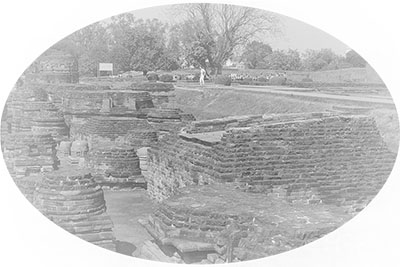
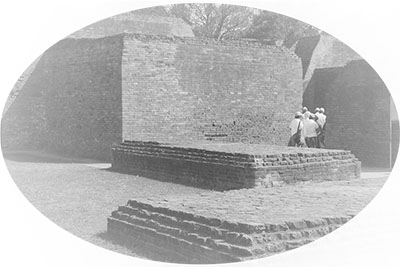
Current remains consist primarily of foundation walls and partial elevations, allowing reconstruction of the original layout. Archaeological interventions have stabilized key areas and clarified the relationships between different components. Despite the loss of upper structures, the spatial configuration remains clearly readable.
Conservation efforts focus on preserving the exposed brickwork and preventing further degradation due to environmental factors. The structural continuity of the complex is maintained, ensuring that the architectural logic of the Mahavihara remains evident in its present condition.