Français (France)
  Nederlands (nl-NL)
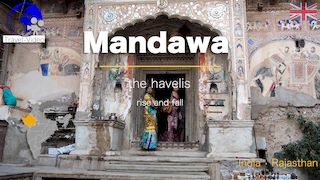
 00:00 • intro | 00:36 • the former palace of the maharajah | 01:14 • havelis in town | 02:41 • life in a haveli abandoned by its former owners | 03:39 • facade details
Personal creation from visual material collected during my trip India • Rajasthan and Varanasi (2015)
Map of places or practices in Mandawa on this site
• Use the markers to explore the content •
Mandawa, Painted Havelis of Shekhawati
A Town Where Houses Became Monuments
Mandawa, located in the Shekhawati region of Rajasthan, is one of northern India’s most distinctive heritage towns. Its reputation rests not on a single fort or palace, but on an extraordinary concentration of havelis—large merchant residences built between the eighteenth and early twentieth centuries by prosperous trading families. Behind carved gateways and painted walls lie courtyards, reception halls, balconies, and richly decorated interiors that transformed private houses into symbols of prestige.
This video introduces a place where domestic architecture became a public statement of wealth, taste, and cultural identity. Streets lined with painted façades, traces of aristocratic patronage, and houses shaped by changing fortunes create a layered urban landscape. Mandawa offers a different image of Rajasthan: less focused on military architecture and more closely linked to trade, urban life, and artistic patronage.
The Former Palace, Merchant Mansions, and Urban Memory
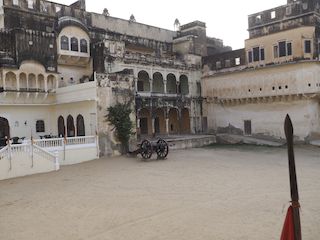
The former palace of the local maharaja recalls Mandawa’s political role within the region. Like many Rajput towns, it combined residence, authority, and ceremonial presence. Its architecture represented local power while overseeing a settlement enriched by commerce.
The havelis seen throughout the town form the core of Mandawa’s historic identity. These residences belonged to merchant families who prospered through networks connecting Rajasthan with Delhi, Calcutta, Bombay, and other commercial centers. A haveli was both a family home and a statement of social rank. Its public façade announced success, while inner courtyards and private rooms organized domestic life according to hierarchy, climate, and custom.
The video also evokes life inside a haveli abandoned by its former owners. This aspect is important for understanding modern change. As economic opportunities shifted toward major cities, many families left Shekhawati. Some mansions were maintained or converted, while others declined gradually. Their empty rooms, faded paintings, and altered interiors tell a story of migration, adaptation, and the transformation of old urban elites.
Close views of façades reveal balconies, projecting windows, painted doorframes, decorative niches, and the remarkable craftsmanship that made Mandawa famous.
Shekhawati Painting Traditions and Composite Motifs
The prosperity of Shekhawati encouraged a highly developed tradition of mural decoration. Owners commissioned paintings to embellish their houses and express refinement. Walls could display religious scenes, episodes from epics, floral patterns, royal imagery, scenes of daily life, and later modern subjects such as trains, automobiles, and European visitors.
Among the most intriguing themes are the composite iconographic motifs known as nava nari kunjara and nava nari ashva.
The nava nari kunjara depicts an elephant formed by multiple human figures arranged so that, from a distance, the viewer first sees the animal. Closer observation reveals that the trunk, body, and legs are composed of people carefully integrated into a single design. The motif combines visual wit, symbolic depth, and technical mastery.
The nava nari ashva applies the same principle to the horse. Human figures together create the shape of a mounted or standing horse. In a region where horses were associated with mobility, nobility, and Rajput martial culture, such imagery could carry additional prestige and meaning.
These motifs were more than decorative curiosities. They rewarded attentive viewers and demonstrated the sophistication of patrons who valued learned visual culture. They also reveal the creativity of painters able to merge illusion, narrative, and ornament in one image.
Architecture itself supported this artistic world. Thick walls moderated heat, inner courtyards improved ventilation, and shaded galleries reduced direct sun. Painting and building therefore formed a unified environment rather than separate elements.
What the Videos on This Site Make Especially Clear
Mandawa is a place best understood through careful observation. A video built from thoughtfully selected and animated photographs is particularly effective for this type of heritage.
Slow transitions allow the viewer to read an entire façade: the rhythm of openings, the placement of balconies, the relationship between painted surfaces and masonry, and the balance between ornament and structure. During a quick walk, many of these details could easily be missed.
Changes in framing also reveal the contrast between modest street fronts and unexpectedly large interiors hidden behind gateways. This is one of the defining qualities of haveli architecture. Public and private space were deliberately separated, and many of the town’s most impressive spaces remain invisible until entered.
Close-up imagery is especially valuable for mural painting. It helps viewers notice brushwork, restored areas, fading pigments, and intricate motifs such as the nara-kunjara and nara-ashva, whose full meaning only appears through attentive viewing.
The sequences devoted to abandoned houses add another layer of understanding. Weathered wood, empty courtyards, cracked plaster, and fading wall paintings show how architecture continues to evolve after its original social world has changed.
A Different Vision of Rajasthan
Mandawa offers a distinctive perspective on Rajasthan through merchant wealth, residential architecture, and painted urban culture rather than through grand forts alone. Its havelis preserve the memory of families who linked desert towns to wider commercial networks while commissioning art of remarkable originality. This video provides an excellent introduction to that world of hidden courtyards, painted walls, and visual invention, while the detailed pages on this site offer further insight into haveli architecture and the heritage of Shekhawati.
Links to related pages
• Main dynasties that ruled the region • •











Audio Commentary Transcript
Mandawa, once a prosperous city, saw its wealthy Jain merchants gradually leave the city because of the severe decline due to the construction of the port of Bombay which gradually took precedence over the caravans that once made Mandawa famous. The havélis remained and were entrusted to the inhabitants of the village. The small town of Mandawa in Rajasthan, which has less than 30,000 inhabitants, is famous for its havélis. Havelis are the richly decorated homes of merchants who prospered before the Silk Road was abandoned by caravans.
About painting techniques
The technique used in Rajasthan for wall paintings is called Ala-Gila. It consists of laying the paint on fresh and still damp lime. The pigments are mixed with a binder (organic or not). As the paint mixed with the binder is applied to the still damp wall, we can speak here of a distemper.
The paintings sometimes represent scenes from mythology and are decorated with scrolls. This kind of paintings, originating from Odisha (formerly called Orissa) is more often found on fabrics. It is then called Pattachitra. When it is applied on a wall, it takes the name of Bhitti Chitra.
The painted scene sometimes represents Krishna surrounded by women, who are called Gopis (the beloved ones of Krishna), mounted on an elephant or a horse. This very particular art is called Nava Nari Kunjara or Nava Nari Ashwa depending on whether Krishna rides an elephant or a horse. The peculiarity of this particular art is that the body of the animal is made up of women's bodies. In principle, 9 female bodies constitute the animal, but it seems that there may be exceptions like in these images.

Music:
- - YouTube video library - Anamalie, (© Anamalie by Kevin MacLeod is licensed under a Creative Commons Attribution 4.0 license. https://creativecommons.org/licenses/by/4.0/
- Source: http://incompetech.com/music/royalty-free/index.html?isrc=USUAN1500007
- Artist: http://incompetech.com/)
- - YouTube video library - Carol of the Bells
Disclaimer: Despite its appropriateness, copyright issues prevent the use of indian traditional music in "Mandawa, the havelis • Rajasthan, India", hence the use of royalty-free music. Despite our careful selection, some might regret this decision, which is necessary to avoid potential lawsuits. Although difficult, this decision is the only viable solution.