Français (France)
  Nederlands (nl-NL)
 00:00 • intro | 00:09 • Karni Mata Temple | 05:16 • brass band and dance
Personal creation from visual material collected during my trip India • Rajasthan and Varanasi (2015)
Map of places or practices in Deshnoke on this site
• Use the markers to explore the content •
Deshnok and the Karni Mata Temple: Devotion and Festive Traditions in Rajasthan
A Distinctive Sanctuary in the Desert Region of Rajasthan
Deshnok lies in Rajasthan, not far from Bikaner, within a region known for semi-arid landscapes, historic caravan routes and powerful local traditions. The town is famous for one highly unusual sanctuary: the Karni Mata Temple, widely known abroad as the “rat temple.” Yet this striking nickname only reflects one visible aspect of a much deeper religious reality. Above all, the site is an active place of worship rooted in regional devotion, historical memory and popular pilgrimage.
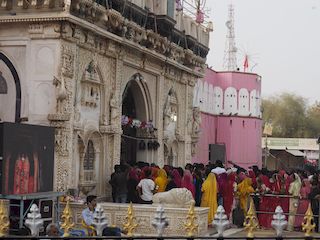
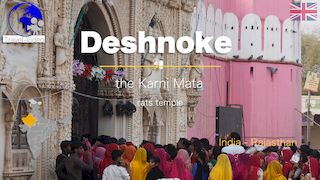
This video approaches Deshnok during a festive occasion. It combines sacred architecture, gathering crowds, music and dance, revealing the temple not as an isolated curiosity but as a living centre of faith. The atmosphere shown here is one of participation and continuity, where ritual life and celebration remain closely connected.
The Temple, Sacred Animals and Public Celebration
The Karni Mata Temple is naturally the central focus of the visit. Its entrance gates, carved surfaces, courtyards and ceremonial spaces reflect architectural traditions found across Rajasthan, where stone craftsmanship and decorative detail often play an important role. The sanctuary is dedicated to Karni Mata, a revered female figure associated with holiness, protection and the history of certain Rajput communities.
The most famous characteristic of the temple is the presence of numerous rats living freely within the complex. These animals are protected, fed and treated with respect by devotees, who associate them with sacred beliefs linked to rebirth and community tradition. While this feature attracts outside attention, it should not overshadow the temple’s primary significance as a place of prayer and blessing.
The scenes of fanfare and dance highlight another essential dimension of the site: the religious festival as a social event. Brass bands, percussion, movement, colour and public participation transform the surroundings of the temple into a dynamic ceremonial space. In many Indian traditions, music accompanies devotion, marks important dates and reinforces collective identity.
Historical Background and Regional Meaning
Karni Mata is generally linked to traditions dating from the fourteenth and fifteenth centuries. Over time, her reputation spread widely in Rajasthan, especially among communities that regarded her as a spiritual protector. In earlier centuries, religious figures such as Karni Mata could hold moral and symbolic authority alongside regional rulers and warrior lineages.
Like many important Indian temples, the present sanctuary is the result of successive phases of construction, restoration and embellishment. Donations from patrons, rulers and worshippers gradually shaped the monument visible today. Its current appearance therefore combines older sacred continuity with later architectural interventions.
Rajasthan is internationally known for its forts, palaces and princely cities, yet popular temples form another vital part of its heritage. Deshnok reminds visitors that regional history is not expressed only through royal monuments. It is also preserved in places of active devotion where ordinary worshippers continue long-established practices.
What the Videos on This Site Make Especially Clear
A video largely created from carefully selected and animated photographs is particularly well suited to a site such as Karni Mata Temple, where details matter. Slow movement across still images allows viewers to observe gates, carvings, courtyards and decorative elements with clarity.
During crowded festival scenes, this method is equally valuable. Expressions, clothing, musical instruments and gestures become easier to read than in rapidly moving footage. The relationship between participants and sacred space appears more coherent and understandable.
Even the temple’s most unusual aspect, the presence of rats within the sanctuary, becomes easier to interpret when shown in architectural and ritual context. Rather than appearing as a simple curiosity, it can be understood as part of a broader symbolic system shaped by belief and tradition.
A Living Heritage Site of Rajasthan
Deshnok and the Karni Mata Temple offer a rare encounter between sacred tradition, popular festivity and distinctive local identity. This video helps reveal the richness of the site beyond the clichés often associated with it. For visitors wishing to explore further, the detailed page devoted to the temple provides additional insight into one of Rajasthan’s most original and enduring places of devotion.
Links to related pages



Audio Commentary Transcript
The famous rat temple was celebrating. We preferred to stay outside not because of the presence of rats but because of that of a compact and very large crowd which would have deprived us of an optimal visit anyway.
There are many videos showing these rats, but not much retracing the atmosphere in front of the temple on a feast day.
Music:
- - Suresh Prajapati (Inde) - Indian Classical Instrumental - Flute Tabla Raga 1, Suresh Prajapati
- (Inde) - Rajasthan vol 1. Musiciens professionnels populaires. - Solo de Murali avec Accompagnement de Vièle, Ocora (OCR 81)