Français (France)
  Nederlands (nl-NL)
 00:00 • intro | 00:03 • Hawa Mahal (the wind palace) | 01:24 • elephants bringing tourists to Amber Fort | 03:14 • Amber fort | 08:01 • Jal Mahal | 08:45 • Jantar Mantar, observatory | 09:45 • City Palace
Personal creation from visual material collected during my trip India • Rajasthan and Varanasi (2015)
Map of places or practices in Jaipur on this site
• Use the markers to explore the content •
Jaipur, the Planned Royal Capital of Rajasthan
A Historic City of Architecture and Urban Vision
Jaipur holds a distinctive place among the historic cities of India. Capital of Rajasthan and widely known as the Pink City, it combines royal architecture, scientific heritage, fortified landscapes and a carefully designed urban plan. Founded in the eighteenth century as the new capital of a Rajput kingdom, Jaipur was conceived not as a medieval settlement that grew gradually, but as an organized city shaped by political ambition, commercial logic and architectural symbolism.
The video offers an introduction to several dimensions of Jaipur. Monumental façades, palace complexes, lakeside scenery, hilltop fortifications and traces of courtly culture all appear within the same itinerary. Rather than presenting a single monument, Jaipur reveals an entire urban world where streets, gates, palaces and ceremonial spaces still reflect the ideals of an earlier princely state. This layered character explains why the city remains one of the most important heritage centres of northern India.
Palaces, Forts and Landmark Structures
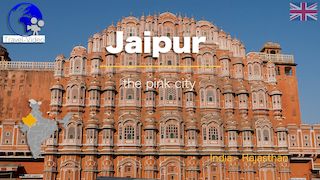
Among Jaipur’s best-known monuments is the Hawa Mahal, often translated as the Palace of Winds. Its remarkable façade, composed of countless small windows, projecting balconies and finely articulated surfaces, has become one of the visual symbols of Rajasthan. Beyond its decorative quality, the building responded to practical and social needs. It allowed women of the royal household to observe street life and processions while remaining screened from public view, while also encouraging air circulation in a hot climate.
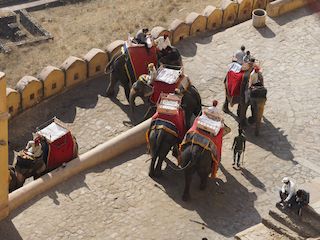
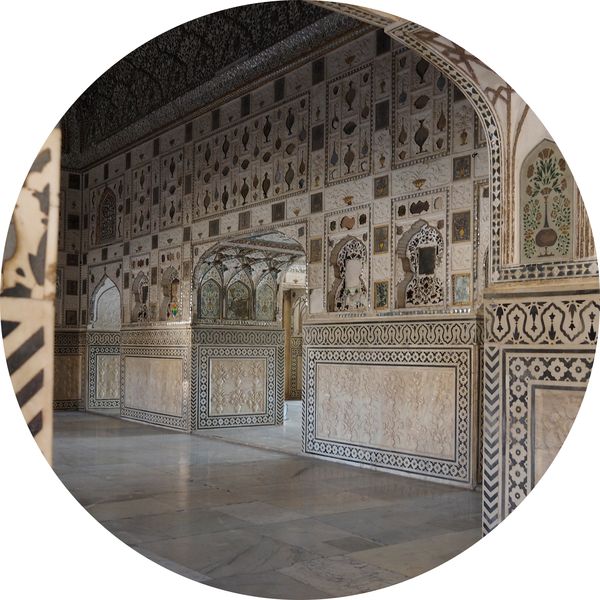
Outside the old city stands Amber Fort, the earlier seat of the Kachwaha rulers before Jaipur was founded. Built on a rugged hillside, the complex combines defensive walls, monumental gateways, courtyards and refined palace interiors. Amber illustrates the dual role of many Rajput strongholds: military protection and ceremonial residence. Images of elephants carrying visitors toward the fort are now associated with tourism, yet they also evoke the long historical connection between royal courts, processions and animal symbolism in the region.
Jal Mahal, rising from the waters of Man Sagar Lake, presents another face of Jaipur’s heritage. Seen from the shore, this lakeside palace creates a striking composition in which architecture and landscape are closely linked. Its setting reflects older traditions of pleasure architecture, water management and elite retreat.
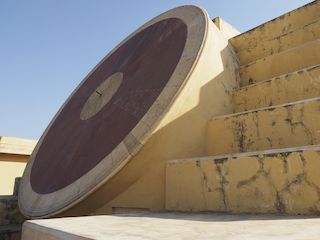
The video also reaches the Jantar Mantar, one of the most extraordinary astronomical observatories in the world. Its large masonry instruments, geometric and sculptural in appearance, were designed for direct observation of celestial movements. Nearby, the City Palace remains a central testimony to Jaipur’s role as a royal capital, combining ceremonial courts, administrative buildings and residential areas within the heart of the historic city.
Jaipur and the Kachwaha Dynasty
Jaipur was founded in 1727 by Maharaja Sawai Jai Singh II, ruler of the Kachwaha Rajput dynasty. The transfer of the capital from Amber responded to several practical concerns, including growing population, water supply limitations and the desire for a more spacious and efficient urban centre. The new city also projected authority through order, scale and planning.
Unlike many older cities shaped over centuries through gradual expansion, Jaipur followed a structured layout based on broad avenues and rectangular sectors. This plan drew on Indian architectural and cosmological traditions while also responding to commercial and administrative needs. Markets, residential quarters and ceremonial routes were integrated into a coherent framework that remains visible today.
The famous pink colour associated with Jaipur became especially prominent in the nineteenth century, when parts of the city were painted in warm terracotta tones for official receptions. Over time, this chromatic identity became inseparable from Jaipur’s public image.
Architecturally, the city reflects the meeting of Rajput traditions, Mughal influence and local climatic adaptation. Arcades, screened windows, courtyards, terraces and elevated pavilions all contributed to buildings suited to both prestige and environment. Jaipur therefore represents not only royal taste, but also a practical response to heat, light and urban life.
What These Videos Make Especially Clear
Videos created from carefully selected and animated photographs are particularly effective for a city such as Jaipur. Historic urban environments often contain many layers of detail that can be missed during a quick visit. Through gradual sequencing, close framing and changing perspectives, the viewer can read the city more clearly.
The façade of Hawa Mahal becomes easier to understand when the rhythm of its windows and balconies is shown step by step. Amber Fort benefits from wider views that reveal its hillside position, defensive perimeter and relationship with surrounding terrain. Jal Mahal gains visual power through composed images that emphasize the contrast between stone architecture and open water.
At Jantar Mantar, photography helps explain forms that may seem abstract at first glance. Angles and transitions reveal that these monumental shapes were instruments rather than decorative structures. The City Palace, meanwhile, becomes more intelligible when separate courtyards, gateways and façades are shown progressively rather than all at once.
This method also helps viewers understand Jaipur as a complete urban ensemble rather than a collection of isolated attractions. Streets, monuments, topography and royal planning all become part of the same narrative.
A City Where Urban Planning Meets Royal Heritage
Jaipur brings together the memory of Rajput rule, eighteenth-century urban design, ceremonial architecture and some of India’s most recognizable monuments. It is a city where science, power, aesthetics and landscape intersect in unusually visible ways. This video offers a clear and engaging overview of that heritage, while the related monument pages provide the opportunity to explore each major site in greater historical and architectural depth.
Music:
- - Duke Ellington - Black, Brown and Beige - Caravan, Naxo's Jazz Legends
- (Inde) - North Indian Folk Music - Dhun on the Shahnai, Odeon (3 C064-17859)
- - Suresh Prajapati (Inde) - Indian Classical Instrumental - Flute Tabla Raga 1, Suresh Prajapati
- - Lakshmi Shankar (Inde) - Inde du Nord (North India) - Season and Time - Raga Dhani: Tala Jhaptal, Ocora
- (Pakistan) - Authentic Music of the Snake Charmer - Sorath, Olympic Records (OL-6101)
Disclaimer: Despite its appropriateness, copyright issues prevent the use of indian traditional music in "Jaipur, the pink city • Rajasthan, India", hence the use of royalty-free music. Despite our careful selection, some might regret this decision, which is necessary to avoid potential lawsuits. Although difficult, this decision is the only viable solution.
Links to related pages
• Main dynasties that ruled the region • •



Audio Commentary Transcript
The Jaipur Wind Palace was built by Maharajah Sawai Pratap Singh at the end of the 18th century.
Its main function was to allow the women of his harem to see what is happening in town without being seen.
This palace is in fact mainly made up of a finely carved and perforated facade to serve its original destination: to see without being seen.
The Maharadjahs lost their title and became hotel owners. The elephants no longer work for them, but did they gain by the way ... Not sure ...
They are probably more badly treated in their new attributions, the folk transport of tourists.