Français (France)
  Nederlands (nl-NL)
 The Pushkar Camel Fair is one of the major seasonal gatherings in the Indian state of Rajasthan. Held in the town of Pushkar, the event brings together camel breeders, traders, and visitors from various parts of the Thar Desert region. The fair combines an important commercial activity related to camel trading with a range of social and cultural events. Animals are presented, exchanged, or sold, while participants take part in meetings, performances, and communal activities. The fair represents a significant moment in the regional calendar, bringing together economic exchange, social interaction, and public festivities.
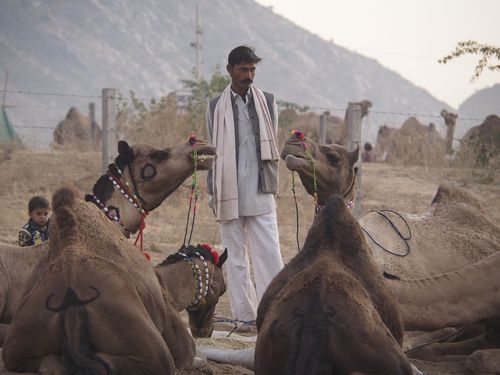
Pushkar • Camel fair

Pushkar • Camel fair

Pushkar • Camel fair
Tradition profile
Camel fair
Tradition category: Animal market
Tradition family: Traditional markets and fairs
Tradition genre: Trade and Local Creativity
Cultural heritage: Hindu
Geographic location: Pushkar • Rajasthan • India
• Links to •
• List of videos about Pushkar on this site •
Pushkar, camel and Marwari horse market • Gypsy dances and music • Rajasthan, India
Pushkar II
History of the Camel Fair tradition in Pushkar
Political and social context of its development
The camel fair of Pushkar developed within the historical and environmental context of Rajasthan, a region in northwestern India characterized by arid landscapes and the presence of the Thar Desert. For centuries, the camel played a central role in the economy of this region, serving as a means of transport, agricultural labor, and military logistics. In societies where distances between settlements were large and infrastructure limited, the camel became indispensable for both everyday activities and long-distance trade.
Pushkar itself has long been recognized as an important religious center in Hindu tradition. The presence of the sacred Pushkar Lake and several temples made the town a destination for pilgrims who gathered there during specific periods of the lunar calendar. These gatherings gradually attracted merchants, pastoral communities, and traders who saw an opportunity to exchange animals and goods while a large population was temporarily present in the area.
The emergence of a camel fair therefore resulted from the intersection of religious pilgrimage and pastoral commerce. Communities involved in camel breeding, particularly pastoral groups from different parts of Rajasthan, required periodic locations where animals could be traded or evaluated. Pushkar’s religious festivals created the conditions for such exchanges by concentrating large numbers of people in a single location.
Local rulers and regional authorities eventually recognized the value of these gatherings. Livestock trade contributed to the economic stability of the desert regions and supported both agricultural and military needs. Merchant groups, pastoral castes, and regional administrators therefore played roles in encouraging the continuity of the fair.
Historical developments and political changes
Over time, the camel fair in Pushkar was influenced by broader political developments affecting northern India. During periods when Rajput kingdoms controlled much of Rajasthan, camels were essential for transport and warfare. Armies operating in desert environments relied heavily on camel caravans for logistics and communication. Markets where camels could be bought and sold were therefore strategically important.
With the expansion of the Mughal Empire across northern India, trade networks grew and commercial exchanges intensified. Although Pushkar remained primarily a religious center, its fairs benefited indirectly from increased regional mobility and commercial activity. Camel trading remained an important aspect of the local economy.
During the British colonial period, the structure of regional economies gradually changed. Colonial administrators sometimes encouraged livestock markets because animals remained important for transport, agriculture, and military purposes. At the same time, the introduction of railways and modern transportation technologies began to reduce the strategic importance of camels in certain contexts.
After India achieved independence in 1947, rural economies continued to evolve. Mechanization and motorized transport gradually replaced some traditional uses of camels. Nevertheless, the Pushkar fair continued to function as a seasonal gathering for livestock trade, while also acquiring new cultural and social dimensions.
Global context and comparative traditions
The development of the Pushkar camel fair can be understood within a wider historical pattern of livestock fairs and seasonal markets found in many parts of the world. In pastoral societies, gatherings for the exchange of animals served not only economic functions but also social and cultural ones.
Comparable markets existed in parts of North Africa and the Middle East, where camel trading played a similar role in desert economies. These events often coincided with religious festivals or pilgrimage routes, allowing trade to take place alongside spiritual gatherings.
More broadly, seasonal fairs were common in agrarian societies across Europe, Asia, and Africa. Medieval markets in Europe, livestock fairs in Central Asia, and pastoral exchanges in African regions all illustrate how economic activity, social interaction, and cultural celebration frequently converged in large gatherings.
In this broader context, the Pushkar camel fair represents a regional expression of a widespread human practice: the organization of large-scale exchanges linked to seasonal rhythms, religious calendars, and pastoral economies.
Transformations over time
During the twentieth century and into the twenty-first century, the Pushkar camel fair underwent significant transformations. The gradual decline in the economic importance of camels in agriculture and transportation altered the balance between commercial and cultural activities within the event.
Although camel trading continues to occur, it is no longer the sole or even primary focus of the fair. Cultural performances, competitions, and demonstrations have been introduced to expand the scope of the event. Activities such as animal decoration contests, traditional music performances, and public spectacles now accompany the commercial exchanges.
Tourism has played a major role in this transformation. As Rajasthan gained international visibility for its cultural heritage and desert landscapes, the Pushkar fair became one of the region’s most recognizable events. Visitors from across India and abroad attend the fair to observe the gathering of camels and the associated cultural activities.
These developments have reshaped the character of the fair. While pastoral communities remain important participants, the event now includes performers, artisans, merchants, and tourism-related services.
Contemporary role and cultural significance
Today, the Pushkar camel fair functions as both a traditional livestock market and a cultural festival. For pastoral communities of Rajasthan, the event remains an opportunity to present animals, maintain social networks, and participate in regional trade.
At the same time, the fair has become a symbol of the cultural identity of Rajasthan. Traditional clothing, music, and public gatherings associated with the event reflect elements of the region’s social life and historical heritage.
The fair also contributes to the local economy. Temporary markets, hospitality services, and commercial stalls generate income for residents and businesses during the event. The presence of visitors has further expanded these economic opportunities.
In addition to its economic impact, the fair serves as a space where rural traditions and modern cultural practices intersect. It illustrates how long-standing pastoral traditions can coexist with contemporary forms of cultural presentation.
Preservation and modern challenges
Despite its continued prominence, the Pushkar camel fair faces several challenges related to social and economic change. The number of camels in certain parts of Rajasthan has declined due to mechanization and changing agricultural practices. This trend has affected the scale of camel trading at the fair.
Urbanization and modernization have also influenced rural lifestyles, sometimes reducing the involvement of younger generations in pastoral occupations. As a result, traditional knowledge related to camel breeding and desert transport may become less widespread.
Tourism presents both opportunities and challenges. While it brings economic benefits and global visibility, it can also shift the focus of the event toward spectacle rather than pastoral commerce. Maintaining a balance between cultural presentation and traditional practices remains an ongoing concern.
Various initiatives at the regional level aim to preserve the cultural importance of the fair and support pastoral communities. By maintaining its connection to local traditions while adapting to modern conditions, the Pushkar camel fair continues to represent a significant example of how historical gatherings can evolve while retaining their cultural relevance.
Characteristics of the Camel Fair tradition in Pushkar
Origin and historical context
The Camel Fair held in Pushkar is closely connected to the historical, environmental, and social context of Rajasthan, a region of northwestern India characterized by arid landscapes and the presence of the Thar Desert. In this environment, camel breeding became a fundamental component of regional economies for centuries. Camels served as essential animals for transport, agriculture, and trade across desert territories where mobility was difficult and distances between settlements were considerable.
The emergence of the Pushkar fair can be understood in relation to both economic necessity and religious activity. Pushkar has long been an important pilgrimage center associated with the sacred Pushkar Lake and several temples. Each year, large numbers of pilgrims gather in the town during a specific period of the Hindu lunar calendar. These gatherings created opportunities for merchants, pastoral communities, and traders to conduct exchanges while a large population was temporarily assembled in the same location.
Camel-breeding communities from different parts of Rajasthan required meeting points where animals could be inspected, traded, and valued. Seasonal markets organized around pilgrimage gatherings gradually developed into large fairs where commercial activity and religious practice occurred simultaneously. In this context, the Pushkar Camel Fair emerged as both a livestock market and a social gathering that reflected the pastoral traditions of the region.
Constituent elements and practices
The organization of the Pushkar Camel Fair follows a structured sequence of activities that unfolds over several days. Camel breeders and traders arrive from various parts of Rajasthan and neighboring regions with their animals, often traveling long distances to reach the fairgrounds located near the town.
The central practice of the fair involves the presentation and exchange of camels. Animals are displayed in open areas where potential buyers examine their physical condition, strength, and suitability for work. Negotiation is an important part of the process, and transactions may involve extended discussions between sellers and buyers.
The visual presentation of the animals plays a significant role in the fair’s atmosphere. Camels are often decorated with colorful textiles, beads, or painted patterns that emphasize the skill and pride of their owners. Grooming and ornamentation can also be part of competitions that reward particularly well-presented animals.
In addition to camel trading, the fair includes numerous complementary activities. Temporary markets offer handicrafts, textiles, food, and everyday goods. Cultural performances, music, and public contests take place during the event, attracting both local participants and visitors.
Participants in the fair represent a variety of roles within regional society. Camel breeders and pastoral communities form the traditional core of the event. Merchants, artisans, performers, and service providers contribute to the broader economic and cultural environment that develops around the fair.
Knowledge associated with camel breeding, animal training, and trade practices is transmitted across generations within pastoral families. Skills such as identifying healthy animals, managing caravans, and negotiating sales remain essential components of this tradition.
Symbolism and cultural meanings
Beyond its economic function, the Pushkar Camel Fair holds symbolic significance within the cultural landscape of Rajasthan. The gathering reflects the long-standing relationship between desert communities and the camel as an animal that made mobility and survival possible in harsh environmental conditions.
The decoration of camels during the fair illustrates this symbolic dimension. Elaborate ornaments and colorful textiles transform the animals into visual representations of local identity and pastoral expertise. These aesthetic practices contribute to the distinctive appearance of the fair.
Social interaction is another important symbolic aspect. The fair provides an opportunity for communities from different parts of Rajasthan to meet, exchange news, and reinforce social ties. Such interactions strengthen relationships among pastoral groups whose livelihoods depend on cooperation and mobility.
The timing of the fair during an important religious period also adds meaning to the event. Pilgrimage rituals associated with the sacred lake occur at the same time as the livestock market, creating a setting where economic activity and religious observance coexist.
Evolution and external influences
Over the centuries, the Pushkar Camel Fair has adapted to changing economic and social conditions. In earlier periods, camel trading played a central role in regional commerce because camels were widely used for transportation, agriculture, and military purposes. As modern transportation systems developed, the practical importance of camels in many sectors gradually declined.
Despite this shift, the fair continued to exist by evolving into a broader cultural gathering. During the twentieth century, new elements such as organized competitions, entertainment events, and cultural displays were incorporated into the program. These additions helped maintain the fair’s relevance even as the economic importance of camel trading changed.
External influences have also shaped the event. Tourism development in Rajasthan introduced new audiences and economic opportunities. The fair became widely recognized as a cultural attraction representing desert traditions and pastoral life.
Comparable animal markets and pastoral fairs exist in several parts of the world, including regions of North Africa and the Middle East where camel trading historically played a similar role. These parallels highlight the broader cultural patterns associated with livestock fairs in arid environments.
Social organization and community impact
The Pushkar Camel Fair plays an important role in the social organization of pastoral communities in Rajasthan. It functions as a meeting point where families and groups who may spend much of the year traveling across rural areas can gather in one place.
The relationships between participants often extend beyond commercial transactions. Traders and breeders establish long-term connections that influence future exchanges and cooperation. These relationships help sustain networks within pastoral societies.
Economically, the fair generates income for a wide range of participants. Traders sell animals, artisans offer handmade goods, and local residents provide services such as accommodation, food preparation, and transportation. The event therefore contributes to the regional economy during the period of the fair.
The fair also strengthens community identity. Traditional clothing, music, and cultural performances displayed during the event reflect the social traditions of Rajasthan and reinforce a sense of shared heritage.
Statistics, anecdotes, and notable aspects
The scale of the Pushkar Camel Fair is one of its most distinctive characteristics. In some years, thousands of camels are brought to the fairgrounds, making it one of the largest gatherings of camel traders in the region. The number of participants and visitors can reach significant levels during the peak days of the event.
Various competitions and public activities have become notable features of the fair. Contests rewarding decorated camels, demonstrations of animal handling skills, and performances of traditional music and dance attract considerable attention from participants and spectators.
Stories from pastoral families often emphasize the generational continuity of participation in the fair. Some traders recount attending the event with their parents and grandparents, highlighting the long-standing connection between the fair and pastoral life.
Recognition and preservation challenges
Today the Pushkar Camel Fair is widely recognized as an important cultural event within Rajasthan. It has become a symbol of desert traditions and pastoral heritage while continuing to function as a livestock market.
However, the tradition faces several challenges. The number of camels in certain regions has declined due to mechanization and changes in agricultural practices. This trend may affect the scale of animal trading in the future.
Modernization and urbanization have also influenced the lifestyles of younger generations, some of whom pursue alternative occupations rather than pastoral livelihoods. As a result, traditional knowledge related to camel breeding may become less widespread.
Tourism, while economically beneficial, can alter the focus of the event by emphasizing entertainment and spectacle. Maintaining the balance between cultural authenticity and commercial promotion remains an ongoing concern.
Local authorities and cultural organizations increasingly recognize the importance of preserving the fair as part of Rajasthan’s living heritage. Efforts to support pastoral communities and maintain traditional practices contribute to the continued vitality of the Pushkar Camel Fair, ensuring that it remains a significant expression of desert culture and social life.
 Links to the main sections of the site