

 Français (France)
  Nederlands (nl-NL)
 The Jahaz Mahal is one of the most recognizable monuments in Mandu, located in the Indian state of Madhya Pradesh. Built in the late fifteenth century, its elongated shape resembles a ship, which explains its name, meaning “Ship Palace.” Positioned between two artificial water tanks, the building formed part of the former royal palace complex of the Malwa Sultanate. Today, Jahaz Mahal is valued as a key landmark illustrating the historical identity of Mandu.
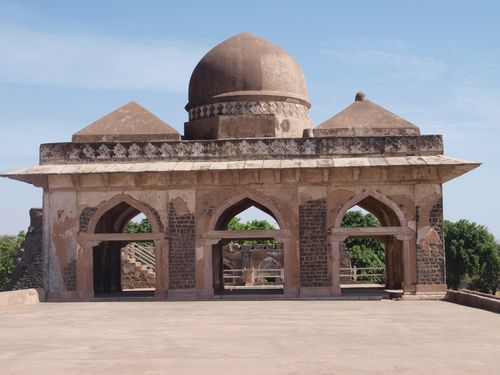
Mandu • Jahaz Mahal
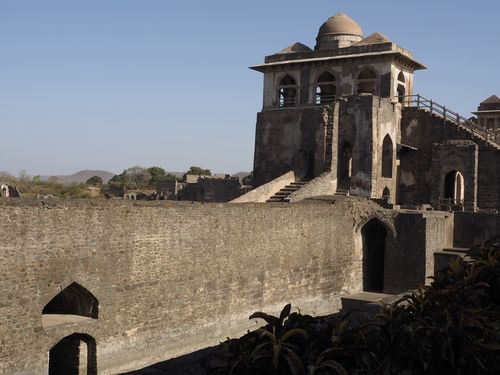
Mandu • Jahaz Mahal
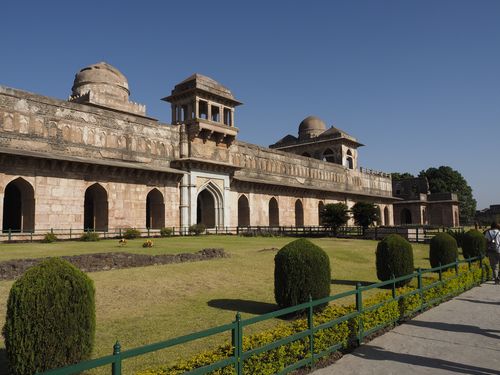
Mandu • Jahaz Mahal
Monument profile
Jahaz Mahal
Monument category: Palace
Monument family: Palace and Annexes
Monument genre: Residential
Cultural heritage: Islamic
Geographic location: Mandu • Madhya Pradesh • India
Construction period: 15th century AD
• Links to •
• Dynasties that contributed to the construction of the monument •

• List of videos about Mandu on this site •
Mandu, ghost capital • Madhya Pradesh, India
History of the Jahaz Mahal in Mandu
Political and social context of construction
The Jahaz Mahal was built in the late fifteenth century, when Mandu served as the capital of the Sultanate of Malwa. This regional Islamic state emerged from the gradual weakening of the Delhi Sultanate and established itself as an independent political power in central India. Mandu’s location on a fortified plateau offered strong defensive advantages while also controlling important commercial routes linking northern India with the Deccan. In this context, monumental architecture played a central role in asserting political authority, dynastic legitimacy, and courtly refinement.
The Jahaz Mahal is generally associated with the reign of Sultan Ghiyath al-Din Khalji, a ruler known for transforming Mandu into a city of palaces, gardens, and waterworks. Unlike administrative halls or fortifications, this monument was conceived as a residential and leisure pavilion. Its function was closely tied to the life of the royal court, particularly the accommodation of the sultan and members of the harem. The building thus reflects social hierarchies and courtly customs, where architecture served to structure space according to rank, privacy, and ceremonial display.
Politically, the construction of such a refined palatial structure was also a statement of confidence. Malwa faced persistent rivalry from neighboring powers, notably the Sultanate of Gujarat, as well as tensions with Rajput kingdoms. By investing in luxurious architecture, the ruling elite demonstrated stability, prosperity, and cultural sophistication, reinforcing Mandu’s image as a legitimate and enduring capital.
Dynastic ambitions and symbolic meaning
Under the Khalji rulers of Malwa, architecture became a primary instrument for expressing dynastic ambition. The Jahaz Mahal formed part of a larger program that included audience halls, mosques, tombs, and pleasure pavilions, all integrated into a carefully planned urban landscape. Its distinctive elongated form, evoking the image of a ship, contributed to its symbolic value and visual prominence.
The setting of the monument between two large artificial water tanks was not accidental. Control of water resources was a key indicator of sovereign power in pre-modern India. The ability to create reservoirs, regulate water levels, and integrate them into palace architecture demonstrated technical expertise and administrative capacity. The Jahaz Mahal thus combined symbolism and practicality: it offered comfort and leisure while simultaneously embodying the authority of the ruler who commissioned it.
Major historical events and political change
The Jahaz Mahal enjoyed its primary period of use during the height of Mandu’s political importance. However, the fortunes of the city changed rapidly in the early sixteenth century. Internal conflicts weakened the Khalji dynasty, making Malwa vulnerable to external aggression. In 1531, the Sultanate of Gujarat invaded and captured Mandu, marking a decisive break in the city’s political trajectory.
Following this conquest, Malwa was eventually absorbed into the Mughal Empire. Under Mughal rule, administrative priorities shifted, and Mandu lost its role as a regional capital. The Jahaz Mahal, designed for courtly residence rather than administration or defense, no longer held strategic importance. It was not destroyed, but its function diminished significantly, leading to reduced maintenance and gradual abandonment.
During subsequent centuries, including periods of Maratha control, Mandu remained peripheral to major political developments. This marginalization contributed to the survival of monuments like the Jahaz Mahal, which were spared large-scale reconstruction or adaptation. Instead, the building entered a long phase of decline marked by natural deterioration rather than deliberate alteration.
Global context at the time of construction
The late fifteenth century was a period of widespread monumental building across many parts of the world. In the Islamic world, royal courts invested in palaces and garden complexes that emphasized leisure, water, and visual harmony. In the Ottoman Empire, Safavid Iran, and parts of Central Asia, similar architectural principles were being explored, combining residential comfort with symbolic display.
In Europe, the same period saw the transformation of medieval castles into Renaissance palaces, reflecting changing notions of power, luxury, and courtly life. Although developed independently, these global trends reveal shared priorities: the desire to express authority through architecture, the integration of landscape and built form, and the use of monumental residences as tools of political communication. The Jahaz Mahal fits within this broader pattern, representing a regional interpretation of a global phenomenon.
Transformations and later use
Architecturally, the Jahaz Mahal underwent relatively few structural modifications after its initial phase of use. The decline of Mandu as a political center meant that the building was not adapted to new administrative or residential functions. Instead, it suffered from gradual decay caused by exposure to climate, water infiltration, and vegetation growth.
During the colonial period, British officials and scholars began to document Mandu as a historic site. The Jahaz Mahal attracted particular attention because of its unusual form and dramatic setting. Early conservation efforts focused on clearing debris and stabilizing vulnerable sections of the structure. These interventions aimed to preserve the monument as a historical artifact rather than restore it to active use, shaping its current appearance as a picturesque ruin.
Changing urban context
The transformation of Mandu from a bustling capital into a sparsely populated heritage landscape altered the relationship between the Jahaz Mahal and its surroundings. Once embedded in a vibrant courtly environment, the monument became increasingly isolated as urban life receded. This shift enhanced its visual impact, allowing the building to be appreciated as a standalone landmark within a broader archaeological setting.
The presence of the water tanks, which originally supported daily life and ceremonial functions, now contributes primarily to the aesthetic and symbolic reading of the site. The Jahaz Mahal’s identity has thus evolved from functional palace to emblem of historical memory.
Contemporary role and cultural significance
Today, the Jahaz Mahal is regarded as one of the most iconic monuments of Mandu. It plays a central role in shaping the city’s cultural identity and is a key reference point for understanding the history of the Malwa Sultanate. Although it no longer serves residential or political purposes, it functions as a site of historical interpretation and cultural tourism.
At the national level, the monument contributes to a broader appreciation of India’s regional sultanates and their architectural legacy. While it is not associated with ongoing religious or social rituals, its presence underpins educational initiatives and heritage awareness, linking local history to national narratives.
Conservation challenges and heritage status
The preservation of the Jahaz Mahal presents several challenges. Its close relationship with water exposes lower structures to moisture-related deterioration, while open terraces and upper levels are vulnerable to weathering. Tourism adds pressure through foot traffic and the need for visitor facilities, requiring careful management to balance access and protection.
Conservation policies implemented by Indian heritage authorities emphasize minimal intervention, structural stabilization, and environmental management. Mandu’s inclusion on India’s tentative list for World Heritage nomination highlights the international significance of the site. In this context, the Jahaz Mahal stands as a crucial element within a larger ensemble of monuments whose preservation is essential for understanding the political, social, and cultural history of central India.
Architecture of the Jahaz Mahal (Mandu, Madhya Pradesh)
A palatial pavilion defined by landscape and water
Jahaz Mahal represents a distinctive form of palatial architecture within the monumental landscape of Mandu. Unlike administrative halls or fortified structures designed around a dominant enclosed volume, it functions as an elongated pavilion conceived in direct relationship with its surroundings. Its architectural identity is inseparable from the two large artificial water tanks between which it was constructed. The building’s length, symmetry, and low horizontal profile produce the impression of a structure suspended between water surfaces, an effect that later gave rise to its well-known “ship palace” designation.
Within the architectural culture of the Malwa Sultanate, Jahaz Mahal belongs to a category of courtly buildings associated with residence, leisure, and controlled display rather than governance or defense. Its design emphasizes openness, movement, and visual continuity, reflecting a conception of architecture as a mediator between built form, landscape, and climate.
Technological and architectural innovations
One of the principal architectural achievements of Jahaz Mahal lies in its integration of environmental considerations into the overall design. The placement of the building between water bodies is not purely symbolic; it contributes directly to thermal moderation through evaporative cooling. Air passing over the tanks enters the building through arcaded galleries and openings, reducing interior temperatures during warmer periods. This approach exemplifies a passive climatic strategy based on urban planning rather than mechanical intervention.
Structurally, the monument demonstrates a sophisticated use of modular repetition. The long elevation is articulated by a regular sequence of bays, arches, and piers, ensuring that loads are distributed evenly along the structure. This repetitive logic allows the building to extend over a considerable length without relying on large singular spans or massive vertical supports. Stability is achieved through continuity and rhythm rather than concentration of force.
Vertical organization also plays an important role. Jahaz Mahal is composed of a solid lower level and more open upper zones, including terraces and pavilions. These upper spaces expand usable area while improving ventilation and offering elevated viewpoints. Roof terraces, in particular, functioned as active architectural surfaces, accommodating circulation and leisure while capturing breezes unavailable at ground level.
Materials and construction techniques
The building is primarily constructed of locally sourced stone assembled in thick masonry walls and bonded with lime-based mortar. Stone offered durability and compressive strength suitable for a multi-level structure exposed to moisture from adjacent tanks and seasonal monsoon rains. Lime mortar, more flexible than modern cement, allowed the masonry to accommodate thermal movement and moisture exchange without excessive cracking.
Construction followed a clear hierarchy of mass. The lower levels employ heavier masonry and deeper recesses, forming a stable base resistant to water exposure. Upper levels, though still largely stone-built, incorporate lighter architectural elements such as kiosks, parapets, and railings. This differentiation between heavy and light zones enhances both structural performance and visual balance.
Original surfaces were likely protected by plaster or lime wash, which unified the façades and shielded stonework from direct weathering. Although much of this finish has disappeared, the underlying construction remains legible, revealing a disciplined approach to assembly and proportion.
Architectural and artistic influences
Jahaz Mahal illustrates a synthesis of regional architectural traditions and broader Indo-Islamic forms. The use of arches, arcaded corridors, and formal symmetry aligns with architectural principles shared across many sultanate courts in the Indian subcontinent. At the same time, the emphasis on terraces, roof pavilions, and open-air circulation reflects indigenous Indian concepts of elevated living and climatic adaptation.
Ornamentation is deliberately restrained. Rather than extensive surface carving or decorative excess, visual interest is created through massing, repetition, and the contrast between solid walls and deep openings. Cornices, parapets, and framing elements articulate horizontal lines, reinforcing the building’s linear identity. This measured aesthetic corresponds to the pavilion’s residential and recreational function, prioritizing comfort, movement, and visual clarity.
Spatial organization and structural layout
The plan of Jahaz Mahal is strongly linear, with rooms and corridors arranged in an extended sequence along the building’s main axis. This organization enables fluid circulation from one end of the pavilion to the other and supports varied uses without fragmenting the architectural whole. Spaces could accommodate private residence, reception, or transition, all within a continuous architectural framework.
Vertically, the structure combines enclosed lower spaces with increasingly open upper levels. Terraces act as circulation platforms and social spaces, while kiosks provide shaded observation points. The absence of domes or minarets confirms the building’s non-religious character and distinguishes it from mosques or tombs within Mandu.
Arches and recessed openings serve multiple purposes. Structurally, they distribute loads and strengthen wall sections. Environmentally, they provide shade and promote air movement. Visually, they establish a consistent rhythm that guides perception and movement through the building.
Dimensions, identity, and notable characteristics
Jahaz Mahal is notable for its exceptional length relative to its width, a proportion that reinforces its ship-like analogy. While exact measurements vary depending on surveyed boundaries, the monument extends across a narrow strip between the tanks, producing a powerful horizontal emphasis. The building comprises numerous rooms, corridors, and terraces arranged across multiple levels, creating spatial diversity within a coherent envelope.
A key characteristic of the design is its ability to generate varied experiences from a limited structural vocabulary. The repeated bay system supports shaded walkways, open terraces, and focused viewpoints without introducing structural complexity. This efficiency reflects an advanced understanding of how repetition and environment can produce architectural richness.
Architectural significance and heritage value
From an architectural perspective, Jahaz Mahal is significant as an example of palatial design that integrates landscape, water management, and built form into a unified system. It demonstrates how late medieval builders in central India addressed issues of climate, comfort, and representation through spatial planning rather than ornamental elaboration.
In comparative terms, the monument belongs to a wider tradition of pre-modern palatial environments where water plays a central role in shaping experience and meaning. Its architecture contributes to an understanding of how regional courts adapted shared architectural ideas to local conditions.
Conservation challenges and contemporary relevance
The close relationship between Jahaz Mahal and water presents ongoing conservation challenges. Prolonged exposure to moisture affects lower masonry, joints, and foundations, while monsoon cycles accelerate erosion. Upper terraces and pavilion elements are exposed to weathering and biological growth, requiring continuous monitoring.
Tourism introduces additional pressures, including surface wear and the need for access infrastructure. Conservation strategies therefore focus on structural stabilization, water management, and controlled visitor circulation. Preserving Jahaz Mahal involves maintaining not only the fabric of the building but also its environmental context, ensuring that the architectural logic linking water, landscape, and structure remains intelligible.