

 Français (France)
  Nederlands (nl-NL)
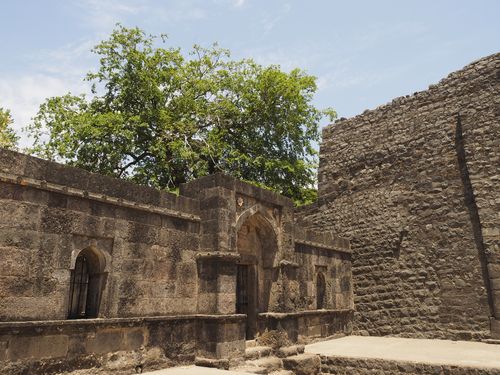
 Delhi Darwaza in Mandu is one of the principal monumental gateways providing access to the former fortified city located in the state of Madhya Pradesh. Integrated into Mandu’s extensive defensive system, the structure controlled the entry of travellers, goods, and military forces approaching the fortified plateau. Its location along major access routes reflects its strategic importance within the urban and military organization of the city. Today, the monument remains one of the most representative elements of Mandu’s network of gates and fortifications. It illustrates the defensive role of the settlement as well as the scale of the construction programs carried out during the Malwa Sultanate period.

Mandu • Delhi Darwaza

Mandu • Delhi Darwaza
Mandu • Delhi Darwaza
Monument profile
Delhi Darwaza
Monument category: Fortified gate
Monument family: Fort, Fortifications or Citadel
Monument genre: Military
Cultural heritage: Islamic
Geographic location: Mandu • Madhya Pradesh • India
Construction period: 15th century AD
• Links to •
• Dynasties that contributed to the construction of the monument •

• List of videos about Mandu on this site •
Mandu, ghost capital • Madhya Pradesh, India
Delhi Darwaza and the Defensive System of Mandu
Construction within the fortified capital
Delhi Darwaza formed one of the principal gateways of the fortified city of Mandu, established on a high plateau in the Malwa region of present-day Madhya Pradesh. The gate was integrated into the extensive defensive network developed between the fourteenth and sixteenth centuries, when Mandu became the capital of the Malwa Sultanate. Its name, meaning “Gate of Delhi,” reflects its orientation toward the northern routes linking the plateau to the regions controlled by the Delhi Sultanate and later political powers in northern India.
The construction of the gate corresponded to a period during which the rulers of Malwa strengthened the military infrastructure of their capital after progressively asserting independence from Delhi. Mandu’s natural setting already provided considerable protection through steep escarpments and elevated terrain, yet these geographical advantages were reinforced by long defensive walls, controlled entrances, bastions, and fortified passages.
Delhi Darwaza occupied a strategic position along one of the main access routes to the plateau. Any movement of armies, caravans, or official delegations approaching Mandu from the north passed through this controlled entrance. The gate therefore played an essential role in the military security of the city and in the regulation of circulation toward the capital.
Administrative and symbolic functions
The gate also functioned as an administrative checkpoint within the urban organization of Mandu. Merchants, travellers, and transport caravans entering the city could be inspected or taxed at this point. Such gateways formed part of a broader system of territorial control through which the Malwa Sultanate supervised trade routes crossing central India.
The monumental scale of Delhi Darwaza additionally conveyed political authority. The controlled progression toward the gate, combined with the fortified environment surrounding it, reinforced the image of Mandu as a powerful and protected royal capital. The route leading to the entrance was intentionally organized to slow movement and complicate direct assaults against the city’s fortifications.
During the fifteenth century, Mandu experienced periods of political expansion under the Malwa sultans, and the defensive gateways gained further importance as symbols of dynastic stability. Delhi Darwaza became one of the principal architectural markers announcing entry into the fortified capital.
Decline of Mandu and preservation of the gateway
After the incorporation of Malwa into the Mughal Empire during the sixteenth century, Mandu gradually lost much of its political centrality. Administrative functions shifted elsewhere, and several military structures ceased to receive the same level of maintenance. Although the defensive system remained partially operational for some time, the strategic importance of the fortified plateau progressively diminished.
Despite this decline, Delhi Darwaza continued to serve as a passage point for regional movement across the plateau. Its robust construction contributed to its long-term survival even as sections of the surrounding fortifications deteriorated because of weathering, vegetation growth, and reduced maintenance.
During the nineteenth and early twentieth centuries, Mandu attracted increasing archaeological and historical interest. Colonial surveys and conservation initiatives identified Delhi Darwaza as one of the major surviving elements of the fortified urban complex. Restoration and stabilization work carried out in later periods focused primarily on preserving the masonry and maintaining access through the structure.
Today, the gateway remains one of the clearest surviving testimonies to the defensive organization of Mandu during the Malwa Sultanate period. Its position along the former access routes continues to illustrate the military and administrative logic that shaped the fortified capital.
Global historical context
The principal development of Mandu’s fortifications during the fifteenth century coincided with the fragmentation of political authority in northern India after the weakening of the Delhi Sultanate. In Europe, this period corresponded to the late Middle Ages and the emergence of the Italian Renaissance. The Ottoman Empire was expanding across southeastern Europe and the eastern Mediterranean. In China, the Ming dynasty consolidated imperial authority following the great maritime expeditions of the early fifteenth century.
Defensive Layout and Architectural Structure of Delhi Darwaza in Mandu
Position within the fortified landscape of Mandu
Delhi Darwaza stands along one of the principal access routes leading to the fortified plateau of Mandu in the Malwa region of central India. The gateway forms part of an extensive defensive network composed of walls, bastions, watchpoints, fortified passages, and controlled entrances distributed across the perimeter of the plateau. Its placement takes direct advantage of the surrounding topography, where steep escarpments naturally restrict access and channel movement toward a limited number of entry points.
The approach to the gate follows an ascending route adapted to the contours of the hillside. This gradual progression toward the entrance reduced the possibility of rapid military assaults while exposing approaching groups to surveillance from elevated defensive positions. The surrounding terrain therefore functions as an integral part of the architectural composition rather than as a simple natural backdrop.
Delhi Darwaza was designed as a deeply fortified entrance rather than a single opening in a defensive wall. The monument occupies a substantial built mass extending laterally beyond the central passage. Thick walls and projecting defensive volumes create a controlled transition between the exterior route and the protected interior zone of the fortified city.
Organization of the gateway and defensive circulation
The principal entrance consists of a high arched passage constructed within a heavy masonry structure. The opening is framed by thick side walls reinforced by projecting masses resembling bastions. This arrangement protected the most vulnerable section of the fortification while allowing defenders to monitor and secure movement through the gate.
The internal passage narrows in certain sections, limiting the speed and density of circulation. Such constrictions were particularly important in fortified gateways because they reduced the effectiveness of direct charges against the entrance. Grooves and recesses visible within the masonry indicate the former presence of heavy wooden doors and additional locking systems. These gates likely operated together with metal reinforcements and transverse barriers.
The upper portions of the structure contained spaces connected to observation and defence. Elevated circulation paths along the top of the gateway allowed guards to move between defensive positions overlooking the entrance. Openings integrated into the masonry provided visual control over the access route while also creating protected positions from which the entrance could be defended.
The relationship between horizontal and vertical circulation forms an important aspect of the structure. The lower level concentrated controlled movement through the gateway itself, while upper sections remained reserved for surveillance and military use. This layered arrangement increased the defensive depth of the entrance without excessively complicating circulation for authorised travellers.
Construction techniques and structural characteristics
Delhi Darwaza was built primarily from locally quarried stone adapted to the geological conditions of the Mandu plateau. Large stone blocks form the principal structural mass of the walls, while smaller masonry elements were used to stabilize joints and internal sections. The thickness of the construction responds directly to defensive requirements, particularly resistance against impact and long-term structural stability.
The vaulted passage represents one of the key structural components of the monument. The arch transfers weight laterally toward the supporting walls, allowing the opening to span a relatively broad corridor without requiring intermediate supports. This system also increased resistance against vertical pressure from the heavy masonry above.
Retaining structures integrated into the surrounding terrain stabilize the approach to the gateway and connect the monument to adjacent defensive walls. The architectural composition therefore extends beyond the visible entrance itself and incorporates the surrounding fortification system as part of a continuous defensive framework.
The monument displays relatively restrained decorative treatment compared to palatial or religious structures in Mandu. Ornamentation is concentrated around selected architectural elements such as cornices, arch frames, parapets, and openings in the upper levels. The limited decorative program reinforces the military character of the gateway and emphasizes mass, solidity, and controlled geometry.
Spatial proportions, visual impact, and conservation
The proportions of Delhi Darwaza contribute significantly to its architectural effect. The height of the central arch, combined with the broad masonry masses surrounding it, produces a strong impression of monumentality during the approach to the gate. The structure was clearly intended not only to defend access but also to communicate authority and control over movement into the fortified capital.
The monument remains visually integrated with the surrounding landscape of cliffs, walls, and elevated defensive lines. Seen from lower terrain, the gateway appears as part of a layered fortified system extending across the plateau edge. This visual continuity reinforces the strategic logic underlying the urban organization of Mandu.
Although sections of the masonry have suffered from erosion, vegetation growth, and long-term weathering, the principal structural elements remain largely intact. Modern conservation work has focused mainly on stabilizing weakened walls, consolidating damaged masonry, and limiting water infiltration within vulnerable sections of the structure.
The survival of the principal passage, upper defensive levels, and adjacent walls continues to allow detailed architectural reading of the monument. Delhi Darwaza remains one of the clearest surviving examples of fortified gateway architecture associated with the Malwa Sultanate and the defensive planning of Mandu.