

 Français (France)
  Nederlands (nl-NL)
 Purana Qila is a historic fortress located in Delhi, within the National Capital Territory of Delhi in India. The site occupies a strategic position near the banks of the Yamuna River and represents one of the oldest fortified complexes in the city. Its massive defensive walls and monumental gateways illustrate the military and political significance of the location during several periods of Delhi’s history. Today, Purana Qila forms an extensive heritage area that includes architectural remains, defensive structures, and archaeological zones. The monument is visited by researchers, tourists, and residents interested in the historical development and urban evolution of the Indian capital.
Monument profile
Purana Qila
Monument category: Fort
Monument family: Fort, Fortifications or Citadel
Monument genre: Military
Cultural heritage: Islamic
Geographic location: Delhi • Delhi (NTC) • India
Construction period: 16th century AD
• Links to •
• Dynasties that contributed to the construction of the monument •


• List of videos about Delhi on this site •
Delhi, capital of India • Delhi, India
• References •
Wikipedia FR: Purana Qila
Wikipedia NL: Purana Qila
History of Purana Qila in Delhi
Early occupation of the site
The area occupied by Purana Qila corresponds to one of the oldest continuously inhabited zones of Delhi. Archaeological excavations conducted inside the fort have revealed multiple layers of occupation that precede the construction of the present fortifications by many centuries. Ceramic fragments, structural remains, and artefacts indicate habitation from the early historic period, including levels associated with the Painted Grey Ware culture, dated to the first millennium BCE.
These archaeological findings have led some scholars to associate the site with the ancient city of Indraprastha mentioned in early Indian literary traditions. Although the identification remains debated, the archaeological record confirms that the location formed part of an urban or proto-urban settlement long before the establishment of the medieval fortified complex.
The strategic characteristics of the terrain explain the repeated use of the area across different historical periods. The site lies close to the Yamuna River and occupies slightly elevated ground, providing access to water resources while also offering advantages for defense and settlement planning. These factors contributed to its selection as the location for a major imperial complex during the sixteenth century.
Foundation of Dinpanah under Humayun
The construction of the fortification known today as Purana Qila began during the reign of the Mughal emperor Humayun in the early sixteenth century. In 1533 Humayun initiated the construction of a new imperial city named Dinpanah, intended to serve as a political and administrative center for the expanding Mughal state.
The foundation of Dinpanah reflected the emperor’s intention to establish a stable seat of power in the Delhi region. Following the consolidation of Mughal authority after Babur’s conquest of northern India, the creation of a fortified capital allowed Humayun to project dynastic legitimacy and administrative control.
The city was planned as a fortified complex surrounded by massive defensive walls and monumental gates. Within these fortifications, the urban layout included royal residences, administrative buildings, religious structures, and open spaces that could accommodate military and ceremonial activities.
Construction progressed rapidly, but the project remained incomplete due to political developments that soon interrupted Mughal rule in northern India.
Conquest of Delhi by Sher Shah Suri
In 1540 Humayun was defeated by the Afghan leader Sher Shah Suri at the Battle of Kannauj. This defeat forced the Mughal emperor into exile and allowed Sher Shah Suri to assume control of Delhi and the surrounding territories.
After seizing the city, Sher Shah Suri occupied the partially completed fortress of Dinpanah and transformed it according to his own political objectives. He renamed the fortified city Shergarh and initiated extensive building works to reinforce the defenses and expand the complex.
The transformation included strengthening the existing fortifications and constructing new structures within the enclosure. Among the most significant buildings associated with this phase are the Qila-i-Kuhna Mosque and the octagonal pavilion known as the Sher Mandal.
These constructions illustrate Sher Shah Suri’s effort to assert his authority through monumental architecture. By reshaping the imperial complex founded by Humayun, he sought to establish a visible symbol of his own sovereignty in the capital.
Architectural and urban consolidation under the Sur dynasty
During the brief rule of the Sur dynasty, the fortified city acquired many of the features that define Purana Qila today. The defensive walls were reinforced and expanded, creating an enclosure capable of housing administrative institutions and military forces.
Sher Shah Suri’s administration used the complex not only as a fortified residence but also as an administrative center from which state authority could be exercised. The presence of monumental gates, religious structures, and royal pavilions indicates that the site functioned as both a political and ceremonial space.
Although the Sur dynasty ruled for only a short period, its architectural interventions had a lasting impact on the structure of the fort. Many of the buildings constructed during this phase remain among the most visible elements of the complex.
Return of Humayun and restoration of Mughal authority
Following the death of Sher Shah Suri in 1545, the Sur dynasty gradually weakened. Political instability within the dynasty created an opportunity for Humayun to reclaim his former territories.
In 1555 the Mughal emperor successfully recaptured Delhi and returned to the fortified complex that had originally been established under his authority. The citadel once again became a Mughal residence and administrative center.
During this period the Sher Mandal pavilion was used as an imperial library. The structure played a significant role in a dramatic event that shaped the history of the Mughal empire: in January 1556 Humayun died after falling from the steps of this building.
The emperor’s death ended his direct involvement with the complex and altered the role of the fort in the political geography of the Mughal empire.
Decline of the site’s political importance
After Humayun’s death, his successor Akbar reorganized the administrative structure of the Mughal empire and established new centers of power in other cities. Agra and later Fatehpur Sikri became the principal imperial capitals.
As a result, Purana Qila gradually lost its role as the primary residence of the Mughal court. Although the fort remained under imperial control, it no longer functioned as the central administrative seat of the empire.
The complex continued to serve secondary military and administrative purposes. The massive defensive walls and strategic location ensured that the fort retained some importance within the urban landscape of Delhi.
Transformations during later Mughal and early modern periods
During the later Mughal period, the fort remained part of the broader network of fortified structures within Delhi. However, no major architectural expansions comparable to those of the sixteenth century are known to have taken place.
The buildings constructed under Sher Shah Suri continued to dominate the architectural character of the site. Over time, some structures deteriorated while others were adapted for different functions.
The surrounding city of Delhi evolved through several phases of urban development, including the construction of new imperial complexes in other parts of the region. These developments further reduced the political importance of Purana Qila.
Use during the colonial period
In the nineteenth century, following the expansion of British colonial authority in northern India, Delhi came under the control of the British Empire. Purana Qila was incorporated into the colonial administrative and military landscape of the city.
After the uprising of 1857 and the subsequent reorganization of British rule, the fort was used for various administrative and military purposes. Some sections of the complex were adapted for storage or barracks, while other areas remained largely unused.
During this period the site began to attract attention from scholars and antiquarians interested in documenting the historical monuments of Delhi. Early surveys and descriptions contributed to the recognition of the fort as an important historical structure.
The site during the partition of India
One of the most significant episodes in the modern history of Purana Qila occurred during the partition of India in 1947. Large numbers of people were displaced by the communal violence that accompanied the creation of India and Pakistan.
The fort was temporarily used as a refugee camp to shelter individuals and families who had been forced to leave their homes. Thousands of refugees were accommodated within the enclosure during this period.
This episode introduced a new social dimension to the history of the site. The fort, originally designed as an imperial citadel, became a place of refuge during one of the most turbulent moments in the history of the Indian subcontinent.
Archaeological research and historical interpretation
In the decades following Indian independence, archaeological investigations were conducted within the fort complex in order to better understand its historical development. Excavations revealed evidence of earlier settlements beneath the Mughal-period structures.
The discovery of pottery, architectural fragments, and habitation layers confirmed that the site had been occupied long before the construction of the sixteenth-century fortifications. These findings contributed to ongoing debates regarding the relationship between Purana Qila and earlier historical settlements in Delhi.
Archaeological research also helped clarify the sequence of construction phases associated with Humayun and Sher Shah Suri, providing a more detailed understanding of how the present fort evolved.
Cultural role in contemporary Delhi
Today Purana Qila forms an important historical landmark within the urban environment of modern Delhi. The fort is open to the public and functions as a cultural and educational site where visitors can explore the remains of one of the earliest Mughal imperial complexes.
The monument plays a role in the presentation of Delhi’s historical heritage and contributes to the city’s cultural landscape. Events, exhibitions, and heritage programs occasionally take place within the enclosure.
Purana Qila also remains a significant subject of academic research, particularly in studies related to the development of Mughal architecture and the historical evolution of Delhi.
Conservation and preservation challenges
The preservation of Purana Qila requires continuous efforts due to the age of its structures and the scale of the fortifications. The defensive walls, gateways, and internal buildings are exposed to environmental factors such as weathering, vegetation growth, and urban pollution.
Conservation programs aim to stabilize the stone masonry, repair damaged sections of the walls, and protect decorative architectural elements. Archaeological areas within the enclosure also require careful management in order to preserve the stratigraphic evidence of earlier settlements.
Purana Qila is not included on the UNESCO World Heritage List, although it remains one of the most historically significant monuments in Delhi. Preservation initiatives therefore focus on maintaining the integrity of the fort while ensuring that the site remains accessible for research, education, and public visitation.
Architecture of Purana Qila in Delhi
Site layout and spatial organisation of the fortress
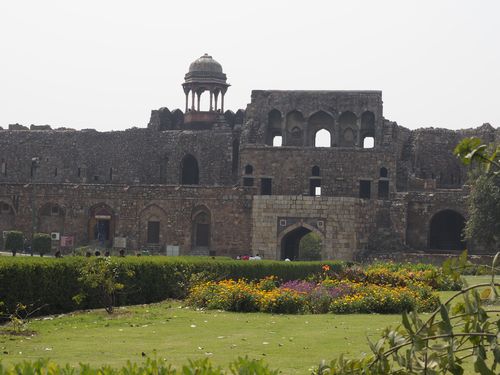
Purana Qila forms a large fortified complex located in the southeastern sector of historic Delhi, near the former course of the Yamuna River. The architectural composition of the site reflects the conception of a fortified imperial city developed during the sixteenth century. The complex occupies a broad enclosure defined by massive defensive walls that delimit a large internal area containing religious structures, pavilions, open spaces and archaeological remains.
The spatial layout of the fortress is not based on a strictly geometric plan. Instead, the irregular outline of the enclosure adapts to the natural terrain and to the strategic requirements of fortification. The perimeter of the walls extends for roughly 1.5 kilometres and encloses an area of approximately seventy hectares. This scale corresponds to the ambitions of the rulers who intended the complex to function as an administrative and residential centre.
The interior of the enclosure contains a relatively open landscape. Unlike later Mughal palace complexes organised around highly formalised gardens and courtyards, Purana Qila preserves wide open areas that once accommodated military activities, administrative structures and temporary constructions. The surviving buildings are dispersed across the interior, indicating that the complex was conceived as a fortified urban settlement rather than a single architectural composition.
The location of the fort close to the Yamuna River influenced the orientation of the walls and gates. Access to water sources was essential for sustaining a fortified city capable of resisting prolonged sieges. The proximity of the river also allowed the transport of construction materials and facilitated communication with other regions connected through river routes.
Defensive walls and structural design
The defensive walls constitute the most imposing architectural element of Purana Qila. Constructed primarily from red sandstone blocks bonded with lime mortar, the fortifications present a continuous barrier that dominates the surrounding landscape. The walls reach heights of approximately eighteen metres in some sections and are reinforced by a series of projecting bastions positioned at regular intervals.
These bastions serve both structural and defensive functions. Their semicircular or polygonal projections allow defenders to monitor the areas adjacent to the walls and to cover blind angles that might otherwise remain vulnerable during an attack. The arrangement of the bastions creates overlapping fields of surveillance along the perimeter of the fortress.
The upper portions of the walls incorporate battlements designed to protect soldiers stationed along the ramparts. These crenellations allowed defenders to fire projectiles while remaining partially shielded from enemy attacks. Narrow passages along the crest of the walls permitted rapid movement between different defensive positions.
The thickness of the walls contributes significantly to their durability. The masonry consists of carefully arranged stone blocks with rubble filling inside the core, creating a structure capable of resisting both artillery and prolonged weathering. The combination of massive stone construction and mortar binding techniques reflects the engineering practices of sixteenth-century North Indian fortification.
Monumental gateways
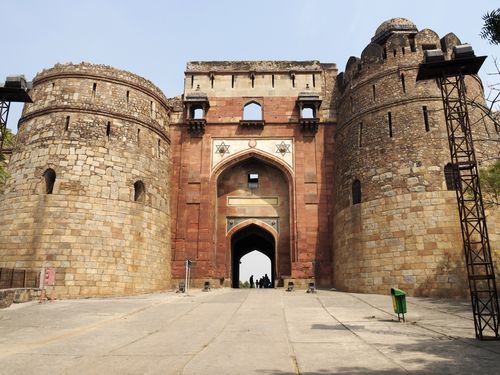
Purana Qila is accessed through three principal gateways that punctuate the fortifications. Each of these entrances combines defensive functionality with architectural display, creating imposing thresholds that controlled movement into the fortified city.
The western entrance, known as Bara Darwaza, serves as the main gateway to the fort. Its monumental scale reflects its ceremonial and administrative importance. The gateway features a large central arch framed by smaller decorative niches and recessed panels. The façade incorporates red sandstone combined with contrasting white stone inlays, producing a visually striking composition.
The southern entrance, called Humayun Darwaza, displays architectural characteristics associated with early Mughal design. The gateway structure includes multiple levels of openings and projecting balconies that overlook the approach road. Decorative bands and carved panels emphasise the vertical articulation of the façade.
The northern entrance, Talaqi Darwaza, presents a more complex architectural arrangement. The gateway includes several chambers and passageways that create a layered defensive sequence. Multiple arches guide visitors through a series of transitional spaces before reaching the interior of the fort.
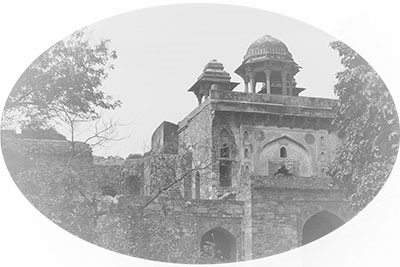
Each gateway is crowned by small pavilions that add vertical emphasis to the otherwise horizontal line of the fortifications. These structures also served as observation points from which guards could monitor activity outside the walls.
Construction materials and masonry techniques
The architecture of Purana Qila relies heavily on the use of red sandstone, a material widely employed in North Indian monumental construction during the sixteenth century. The stone was quarried in nearby regions and transported to the site for use in both structural and decorative elements.
Red sandstone provides significant structural advantages due to its durability and resistance to erosion. Its relatively uniform texture also allows precise carving, enabling architects to incorporate ornamental patterns directly into the masonry surfaces.
The masonry technique used in the construction of the walls involves large dressed stone blocks forming the exterior surfaces, while the internal core consists of rubble masonry bonded with lime mortar. This method produces thick, stable walls capable of supporting heavy loads while resisting environmental deterioration.
Lime mortar played an essential role in binding the stone blocks together. The mixture, prepared from burnt limestone and other organic additives, provided flexibility and strength to the masonry. This technique allowed the walls to absorb structural stress without cracking excessively.
Decorative elements such as carved panels, lattice screens and ornamental arches were often executed using more refined stoneworking techniques. These features demonstrate the craftsmanship of the artisans involved in the construction of the complex.
Internal spatial arrangement
The internal layout of Purana Qila reflects the functions of a fortified imperial city rather than a purely residential palace complex. Archaeological remains and historical descriptions indicate the presence of administrative buildings, residential quarters, religious structures and open courtyards.
Large open spaces occupy much of the interior area. These zones may have served as gathering grounds for troops, locations for temporary markets or venues for ceremonial events. The absence of dense building clusters suggests that many structures inside the fort were constructed from materials that have not survived.
The positioning of surviving monuments indicates that the internal organisation of the complex followed a functional logic. Religious buildings and royal pavilions were placed in prominent positions, while administrative and residential structures were distributed throughout the enclosure.
The spatial relationship between the buildings and the surrounding walls reflects a balance between defensive considerations and urban planning.
Qila-i-Kuhna Mosque
One of the most significant architectural structures within Purana Qila is the Qila-i-Kuhna Mosque. Built during the reign of Sher Shah Suri in the sixteenth century, the mosque represents an important example of transitional Indo-Islamic architecture.
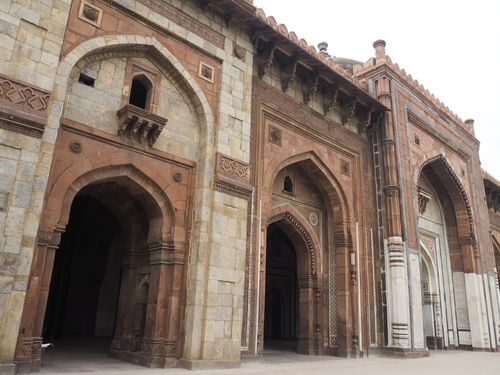
The façade of the mosque consists of five large arches arranged symmetrically across the front elevation. The central arch is considerably larger than the others, emphasising the main entrance axis and creating a hierarchical visual composition.
The building combines red sandstone with white marble decorative elements. These contrasting materials produce geometric patterns across the façade, highlighting the structural lines of the arches and framing the entrances.
Inside the mosque, the prayer hall is divided into several bays covered by domed ceilings. The qibla wall includes a richly decorated mihrab indicating the direction of Mecca. The interior decoration incorporates carved stone panels and ornamental inscriptions arranged in geometric patterns.
The proportions of the mosque demonstrate a careful balance between structural clarity and ornamental refinement.
Sher Mandal pavilion
Another prominent structure within the fort is the Sher Mandal pavilion. This building has an octagonal plan and consists of two storeys constructed entirely from red sandstone. The pavilion stands on a raised platform that accentuates its architectural prominence within the complex.
Each side of the octagon contains arched openings that allow light and air to circulate through the interior. The arches are framed by carved decorative bands that emphasise the geometric symmetry of the structure.
The upper level of the pavilion is crowned by a dome supported by a drum. The transition between the octagonal base and the circular dome is achieved through architectural elements that distribute the structural load across the walls.
The internal space of the Sher Mandal is relatively compact. Historical accounts indicate that the building was used as a library during the reign of Humayun. Its elevated position also allowed views across the interior of the fortress and the surrounding landscape.
Architectural influences
The architecture of Purana Qila reflects a combination of stylistic influences that correspond to the political transition between the late Delhi Sultanate and the early Mughal period. Structural elements such as pointed arches and large gateways display characteristics associated with Afghan architectural traditions.
Decorative motifs and proportional systems indicate the emergence of architectural ideas that would later become prominent in Mughal monuments. The integration of symmetrical compositions and carefully proportioned façades anticipates the design principles visible in later imperial buildings.
The use of pavilions above gateways represents another stylistic feature that became common in Mughal architecture. These small domed structures create a vertical accent while also functioning as observation platforms.
The coexistence of Afghan stylistic elements and early Mughal architectural tendencies makes Purana Qila a valuable example of architectural transition during the sixteenth century.
Dimensions and structural characteristics
Purana Qila occupies an area of approximately seventy hectares within its fortifications. The scale of the enclosure reflects the intention to create a fortified urban centre rather than a compact palace compound.
The defensive walls extend for about one and a half kilometres and include numerous bastions positioned along the perimeter. The height and thickness of these walls demonstrate the emphasis placed on military protection during the construction of the complex.
The gateways rise several storeys above the surrounding terrain, creating strong visual landmarks within the landscape. Their massive construction allowed them to function simultaneously as defensive barriers and ceremonial entrances.
Within the enclosure, the surviving monuments are relatively modest in size compared with the scale of the walls. Their architectural importance lies primarily in their refined design and in the quality of their stonework.
Conservation and architectural preservation
Preserving the architecture of Purana Qila presents several challenges due to the age of the structures and the size of the complex. The sandstone masonry is exposed to weathering caused by temperature variations, humidity and air pollution.
Conservation programmes focus on stabilising the walls and repairing damaged sections of the masonry. These efforts often involve replacing deteriorated mortar, reinforcing weakened stone blocks and removing vegetation that threatens the integrity of the structures.
The preservation of decorative elements requires specialised conservation techniques. Carved stone surfaces must be carefully cleaned and protected in order to prevent further deterioration.
Archaeological zones within the enclosure also require protection, as they contain evidence of earlier settlement layers that contribute to understanding the historical development of the site.
The management of visitor access forms another aspect of architectural preservation. Controlled pathways and restricted zones help limit physical wear on fragile structures while allowing the public to explore the monument.
These conservation measures aim to maintain the structural stability and historical authenticity of Purana Qila while ensuring that the architectural heritage of the fort remains accessible for future generations.