

 Français (France)
  Nederlands (nl-NL)
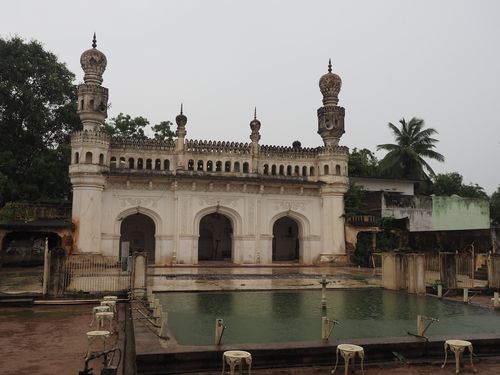
 The Paigah Tombs are a funerary complex located in Hyderabad, in the Indian state of Telangana. They contain the graves of members of the Paigah nobility, an influential aristocratic family closely associated with the rulers of the princely state of Hyderabad. The site represents an important chapter in the political and social history of the region during the eighteenth and nineteenth centuries. It consists of several mausoleums arranged within an enclosed compound, reflecting the prominent status of the family. Today, the Paigah Tombs are regarded as a significant heritage site and attract visitors interested in the history of the Deccan.

Monument profile
Paigah Tombs
Monument category: Tomb
Monument family: Tomb, Necropolis, Mausoleum or Cenotaph
Monument genre: Funerary
Cultural heritage: Islamic
Geographic location: Hyderabad • Telangana • India
Construction period: 18th century AD
• Links to •
• Dynasties that contributed to the construction of the monument •

• List of videos about Hyderabad on this site •
Hyderabad, Charminar Square and its surroundings • India, Telangana
Hyderabad, Golconda fort • India, Telangana
Hyderabad • Hidden Gems: Ashoorkhana, Chowmahalla, Bhagyalakshmi
Hyderabad, mausoleums and remarkable tombs • India, Telangana
History of the Paigah Tombs (Hyderabad, Telangana)
The Paigah Tombs form a distinguished funerary complex in Hyderabad, in the present-day Indian state of Telangana. They contain the graves of members of the Paigah family, one of the most powerful aristocratic lineages of the former princely state of Hyderabad. The history of the complex is closely tied to the political structure of the Nizamate and reflects the social hierarchy, courtly culture, and changing political circumstances of the Deccan from the eighteenth to the twentieth century.
Political and social context of the foundation
The Paigah family emerged in the eighteenth century, during a period of major political transformation in the Indian subcontinent. As the Mughal Empire declined, regional powers asserted their autonomy. In 1724, Asaf Jah I, a Mughal governor in the Deccan, established an effectively independent state with Hyderabad as its capital. This new polity required a loyal aristocracy capable of supporting the ruler both militarily and administratively.
The Paigah were among the most prominent noble families to rise in this context. Their name, which signifies rank or dignity, reflected their exceptional status within the hierarchy of the Hyderabad state. They stood immediately below the ruling Nizam in precedence and were among the few families entitled to maintain private armies and extensive estates.
The construction of the Paigah tombs must be understood within this aristocratic culture. Monumental burial complexes were a traditional way for elite families to assert their social prestige, commemorate their lineage, and demonstrate their loyalty to the ruling house. In the case of the Paigah, these tombs symbolized their proximity to power and their role as pillars of the Nizam’s administration.
The decision to build such an elaborate funerary complex was therefore both religious and political. It provided a dignified resting place for family members while simultaneously projecting the authority and continuity of the Paigah lineage. In a society structured around rank, honor, and hereditary privilege, monumental tombs functioned as architectural expressions of social hierarchy.
Development of the complex and major historical phases
The Paigah Tombs were not constructed as a single project. Instead, they developed gradually over several generations, mainly between the late eighteenth century and the early twentieth century. Each mausoleum commemorates a specific member of the family, resulting in a layered complex that reflects changing architectural tastes and political circumstances.
During the eighteenth and nineteenth centuries, Hyderabad remained one of the most important princely states in India. Although formally subordinate to the Mughal emperor, it operated with substantial autonomy. Over time, the Nizams entered into alliances with European powers, particularly the British East India Company.
By the early nineteenth century, Hyderabad had become a princely state under British protection. The Nizam retained his throne, but the state’s foreign policy and military arrangements were heavily influenced by the colonial administration. The Paigah family continued to hold prominent positions within this system, serving as generals, ministers, and administrators.
The tomb complex itself was not the scene of major battles or sieges. However, the broader political transformations of the region had indirect effects on the site. The gradual decline of aristocratic power in the late nineteenth and early twentieth centuries reduced the financial resources available for maintaining such monuments. As political authority shifted from hereditary elites to colonial and later national institutions, the symbolic role of aristocratic tombs diminished.
Global context and comparable developments
The construction of the Paigah Tombs occurred during a period of significant global change. From the eighteenth to the nineteenth century, many regions of the world experienced the consolidation of centralized states, the rise of new elites, and the transformation of aristocratic culture.
In Europe, the same period saw the construction of grand mausoleums, family chapels, and memorial monuments by noble families seeking to assert their lineage and social standing. In the Islamic world, monumental tombs had long been a symbol of political and spiritual authority, from Ottoman imperial mausoleums to Safavid and Mughal funerary complexes.
The Paigah Tombs can thus be understood as part of a broader global tradition in which architecture served as a medium for commemorating elite families. Their construction reflects the persistence of aristocratic culture in the Deccan even as political conditions changed under colonial influence.
The cosmopolitan character of Hyderabad also played a role. The city was a major cultural center, where Persian, Central Asian, Indian, and European influences coexisted. The Paigah family, like other nobles of the court, participated in this cosmopolitan environment, which is reflected in the architectural language of their tombs.
Transformations over time
As the Paigah family continued to play a central role in the administration of Hyderabad, new tombs were added to the complex. This gradual expansion transformed the site into a family necropolis, where successive generations were commemorated.
The most significant political transformation occurred after India gained independence in 1947. The princely state of Hyderabad initially remained outside the Indian Union, but in 1948 it was integrated through military action. This marked the end of the Nizam’s sovereignty and the dissolution of the aristocratic political order.
With the decline of the princely system, the Paigah family lost its political influence. The tomb complex, no longer supported by aristocratic patronage, entered a period of neglect. Some structures deteriorated due to lack of maintenance, while the expanding city gradually surrounded the site.
In the later twentieth century, awareness of the monument’s historical and artistic value led to renewed interest in its preservation. Government agencies and heritage organizations began restoration efforts aimed at stabilizing the structures and preserving their decorative elements.
Cultural role and contemporary perception
Today, the Paigah Tombs are regarded as an important part of Hyderabad’s cultural heritage. They represent the memory of a powerful aristocratic family and the social structure of the princely state.
The complex is primarily used as a heritage site and attracts visitors interested in the history of Hyderabad and the Deccan. It also serves as a visual reminder of the city’s aristocratic past, when noble families played a central role in governance and cultural life.
Although the tombs were originally built for religious and commemorative purposes, they do not function as major pilgrimage sites. Instead, they are valued mainly for their historical and architectural significance.
In the collective memory of the city, the Paigah Tombs symbolize a period of courtly refinement, aristocratic patronage, and social hierarchy. They complement other monuments of Hyderabad that reflect different phases of its political and cultural development.
Conservation status and modern challenges
The Paigah Tombs are now protected as a heritage monument under the authority of the Archaeological Survey of India. Conservation efforts have focused on stabilizing the structures, repairing damaged stonework, and restoring decorative elements.
However, the site faces several challenges. Rapid urbanization around Hyderabad has brought dense residential and commercial development close to the complex. Pollution, moisture, and vegetation growth contribute to the deterioration of stone and plaster surfaces.
The delicate carved screens and ornamental details are particularly vulnerable to environmental damage and mechanical impact. Limited financial resources and administrative complexities also affect the pace and scope of restoration work.
Conservation policies aim to balance public access with the need to protect the fragile structures. Efforts include controlled visitor routes, periodic maintenance, and documentation of the decorative features.
Despite these challenges, the Paigah Tombs remain one of the most significant aristocratic funerary complexes in southern India. Their historical evolution reflects the rise, prominence, and eventual decline of a noble lineage closely associated with the political history of Hyderabad.
Architecture of the Paigah Tombs (Hyderabad, Telangana)
The Paigah Tombs form a distinguished funerary complex in Hyderabad, representing one of the most refined expressions of aristocratic architecture in the Deccan during the eighteenth and nineteenth centuries. Built for members of the Paigah family, one of the highest-ranking noble lineages under the Nizams of Hyderabad, the complex reflects a combination of courtly prestige, regional traditions, and cosmopolitan artistic influences. The architectural ensemble stands out for its delicate stone screens, refined proportions, and synthesis of stylistic elements drawn from various cultural contexts.
General layout and spatial organization
The Paigah Tombs are arranged within a walled enclosure, forming a compact necropolis composed of several individual mausoleums. Each structure corresponds to a member of the Paigah family, and the complex developed gradually over generations rather than as a single planned monument.
The tombs are distributed around open courtyards, with pathways linking the different structures. This arrangement reflects both practical and symbolic considerations. The enclosed space creates a controlled and secluded funerary environment, while the separation of individual mausoleums preserves the identity and rank of each deceased noble.
Most tombs follow a square or rectangular ground plan. The central chamber houses the cenotaph, while the surrounding space is often articulated by arcades, verandas, or open corridors. These transitional zones create a gradual movement from the exterior courtyard to the sacred interior, a characteristic feature of many Islamic funerary structures.
Materials and construction techniques
The principal materials used in the Paigah Tombs are locally available limestone and stucco, combined with finely carved stone elements. The structural walls are generally built with dressed stone blocks bonded with lime mortar. These walls provide a solid base for the superstructures, which include domes, parapets, and decorative screens.
One of the most distinctive features of the complex is the extensive use of perforated stone screens, or jalis. These are carved from single slabs of stone, forming intricate geometric and floral patterns. The precision required to create such screens indicates a high level of craftsmanship and technical expertise.
The use of lime plaster and stucco allowed builders to create detailed ornamental surfaces. These materials were suitable for producing fine reliefs and decorative motifs, while also providing a protective coating for the underlying masonry.
Technological and architectural innovations
Although the tombs do not incorporate large-scale engineering systems comparable to major fortifications, they demonstrate refined architectural solutions in terms of ventilation, light, and structural balance. The perforated stone screens serve both decorative and functional purposes. They allow filtered light and air to enter the interior spaces, creating a cooler and more comfortable environment while maintaining privacy and sanctity.
The domed roofs are carefully proportioned to distribute weight evenly across the supporting walls and arches. The use of symmetrical plans and balanced elevations contributes to the structural stability of the buildings. Arched openings and arcaded galleries help reduce the load on the walls and create open transitional spaces.
In some tombs, the superstructures include layered or stepped forms, combining flat roofs with smaller domed elements. This approach reflects an adaptation of traditional Islamic architectural forms to local building practices.
Architectural influences and stylistic synthesis
The architecture of the Paigah Tombs illustrates a fusion of multiple stylistic traditions. The overall layout and use of domed chambers derive from Islamic funerary architecture, which had been established in the Deccan since the period of the Bahmani and Qutb Shahi sultanates.
However, the decorative vocabulary shows influences from a wider range of sources. Geometric patterns and arabesque motifs reflect Persian and Central Asian traditions. Some ornamental elements, including stylized floral patterns and certain forms of latticework, display affinities with Mughal aesthetics.
At the same time, local Deccan traditions are evident in the use of specific stone types, the treatment of surfaces, and the integration of structural and decorative elements. In certain tombs, one can observe forms reminiscent of Rajput or even European decorative motifs, reflecting the cosmopolitan environment of Hyderabad in the nineteenth century.
The combination of these influences results in an architectural language that is both eclectic and harmonious. Rather than imitating a single tradition, the tombs express the cultural diversity of the courtly environment in which they were built.
Structural elements and notable design features
Each tomb generally consists of a central domed chamber, often raised on a platform. The cenotaph is placed within this chamber, while the actual grave lies below, in accordance with Islamic funerary practices.
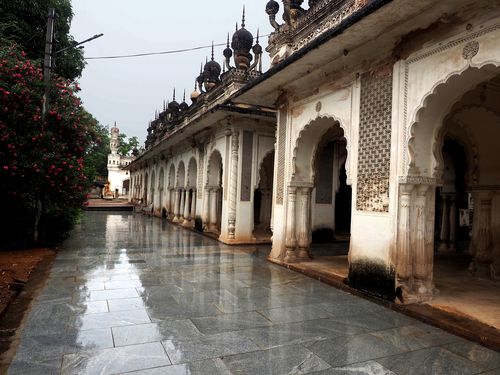
The exterior elevations are characterized by arcaded openings, parapets, and ornamental screens. In many cases, the walls are almost entirely composed of intricately carved jalis, giving the structures a light and delicate appearance despite their solid masonry cores.
Some tombs feature corner pavilions or small domed kiosks, which enhance the vertical profile of the building. The domes themselves vary in shape, from simple hemispherical forms to slightly elongated or ribbed profiles.
Balustrades, cornices, and carved panels add further visual richness. Although the scale of each individual tomb is relatively modest, the density and refinement of the decorative work create a strong visual impact.
Dimensions and notable characteristics
The Paigah Tomb complex contains several mausoleums of varying sizes. The largest tombs occupy central positions within the enclosure and feature more elaborate domes and decorative programs. Smaller tombs, often built later, are simpler in form but maintain the same architectural vocabulary.
One of the most remarkable aspects of the complex is the fineness of the stone carving. Some jali screens are so delicately carved that they appear almost lace-like, with extremely thin stone elements forming complex geometric compositions.
Another notable feature is the diversity of designs within a relatively small area. Each tomb displays distinct decorative patterns and structural details, reflecting the individual preferences and status of the person commemorated.
Conservation status and architectural significance
The Paigah Tombs are recognized as an important example of aristocratic funerary architecture in the Deccan. Their architectural significance lies in the quality of craftsmanship, the refinement of decorative elements, and the synthesis of multiple stylistic traditions.
The complex is protected as a heritage monument, and conservation efforts have been undertaken to stabilize the structures and restore damaged elements. However, the preservation of the tombs presents several challenges.
The delicate stone screens are particularly vulnerable to weathering, pollution, and mechanical damage. Urban expansion around the site has also increased environmental pressures, including vibrations, humidity changes, and air pollution.
Restoration programs focus on cleaning the stone surfaces, reinforcing weakened structures, and preventing further deterioration of the decorative elements. These efforts aim to preserve both the structural integrity and the artistic character of the complex.
Architectural legacy
The Paigah Tombs represent a refined phase in the evolution of funerary architecture in Hyderabad. Unlike the grand royal mausoleums of earlier periods, they reflect the aspirations of a powerful aristocratic family operating within a princely state influenced by both Islamic and European cultural currents.
Their architecture demonstrates how local craftsmanship and cosmopolitan influences could be combined to produce a distinctive visual language. The complex stands as a testament to the artistic ambitions and social prestige of the Paigah nobility, and as an important example of late aristocratic architecture in the Deccan.