

 Français (France)
  Nederlands (nl-NL)
 The Bolo Khaouz Mosque, located in Bukhara, is one of the city’s most iconic religious landmarks. Built in the early 18th century during the Ashtarkhanid dynasty, it was part of a larger complex that included a pond for ablutions, a minaret, and auxiliary structures. Designed to host Friday prayers, it reflects the spiritual and social importance of religion in Bukhara’s urban life. Its balanced proportions and the wooden colonnade of the entrance hall illustrate the refined craftsmanship characteristic of Uzbek architecture. Still functioning as a place of worship, the mosque also serves as an important cultural site for understanding the Islamic heritage of Central Asia.
Monument profile
Bolo Khaouz mosque
Monument category: Mosque
Monument family: Mosque, Minaret or Madrasa
Monument genre: Religious
Cultural heritage: Islamic
Geographic location: Bukhara • Uzbekistan
Construction period: 18th century AD
This monument in Bukhara is inscribed on the UNESCO World Heritage List since 1993 and is part of the serial property "Historic Centre of Bukhara".See the UNESCO monuments featured on this site
• Links to •
• This monument illustrates the following theme •
Architecture • Mausoleums : Muslim Mausoleums
• List of videos about Bukhara on this site •
Bukhara, oasis on the silk road • Uzbekistan
• References •
Asian HIsgtorical Architecture: Bolo Hauz Mosque, Bukhara, Uzbekistan
Wikipedia EN: Bolo Haouz Mosque
UNESCO: Historic Centre of Bukhara
History of the Bolo Khaouz Mosque, Bukhara
The Bolo Khaouz Mosque, located on the Registan square opposite the Ark Citadel of Bukhara, stands as one of the most elegant and enduring monuments of Islamic architecture in Central Asia. Built in the early 18th century, it represents a turning point in the city’s religious and political life, symbolizing both the authority of the Emir and the deep spiritual traditions of the region. Its history reflects the evolution of Bukhara itself — from a powerful emirate to a cultural center of the Islamic world, then a Soviet protectorate, and finally a UNESCO-listed heritage city in independent Uzbekistan.
Political and Social Context of Construction
The Bolo Khaouz Mosque was commissioned in 1712 during the rule of Abu’l-Fayz Khan, a ruler of the Ashtarkhanid (Janid) dynasty, which governed Bukhara between the late 16th and mid-18th centuries. This dynasty emerged in the aftermath of the Shaybanid period and sought to reaffirm its legitimacy by continuing the cultural and religious patronage that had long characterized the region. The early 18th century was a time of internal instability: political authority was weakening, and the emirate faced pressures from tribal alliances and the economic decline of Silk Road trade routes.
In this context, the construction of Bolo Khaouz — a congregational Friday mosque built directly across from the royal Ark fortress — had an explicit political function. It asserted the divine right and public piety of the khan’s rule, serving as a visible counterpart to the seat of temporal power. The mosque’s proximity to the Ark symbolized the unity between religious and political authority in an Islamic state, while its accessibility to the people demonstrated the ruler’s role as both spiritual and civic leader.
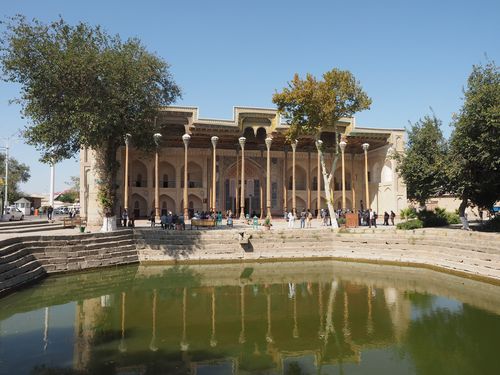
The name “Bolo Khaouz” — literally “above the pond” — refers to the rectangular water basin located in front of the mosque. This feature, typical of Bukhara’s urban design, not only served ritual and climatic purposes but also created a space of social gathering that linked the mosque to the daily life of the city.
Historical Events and Dynastic Changes
Over the course of its existence, the mosque has witnessed multiple phases of transformation reflecting the broader history of Bukhara. Following the fall of the Ashtarkhanids, the Manghit dynasty came to power in the mid-18th century and established the Emirate of Bukhara as an autonomous polity. The mosque continued to serve as a place of Friday prayer for the emirs and the population alike.
In the 19th century, under Emir Shahmurad (r. 1785–1800) and his successors, Bukhara experienced a revival of religious construction and restoration projects, reinforcing the city’s image as a bastion of Islamic scholarship. The Bolo Khaouz Mosque remained an active ceremonial site, frequently used for public prayers attended by the emir himself. Its elevated spiritual status made it an integral part of the emir’s public persona as both ruler and believer.
During the Russian imperial expansion into Central Asia in the late 19th century, Bukhara was transformed into a protectorate (1873). While the emir retained nominal power, modernization pressures and limited Russian influence began to reshape the city. The mosque survived this period largely intact, maintaining its traditional functions even as new administrative and educational structures emerged around it.
The 20th century brought profound changes. In 1914–1917, the mosque underwent major restoration work, including the addition of its most iconic feature: the twenty slender wooden columns supporting a painted summer portico (iwan). This restoration blended traditional craftsmanship with emerging stylistic trends of the time, symbolizing both continuity and renewal on the eve of Soviet domination.
Under Soviet rule, religious practice was heavily restricted. Many mosques were closed or repurposed, and religious leaders were persecuted. While the Bolo Khaouz Mosque faced periods of neglect, it was spared from destruction, likely due to its historical and architectural significance. It stood as a silent witness to the city’s transformation during the Soviet period, occasionally used for non-religious community functions.
Global Context and Comparative Perspective
The early 18th century marked a transitional era in Islamic architecture across Eurasia. In the Ottoman Empire, monumental mosques such as the Yeni Valide Mosque in Istanbul reflected a synthesis of classical and baroque influences. In Persia and Mughal India, architectural creativity was still flourishing, with buildings combining geometric precision, color, and monumental design.
The Bolo Khaouz Mosque, while more modest in scale, belongs to this broader cultural current. Its design reconciles the functionalism of Central Asian religious architecture — with separate spaces for summer and winter prayer — and the aesthetic refinement of earlier Timurid and Safavid traditions. The integration of a water basin as a focal point of urban and religious life also aligns with Islamic architectural concepts emphasizing purity, reflection, and harmony between built and natural environments.
Transformations, Decline, and Restoration
Throughout its three centuries of existence, the mosque has undergone several transformations. The wooden portico added in the early 20th century became its defining visual element. The minaret, constructed in 1917, completed the composition of the site. These additions not only enhanced its beauty but also adapted the mosque to changing liturgical and social needs.
During the Soviet era, the building’s maintenance was inconsistent. Exposure to harsh climate variations — freezing winters and arid summers — damaged the wooden structures and mural decorations. Restoration campaigns initiated in the 1970s and intensified after Uzbekistan’s independence in 1991 sought to stabilize and rehabilitate the monument using traditional materials and techniques.
In recent decades, conservation efforts have focused on the delicate painted ceilings, the preservation of the twenty wooden columns, and the stabilization of the foundation surrounding the hauz (pond). These initiatives were carried out under the supervision of Uzbek and international heritage organizations, in line with the site’s inclusion within the UNESCO World Heritage boundaries of the Historic Centre of Bukhara (listed in 1993).
Cultural Role and Contemporary Significance
Today, the Bolo Khaouz Mosque functions both as an active place of worship and as a major cultural landmark. It retains its role as a Friday mosque, welcoming the faithful from Bukhara and beyond. Its symbolic proximity to the Ark continues to embody the enduring connection between faith, governance, and community — a relationship deeply rooted in the city’s history.
For local residents, the mosque is a living monument, a space where centuries of devotion are physically and spiritually present. For visitors and scholars, it represents a unique case study in the continuity of Central Asian religious architecture from the pre-modern to the contemporary era.
The mosque also serves as an emblem of national pride. Its image frequently appears in official publications, tourism campaigns, and educational materials, highlighting its role as an icon of Uzbek heritage and Islamic identity. Annual religious celebrations, including Friday sermons during Ramadan, reinforce its centrality in the spiritual landscape of Bukhara.
Conservation Challenges and Heritage Status
The preservation of the Bolo Khaouz Mosque poses several technical and environmental challenges. The wooden columns, exposed to temperature fluctuations and humidity, require ongoing maintenance and protective treatment. The proximity of the pond, while aesthetically essential, contributes to moisture and biological degradation of nearby structures. Increasing tourism has also introduced physical and atmospheric stress to the fragile painted surfaces and wooden ceilings.
Nevertheless, the mosque benefits from the protective framework established by the UNESCO World Heritage designation of Bukhara’s historic center. Restoration projects prioritize reversible methods, minimal intervention, and the use of authentic materials. Collaborative efforts between national institutions and international experts ensure that the site remains both accessible and preserved for future generations.
Architecturally and historically, the Bolo Khaouz Mosque encapsulates the essence of Bukhara — a city where religion, art, and politics intertwine to create a built environment of profound symbolic resonance. Through its centuries-long survival, the mosque stands not only as a relic of the past but as a vibrant testament to the enduring spiritual and cultural life of Central Asia.
Architecture of the Bolo Khaouz Mosque, Bukhara
The Bolo Khaouz Mosque, built in 1712, stands as one of the finest examples of religious architecture in Bukhara and a masterpiece of Central Asian craftsmanship from the late Ashtarkhanid period. Located directly opposite the Ark Citadel, it was designed as the Emir’s Friday mosque and reflects a remarkable synthesis of functional ingenuity, ornamental refinement, and symbolic meaning. The structure’s balance between solidity and delicacy, between traditional design and evolving artistic trends, makes it one of the most distinctive monuments in the architectural landscape of Uzbekistan.
Technological and Architectural Innovations
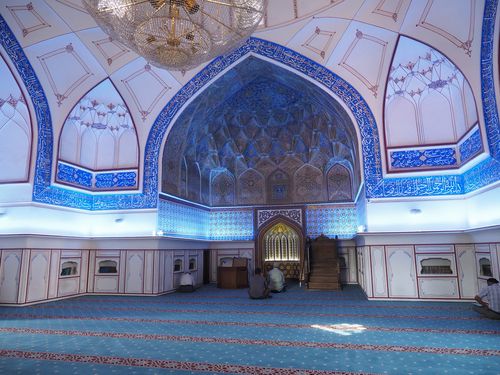
The mosque’s design embodies several technological advances typical of Central Asian religious construction in the 18th century. It integrates both climatic adaptability and ceremonial grandeur. The principal innovation lies in its dual spatial composition: a covered winter prayer hall for colder months and an open summer prayer area (iwan) supported by twenty slender wooden columns. This structural layout demonstrates an acute understanding of environmental conditions and a mastery of spatial fluidity that allowed worshippers to gather comfortably throughout the year.
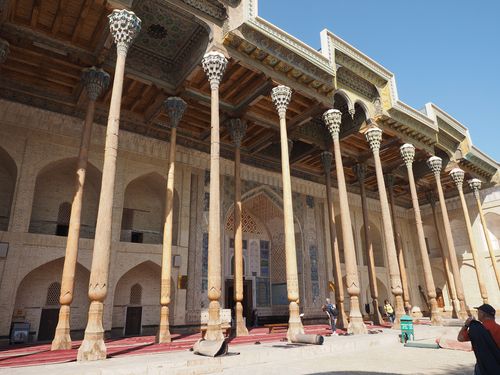
The twenty columns, reaching approximately twelve meters in height, are individually carved and arranged in five rows of four. Their alignment not only supports the vast wooden roof but also creates a rhythmic sequence that guides the eye toward the mosque’s main façade. The portico’s openness enables natural ventilation and light diffusion, minimizing heat buildup while maintaining a serene atmosphere. The entire wooden superstructure rests on a stone base, ensuring stability against ground movement and the seasonal expansion of materials—a critical adaptation to Bukhara’s dry continental climate. This use of organic flexibility combined with a rigid base reflects an advanced understanding of structural behavior long before the development of modern engineering principles.
Materials and Construction Techniques
The Bolo Khaouz Mosque was constructed using locally available materials, each chosen for its specific functional and aesthetic properties. The main prayer hall is built in fired brick, the most common building material in Central Asia, known for its durability and thermal resistance. The bricks, laid in symmetrical courses, form thick walls that moderate temperature fluctuations, keeping interiors cool in summer and warm in winter. The roof of the main hall rests on vaults and domes typical of post-Timurid masonry techniques, while the façade transitions seamlessly into the wooden portico through stone foundations and reinforced junctions.
The most striking feature of the mosque—the twenty wooden columns—was crafted from elm or poplar, woods prized for their resilience and fine grain. Each column was carved from a single trunk, then ornamented with delicate floral and geometric motifs inspired by Islamic art. The surfaces were treated with natural resins and oils to resist humidity, and the capitals were painted using the kundal technique, a polychrome and gilding method typical of Bukhara’s late medieval artistic tradition. The ceiling of the portico displays a dazzling variety of patterns: interlacing vines, eight-pointed stars, and rosettes outlined in gold. The depth of the carvings enhances the play of light and shadow, producing a visual richness that transforms the structure into a dynamic ornament rather than a static canopy.
The mosque’s hauz—the rectangular pond located in front of the building—was an integral part of its design, both practical and symbolic. The water provided a natural cooling system and a source of purification for ritual ablutions. In combination with the portico, it created a spatial dialogue between reflection, light, and symmetry, reinforcing the sense of harmony that characterizes Islamic architecture.
Artistic and Cultural Influences
Architecturally, the Bolo Khaouz Mosque reflects the intersection of multiple artistic traditions. The use of brick and dome construction traces its lineage to Timurid and Persian precedents, while the portico of wooden columns represents a distinctly local development within Central Asia. The concept of an open iwan supported by timber columns has deep roots in Uzbek and Turkmen vernacular architecture, where domestic houses and madrasas employed similar structures for summer gatherings. The integration of this vernacular form into a monumental mosque demonstrates how local craftsmanship could adapt traditional techniques for prestigious public buildings.
The decorative program of the mosque illustrates both continuity and evolution. The geometric and vegetal motifs carved into the wooden ceilings echo the symbolic vocabulary of Islamic ornamentation—endless repetition representing divine infinity. The chromatic palette of deep reds, turquoise blues, and gilded highlights connects the monument to the artistic heritage of Samarkand and Khiva while showing a restraint appropriate to a place of worship. Some decorative restorations from the early 20th century reveal the influence of Russian artisans active during the protectorate period, notably in the use of brighter pigments and stylized floral patterns that reflect a synthesis of local and imported aesthetics.
Spatial Organization and Structural Composition
The spatial layout of the mosque follows a coherent and hierarchical organization. The prayer hall, oriented toward the qibla, forms the core of the building. It is flanked by a portico that acts as an antechamber between the urban space and the sacred interior. The open colonnade forms a transitional zone between the bustling square and the meditative atmosphere of prayer. This interplay between openness and enclosure exemplifies the architectural philosophy of Islamic Bukhara, where sacred architecture often merges seamlessly with the life of the city.
The small cylindrical minaret adjacent to the mosque, added in 1917, complements the ensemble’s proportions. Though modest compared to the monumental minarets of the 12th century, such as that of the Kalyan Mosque, its elegant silhouette provides a vertical counterpoint to the horizontal rhythm of the colonnade. The alignment of the columns, pond, and minaret along a central axis establishes a compositional symmetry that enhances both visual coherence and symbolic balance.
Structurally, the mosque’s design exhibits an equilibrium between flexibility and permanence. The brick core provides mass and insulation, while the wooden portico absorbs seismic vibrations, minimizing potential damage from the region’s earthquakes. The slightly inward inclination of the columns—a subtle but deliberate feature—adds additional stability, allowing them to bear the weight of the heavy wooden ceiling without visible deformation. This structural harmony contributes to the monument’s exceptional longevity.
Dimensions, Features, and Anecdotes
The mosque occupies an area of approximately 1,200 square meters. The pond measures around 20 meters per side, and the minaret rises to a height of about 15 meters. Each of the twenty columns bears a unique carved motif, suggesting the participation of multiple master craftsmen whose individual artistry was preserved within the collective design. Local tradition holds that the shadow of the minaret falls precisely onto the pond at the hour of Friday prayer, symbolizing the unity of heaven and earth through reflection—a poetic allegory rather than an engineering reality, yet one that reveals the spiritual sensibility embedded in the monument’s conception.
Historical accounts mention that during the emirate period, the mosque was used exclusively for the ruler’s Friday prayers, accessible only to his court and religious dignitaries. This ceremonial function elevated the mosque’s status as an architectural expression of divine kingship, linking religious devotion with state authority.
Conservation and Global Significance
The architectural importance of the Bolo Khaouz Mosque lies not only in its artistic beauty but also in its technical ingenuity. It is one of the few surviving examples of a mosque combining monumental brickwork with an extensive wooden portico, a typology that once characterized much of Bukhara’s urban landscape. Its integration into the UNESCO World Heritage–listed Historic Centre of Bukhara underscores its universal value as a testament to the region’s cultural and technological achievements.
Conservation efforts have focused on stabilizing the portico’s wooden structure, restoring the painted ceilings, and reinforcing the brick foundations. The main challenges remain the effects of humidity from the nearby pond and temperature variations that threaten the wooden elements. Preventive maintenance includes periodic reapplication of natural protective coatings and structural inspections. Preservation policies emphasize minimal intervention and respect for traditional materials, ensuring that the monument retains its authenticity while remaining functional as a place of worship.
The Bolo Khaouz Mosque stands as a harmonious union of artistry, engineering, and spirituality. Its wooden columns, mirrored in the still waters of the hauz, seem to bridge the temporal and the eternal—a perfect metaphor for Bukhara itself, a city where the legacy of Islamic architecture continues to inspire both reverence and admiration.