

 Français (France)
  Nederlands (nl-NL)
 Hathi Mahal is part of the monumental heritage of Mandu, a historic fortified city in the Indian state of Madhya Pradesh known for its medieval architecture and extensive palace complexes. The structure, whose name literally means “Elephant Palace,” is recognized for its massive proportions and imposing appearance, features that contributed to its local identity over time. Located among the remains associated with the Malwa Sultanates, the monument reflects the historical importance of Mandu as a political and cultural center in central India. Today, Hathi Mahal remains an important element of the region’s architectural heritage and forms part of the wider archaeological landscape visited by travelers, historians, and cultural enthusiasts.
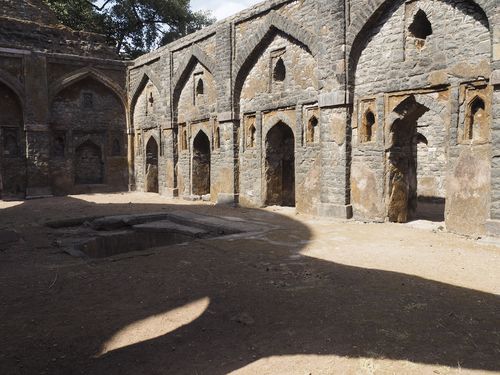
Mandu • Hathi Mahal
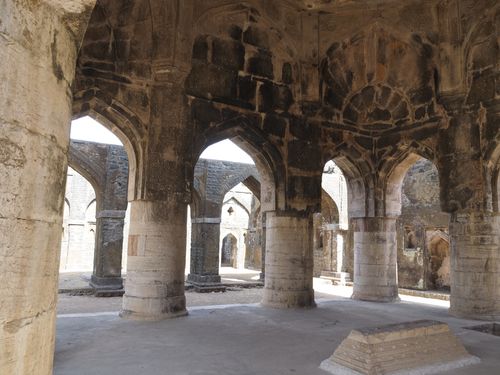
Mandu • Hathi Mahal
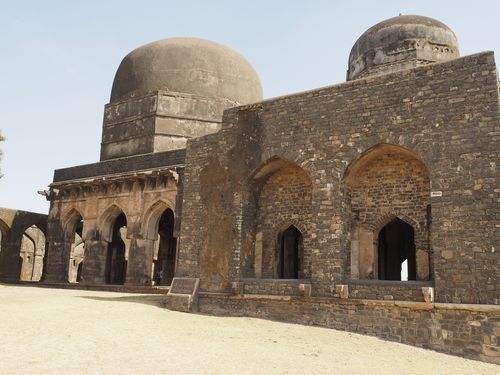
Mandu • Hathi Mahal
Monument profile
Hathi Mahal
Monument category: Palace
Monument family: Palace and Annexes
Monument genre: Residential
Cultural heritage: Islamic
Geographic location: Mandu • Madhya Pradesh • India
Construction period: 15th century AD
• Links to •
• Dynasties that contributed to the construction of the monument •

• List of videos about Mandu on this site •
Mandu, ghost capital • Madhya Pradesh, India
Hathi Mahal and the Urban Development of Mandu
Construction During the Malwa Sultanate Period
Hathi Mahal is located within the fortified city of Mandu in present-day Madhya Pradesh. The monument is generally associated with the late phase of the Malwa Sultanate, probably between the late fifteenth and early sixteenth centuries, when Mandu functioned as a major political center in central India. Its name, meaning “Elephant Palace,” derives from the heavy external buttresses and massive proportions that characterize the structure.
The building formed part of a broader architectural expansion linked to the consolidation of the Malwa rulers in Mandu. During this period, numerous palaces, administrative buildings, service structures, and residential complexes were erected across the plateau city. Hathi Mahal appears to have belonged to this administrative and residential environment rather than to the ceremonial core associated with the principal royal palaces.
The exact patron of the monument remains uncertain. Surviving historical documentation concerning the building is limited, and no detailed inscription directly identifies its founder or original function. Its architecture nevertheless suggests that it served an important institutional or residential role connected with the functioning of the court.
Administrative and Residential Functions
The monument’s layout indicates a practical rather than ceremonial purpose. Unlike audience halls or royal pleasure pavilions intended for public representation, Hathi Mahal was organized around enclosed halls and robust structural elements. The arrangement of interior spaces suggests accommodation or administrative use linked to officials or members of the ruling elite.
Its position within Mandu also reflects the urban organization of the sultanate capital. The city was divided into sectors containing military, residential, religious, and administrative structures. Hathi Mahal belonged to a built environment designed to support the daily operations of the court and the regional government.
Political changes during the sixteenth century affected the role of many buildings in Mandu. The conquest of Malwa by the Gujarat Sultanate and the later expansion of Mughal authority altered the administrative importance of the city. As political centers shifted elsewhere, several structures gradually lost their original functions. Hathi Mahal appears to have entered a phase of reduced use during this transition.
Decline and Archaeological Preservation
Following the decline of Mandu’s political significance, many parts of the city experienced partial abandonment. Hathi Mahal survived this process more successfully than some neighboring structures because of the strength of its construction. Nevertheless, sections of the monument deteriorated through prolonged exposure to weathering and the absence of regular maintenance.
During the colonial period, British administrators and early archaeological surveyors documented the ruins of Mandu, including Hathi Mahal. The monument became part of the wider effort to identify and preserve the remains of the Malwa Sultanate. Basic conservation measures were introduced to stabilize damaged masonry and prevent further structural collapse.
Today, Hathi Mahal is preserved as part of Mandu’s historical landscape under the supervision of Indian archaeological authorities. Although no longer associated with its original function, the building remains an important example of the non-ceremonial architecture that supported the operation of the medieval capital. Its massive appearance and distinctive buttressed walls continue to make it one of the recognizable monuments within the site.
Global Historical Context
The main construction phase of Hathi Mahal coincided with major political and cultural developments in other parts of the world. In Europe, the Renaissance was expanding through Italian city-states and royal courts. The Ottoman Empire consolidated its control over Constantinople after 1453 and continued its territorial expansion. In China, the Ming dynasty maintained large-scale imperial construction programs. In the Indian subcontinent, several regional sultanates coexisted before the growing dominance of the Mughal Empire during the sixteenth century.
Structural Design and Spatial Organization of Hathi Mahal in Mandu
Position Within the Urban Layout of Mandu
Hathi Mahal stands in the southern sector of Mandu, within an area containing several structures associated with the late Malwa Sultanate period. The monument occupies part of the elevated basalt plateau that defines the fortified city. Its position on relatively level ground allowed the construction of a broad rectangular building with heavy exterior supports and large enclosed interior spaces. The surrounding terrain reinforces the visual dominance of the structure, particularly because of its compact mass and limited vertical articulation.
The monument follows an elongated rectangular plan organized around a sequence of vaulted halls. It was conceived as a self-contained architectural unit rather than as an open pavilion. Exterior walls are defined by continuous masonry surfaces interrupted by pointed arches and projecting buttresses. The overall composition emphasizes structural stability more than decorative effect.
The proportions create a strong horizontal balance reinforced by the rhythm of the exterior supports. The compact arrangement suggests a practical role linked to accommodation or administrative activity rather than ceremonial display. Unlike several neighboring structures in Mandu, Hathi Mahal does not rely on terraces, courtyards, or elevated viewing platforms as major architectural features.
Masonry Techniques and Structural Stability
The building is constructed mainly from local stone masonry bonded with lime mortar. The walls are exceptionally thick in order to support the vaulted roofing system. The most distinctive feature of the monument is the series of massive sloping buttresses attached to the exterior walls. These elements absorb the lateral pressure generated by the vaults and play a central role in maintaining structural stability.
The buttresses resemble heavy elephant legs, an appearance that likely explains the name “Hathi Mahal,” or “Elephant Palace.” Their scale distinguishes the monument from many other buildings in Mandu. Rather than serving as decorative additions, they form an essential part of the load-bearing system.
Interior spaces are covered with masonry vaults built through Indo-Islamic construction techniques used in central India. The arches transfer weight toward the thick side walls and buttresses, reducing the need for numerous internal supports. This system allowed the creation of relatively open halls with broad uninterrupted floor areas.
Decorative treatment remains restrained. Architectural emphasis is placed on the geometry of arches, wall masses, and structural forms rather than carved ornamentation. Surviving surfaces indicate that the visual effect originally depended largely on proportions and the clarity of the construction.
Interior Arrangement and Architectural Elements
The interior consists of large interconnected halls aligned along a longitudinal axis. Openings between spaces are framed by pointed arches that regulate circulation while maintaining continuity between rooms. The dimensions of the halls suggest collective or institutional functions rather than compartmentalized residential use.
The limited number of interior supports demonstrates the efficiency of the perimeter load-bearing system. Thick exterior walls carry much of the structural weight, allowing wider interior spans. Ceiling heights improve ventilation and reduce heat accumulation within enclosed spaces.
Architectural detailing remains comparatively simple throughout the monument. Pillars and supports are functional rather than ornamental. Some openings preserve traces of molded stone framing, but decorative treatment remains secondary to structural organization. The contrast between solid wall surfaces and recessed arches creates visual depth without extensive carving.
Upper sections of the building have partially deteriorated, but surviving remains indicate the former existence of substantial roof structures and elevated chambers. Fragments of parapets and damaged upper masonry suggest that the monument originally possessed a more complete upper profile than survives today.
Architectural Preservation and Present Condition
The monument has gradually deteriorated since the decline of Mandu as a political center. Seasonal rainfall, vegetation growth, and long periods without systematic maintenance contributed to the loss of sections of the upper structure. Nevertheless, the principal architectural framework survives because of the strength of the masonry and the effectiveness of the buttress system.
Modern conservation work has focused mainly on structural stabilization rather than reconstruction. Damaged wall sections have been reinforced where necessary to prevent collapse, while surviving vaults have been preserved through controlled maintenance programs. Restoration work generally remains discreet, allowing the monument to retain its archaeological character.
Today, Hathi Mahal remains one of the clearest examples in Mandu of architecture based on mass, load distribution, and structural reinforcement rather than decorative complexity. Its architectural identity continues to depend on the relationship between heavy buttressed walls, vaulted interiors, and compact spatial organization.