

 Français (France)
  Nederlands (nl-NL)
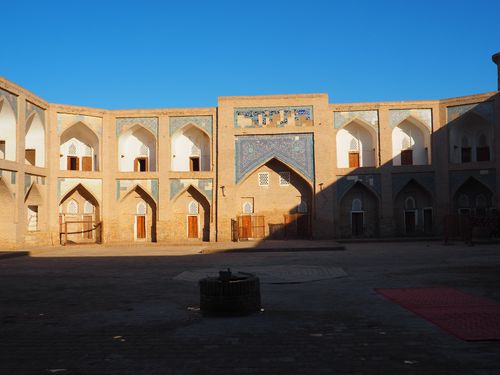
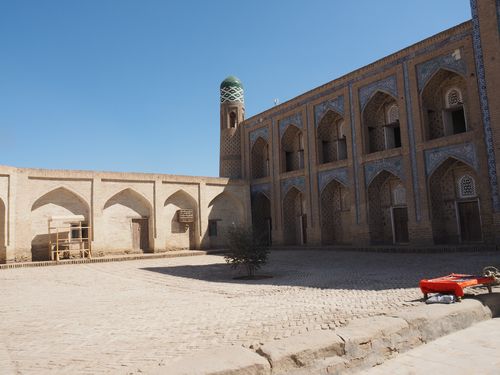
 The madrasas of Khiva, located in the historic city of Khiva in Uzbekistan, reflect the former role of the city as a prominent center for Islamic education. Built mainly between the 17th and 19th centuries, these institutions were devoted to religious and legal instruction within the Sunni tradition. They are known for their symmetrical layouts, glazed ceramic tile façades, and their integration into the urban fabric of Itchan Kala, the fortified old town recognized as a UNESCO World Heritage site. Today, some madrasas function as museums, libraries, or cultural institutions, playing an active role in preserving knowledge and highlighting Uzbek heritage.

Monument profile
Madrasas of Khiva
Monument category: Madrasa
Monument family: Mosque, Minaret or Madrasa
Monument genre: Religious
Cultural heritage: Islamic
Geographic location: Khiva • Uzbekistan
Construction period: 16th century AD
This monument in Khiva is inscribed on the UNESCO World Heritage List since 1990 and is part of the serial property "Itchan Kala".See the UNESCO monuments featured on this site
• Links to •
• List of videos about Khiva on this site •
Khiva, open-air museum • Uzbekistan (EN)
• References •
UNESCO: Itchan Kala
History of the Madrasas of Khiva
The madrasas of Khiva, located in the ancient city of Khiva in modern-day Uzbekistan, stand as a testimony to the religious, intellectual, and political aspirations of the Khorezm region between the 17th and 19th centuries. More than simple educational institutions, they were powerful symbols of dynastic legitimacy, regional prestige, and cultural continuity in Central Asia. Their emergence, decline, and transformation reflect the historical dynamics of the Khanate of Khiva, its geopolitical interactions, and its place in the wider Islamic world.
Political and Social Context of Construction
The construction of Khiva’s madrasas must be understood within the complex context of post-Timurid Central Asia. The Khanate of Khiva, established in the 16th century on the ruins of previous Turco-Mongol principalities, was one of three major Uzbek khanates, alongside Bukhara and Kokand. Located near the Amu Darya River, Khiva became a significant political and economic center, acting as both a buffer and a competitor in regional power struggles.
In this volatile environment, the rulers of Khiva used religious architecture to consolidate their rule and promote their legitimacy. By constructing madrasas, the khans affirmed their role as defenders of Sunni Islam and patrons of Islamic scholarship. These buildings were not merely functional centers of learning but also ideological instruments—part of a broader strategy to project the image of a devout and enlightened state.
The commissioning of madrasas was often linked to specific rulers. Muhammad Rahim Khan I (r. 1806–1825), Muhammad Amin Khan (r. 1845–1855), and Alla Kuli Khan (r. 1825–1842) were especially active in promoting religious education through monumental architecture. Their projects were meant to rival those of Bukhara, a more established center of Islamic learning. These efforts were not only religious but also political, aiming to create a parallel network of scholars, jurists, and officials loyal to the Khivan state.
Major Historical Events and Transformations
The madrasas of Khiva were directly affected by the region’s turbulent history. Although the city often enjoyed relative autonomy, it was occasionally besieged or threatened by rival khanates, nomadic incursions, and foreign powers. The most transformative moment came in 1873, when the Russian Empire, under General von Kaufmann, captured Khiva. Though the city remained nominally autonomous, it became a Russian protectorate.
Under Russian influence, the social role of the madrasas began to diminish. New secular institutions emerged, and the traditional clergy lost some of its former authority. Nevertheless, many madrasas continued to function until the early Soviet period.
During the Soviet era, particularly from the 1920s onward, most religious institutions were closed or repurposed. Some madrasas were used as warehouses, government offices, or even prisons. Others fell into neglect, their religious function suppressed in favor of ideological conformity. Still, the architectural integrity of many buildings remained, allowing for their eventual restoration in the post-Soviet era.
With Uzbekistan’s independence in 1991, efforts to restore national identity included the preservation and celebration of Islamic and cultural heritage. Several madrasas were renovated, with support from both local authorities and international organizations. Today, they function primarily as cultural institutions, museums, or educational centers rather than religious schools.
Global Context at the Time of Construction
The proliferation of madrasas in Khiva mirrored broader trends in the Islamic world. From the Maghreb to the Indian subcontinent, the 17th to 19th centuries were marked by the consolidation of Islamic education as a pillar of state legitimacy. In cities like Cairo, Istanbul, Isfahan, and Delhi, rulers erected religious institutions as part of monumental urban programs that combined politics, theology, and aesthetics.
Khiva’s madrasas were thus part of a global Islamic phenomenon: the assertion of cultural autonomy and religious orthodoxy through architecture. Their relative modesty in scale compared to those of larger capitals was compensated by their density, symbolic importance, and intricate design. This architectural movement also reflected the need to anchor Islam in urban centers that were increasingly threatened by external (colonial) or internal (sectarian) instability.
Structural and Functional Changes
Over the centuries, Khiva’s madrasas underwent various transformations. Architecturally, some were expanded or embellished with new portals, decorative tiles, or additional cells for students. Functionally, many were repurposed after the decline of traditional religious education.
During the Soviet era, the state’s anti-religious policies led to the closure of all madrasas. Their spaces were reallocated for secular uses—storage, administration, housing. Despite this, their architectural forms remained intact in many cases, which made their later rehabilitation possible.
In the post-independence period, a number of madrasas have been restored and integrated into the city’s cultural and touristic circuit. Others serve as spaces for exhibitions, artisan workshops, or even state-sponsored educational programs. Their place in the urban landscape has also evolved: once enclosed within a predominantly religious city, they now coexist with hotels, cafés, and craft shops, especially within the Itchan Kala historical complex.
Contemporary Role and Cultural Significance
Today, the madrasas of Khiva play a central role in shaping Uzbekistan’s historical narrative. Although they are no longer centers of Islamic instruction, they symbolize the scholarly past and religious identity of the region. They are used as venues for festivals, cultural events, and heritage exhibitions, and feature prominently in the educational content of museums and heritage tours.
These buildings are integral to the visual and symbolic identity of Khiva. They appear on guidebooks, postcards, and promotional materials, reinforcing their function as markers of national pride. While some serve ceremonial or symbolic religious functions, such as during Islamic holidays, their main significance now lies in their cultural and architectural heritage.
Their educational function, once defined by the teaching of jurisprudence, grammar, rhetoric, and theology, has been supplanted by new forms of learning. Nonetheless, the image of the madrasa as a place of knowledge continues to resonate in contemporary cultural discourse.
Conservation Status and Modern Challenges
The madrasas of Khiva benefit from their inclusion in the UNESCO World Heritage listing of the Itchan Kala, designated in 1990. This status has brought increased funding, international expertise, and legal protections. It has also enhanced public awareness of the need to preserve Central Asia’s built heritage.
However, significant conservation challenges persist. The region’s arid climate, combined with temperature extremes, poses risks to traditional materials such as adobe bricks and glazed tiles. Some buildings have suffered from inappropriate restorations, often involving the use of modern materials or techniques that compromise authenticity.
Tourism, while economically beneficial, introduces wear and tear, overuse, and the commercialization of sacred spaces. Urban development around Itchan Kala, though regulated, places pressure on the historic fabric of the city. Sustainable conservation efforts must balance tourism, education, and respect for the monument’s original functions and materials.
Local authorities, supported by international partners, have implemented training programs in traditional construction techniques and documentation methods. There is growing recognition that the long-term survival of Khiva’s madrasas depends not only on physical preservation but also on maintaining the cultural knowledge that gave rise to them.
Architecture of the Madrasas of Khiva
The madrasas of Khiva are among the most iconic architectural ensembles in Central Asia, forming an integral part of the historical core of the city known as Itchan Kala. Built primarily between the 17th and 19th centuries, these Islamic educational institutions reflect a unique synthesis of religious function, urban planning, ornamental craft, and regional technological expertise. As architectural expressions of authority, scholarship, and devotion, they stand as testaments to the cultural and aesthetic sophistication of the Khivan Khanate. Their construction illustrates not only mastery in building techniques but also the adaptation of design principles to climate, material availability, and symbolic ambition.
Technological and Architectural Innovations
The architectural design of Khiva’s madrasas embodies technical ingenuity and environmental responsiveness. Builders employed a quadrangular plan centered around an open courtyard, following a tradition that stretches back to Timurid-era educational complexes. This configuration was not only practical for organizing space but also facilitated airflow and natural lighting—critical factors in Khiva’s arid continental climate.
One of the notable architectural strategies was the use of orientation and geometry to manage light and temperature. The buildings were often aligned along east-west axes to optimize solar exposure and ventilation. Cross-ventilation was enhanced by narrow windows placed high on walls and by the courtyards themselves, which acted as thermal regulators by cooling the surrounding air. Deep porches and shaded arcades also contributed to thermal comfort and created intermediate spaces between interior and exterior environments.
In structural terms, the use of foundation beds reinforced with compacted reeds or horizontal brick layers helped counteract soil instability and reduce the risk of subsidence—a common issue in the sandy subsoil of the Khorezm oasis. Vaults and domes were constructed using interlocking brick patterns that distributed weight evenly, while muqarnas (stalactite vaulting) were introduced in portal recesses to transition gracefully between vertical and horizontal architectural elements.
Materials and Construction Methods
The materials used in the madrasas of Khiva were overwhelmingly local, selected for both availability and climatic suitability. The primary construction material was sun-dried or baked clay brick (adobe), which offered good insulation and was easy to produce. These bricks formed the structural core of walls, vaults, and domes, and were sometimes covered with layers of plaster or stucco to enhance durability and allow for painted or incised decoration.
Ceramic tilework became one of the defining features of Khiva’s religious architecture, especially during the 18th and 19th centuries. Artisans employed glazed faience tiles in tones of cobalt blue, turquoise, white, and occasionally green and yellow, applying them to façades, arches, domes, and inscription bands. These tiles were produced in kilns either locally or in regional centers such as Bukhara and Gijduvan, using techniques that required careful control of glaze composition, temperature, and design alignment.
Construction methods involved meticulous planning and sequential execution. Walls were built first, often using bonding patterns that alternated vertical and horizontal bricks for stability. Once cured, wooden beams and iron hooks were sometimes inserted to strengthen the upper portions. Tile decoration was applied either in mosaic technique (cut pieces assembled into motifs) or by covering entire surfaces with pre-molded relief tiles.
Architectural and Artistic Influences
The madrasas of Khiva represent a confluence of architectural traditions from Persia, the Timurid Empire, and local Khorezmian customs. The influence of Persian and Timurid design is evident in the symmetrical layouts, monumental portals (pishtaks), and the use of geometric and epigraphic ornamentation. However, Khivan artisans developed their own distinctive style, characterized by more compact proportions, subtler color schemes, and a greater integration of structural and decorative elements.
The decorative vocabulary of the madrasas includes floral arabesques, interlaced geometric bands, and Quranic inscriptions rendered in Kufic or Naskh script. These elements were not merely ornamental but served to reinforce the sacred function of the buildings. The calligraphic panels typically included foundation texts, religious verses, or dedications that linked the structure to its patron and theological purpose.
Khivan architectural aesthetics also included more pragmatic local features. For example, the use of latticework windows (panjara), carved wooden doors, and thick outer walls responded to both climatic and social needs, offering privacy, security, and temperature moderation.
Organization and Spatial Structure
The spatial organization of a typical Khiva madrasa followed a standardized plan, adapted to the site’s size and the builder’s resources. A large, often richly decorated portal gave access to a central courtyard, around which rooms were symmetrically arranged on one or two floors. These rooms included hujras (student cells), darskhana (lecture halls), a small mosque, storerooms, and sometimes a library.
The courtyard itself served as both a social and functional space, often paved and occasionally featuring a water basin or shade trees. The upper stories, when present, were accessed by narrow staircases built into the corners. Roofs were flat or gently domed, supported by arches or squinches. In some cases, a small minaret or cylindrical tower stood adjacent to the complex, acting both as a symbolic marker and a functional element for the call to prayer.
The portal (pishtak) was usually the most architecturally elaborate part of the complex, featuring muqarnas niches, tilework inscriptions, and tall pointed arches. It served not only as an entrance but also as a visual anchor for the surrounding streetscape.
Notable Dimensions and Anecdotes
Among Khiva’s madrasas, the Muhammad Amin Khan Madrasa (1851–1854) stands out as the largest and most ambitious. It measures approximately 72 by 60 meters and contains more than 125 cells arranged around a spacious courtyard. Its monumental façade, facing the city gate, was designed to impress visitors and demonstrate the wealth and piety of its patron.
Another significant complex is the Islam Khodja Madrasa (1908–1910), paired with one of Khiva’s tallest minarets. Though built later, it echoes classical forms while introducing slight stylistic updates, such as more colorful tile palettes and tighter spatial planning.
A local legend claims that the design of the Muhammad Amin Khan Madrasa was revealed to the khan in a dream by a holy man from Arabia, who instructed him to build a center of learning that would rival those in Cairo and Bukhara. Whether apocryphal or not, such stories reflect the symbolic importance attributed to these structures in local consciousness.
International Recognition and Conservation Challenges
The madrasas of Khiva, as part of the Itchan Kala, were inscribed as a UNESCO World Heritage Site in 1990. This recognition has helped channel attention and funding toward preservation efforts and has elevated the architectural heritage of Khiva on a global scale.
However, conservation presents ongoing challenges. Traditional materials like adobe and glazed tile are susceptible to environmental degradation, particularly in the face of climate change and increased tourism. Inappropriate restorations, especially those conducted in the mid-20th century, sometimes used cement or synthetic materials incompatible with the original fabric, leading to structural stress.
Urban development pressures, commercialization of heritage spaces, and the need for sustainable tourism infrastructure add complexity to preservation strategies. There is also the risk of turning madrasas into static museum pieces, devoid of the educational and religious life that once animated them.
Recent conservation approaches have emphasized authenticity and community involvement. Training programs for local craftsmen, documentation of traditional techniques, and careful urban planning have all contributed to the continued relevance of Khiva’s madrasas. As architectural documents of Islamic scholarship, civic ambition, and artistic ingenuity, they remain among the most important historical structures in Central Asia.