

 Français (France)
  Nederlands (nl-NL)
 The mausoleum of Tamerlane, known as Gur-e-Amir, is a prominent structure in Samarkand, Uzbekistan. Built in the late 14th century, it was initially intended for members of the Timurid royal family and later became the burial place of Tamerlane himself. This monument reflects the Islamic architectural traditions of Central Asia and later influenced the design of mausoleums in other parts of the Muslim world, particularly under the Mughal dynasty in India. Today, Gur-e-Amir is recognized for its cultural and historical significance and draws visitors interested in exploring the legacy of Central Asian empires and their artistic heritage.
Monument profile
Mausoleum of Timur, Gur-e-Amir
Monument category: Mausoleum
Monument family: Tomb, Necropolis, Mausoleum or Cenotaph
Monument genre: Funerary
Cultural heritage: Islamic
Geographic location: Samarkand • Uzbekistan
Construction period: 15th century AD
This monument in Samarkand is inscribed on the UNESCO World Heritage List since 2001 and is part of the serial property "Samarkand – Crossroad of Cultures".See the UNESCO monuments featured on this site
• Links to •
• This monument illustrates the following theme •
Architecture • Mausoleums : Muslim Mausoleums
• List of videos about Samarkand on this site •
Samarkand, the city of Amir Timur • Uzbekistan
• References •
Wikipedia FR: Gour Emir
UNESCO: Samarkand – Crossroad of Cultures
The Mausoleum of Tamerlane (Gur-e-Amir) in Samarkand: Imperial Memory and Historical Evolution
The Gur-e-Amir mausoleum, final resting place of Tamerlane (Timur), is one of the most emblematic historical monuments of Central Asia. Built at the end of the 14th century in Samarkand, present-day Uzbekistan, it stands as a symbol of imperial ambition, dynastic continuity, and architectural innovation. The history of this site reflects the broader geopolitical shifts of the region, the legacy of Timurid rule, and the cultural dynamics of the Islamic world.
Political and Social Context of Its Construction
The construction of the Gur-e-Amir was deeply embedded in the political aspirations and dynastic strategies of Tamerlane. Born in the 1330s near Shahrisabz, Timur emerged from the Chagatai Khanate’s aristocracy and forged a vast empire through conquest, diplomacy, and strategic marriages. By the late 14th century, he had established control over a territory stretching from Anatolia to northern India.
Samarqand, designated as his imperial capital, became the showcase of his power. The Gur-e-Amir was initially commissioned around 1403 not for Timur himself, but for his beloved grandson and heir apparent, Muhammad Sultan, who died prematurely during a military campaign. His unexpected death deeply affected Timur, who decided to construct a grand mausoleum to honor him. However, when Timur himself died in 1405 during a campaign to China, his body was brought back and buried there, effectively transforming the mausoleum into the dynastic tomb of the Timurid family.
The monument was thus conceived both as an expression of personal mourning and a declaration of dynastic legitimacy. In the context of internal rivalries and contested succession among Timur’s descendants, the Gur-e-Amir served as a focal point for the perpetuation of his legacy and the sacralization of the Timurid line.
Major Historical Events Affecting the Site
Over the centuries, the Gur-e-Amir has witnessed periods of both reverence and neglect, shaped by changing political regimes and historical upheavals.
Following the fragmentation of the Timurid Empire in the late 15th century, the center of political gravity shifted to Herat and then to Bukhara under the Shaybanids. Samarkand lost its status as a capital, and the maintenance of the Gur-e-Amir diminished. Nevertheless, it remained a symbolically important site for Timurid identity and cultural memory.
During the 16th and 17th centuries, the complex suffered from natural deterioration and episodes of neglect. Portions of its architectural ensemble, including the madrasa and khanaqah, fell into ruin or disappeared. The mausoleum itself was subjected to damage during local conflicts and seismic events.
Under Russian imperial rule in the 19th century, the site attracted the attention of Orientalists and early archaeologists. The first architectural surveys and photographic documentation were carried out during this period, laying the groundwork for later restoration efforts.
A particularly significant moment in the site’s history occurred in 1941 when, under Stalin’s orders, Soviet anthropologist Mikhail Gerasimov exhumed the tomb of Timur as part of a research project. According to popular legend, this act triggered a curse that coincided with the launch of the Nazi invasion of the Soviet Union three days later. While the coincidence is widely regarded as apocryphal, the story has contributed to the mausoleum’s aura and cultural significance.
In the decades that followed, especially during the Soviet era, the site underwent intermittent restoration, often with a focus on visual reconstruction rather than strict archaeological preservation. After Uzbekistan’s independence in 1991, the mausoleum was reinterpreted as a symbol of national pride, and Tamerlane’s image was rehabilitated as a foundational figure of Uzbek history.
Global Context at the Time of Construction
The Gur-e-Amir emerged in a period of intense monumental activity across Eurasia. The late 14th and early 15th centuries saw the consolidation of empires that used architecture as a tool for expressing political power and religious legitimacy.
In China, the Ming dynasty was undertaking massive urban and architectural projects, including the development of the Forbidden City. In the Islamic world, the Mamluks in Cairo and the Marinids in Morocco were building elaborate madrasas, mosques, and mausoleums. In Europe, Gothic cathedrals and civic buildings continued to rise in cities like Florence, Prague, and Paris.
The Gur-e-Amir fits into this global trend of dynastic monumentalization. As with its counterparts, it sought to fuse religious meaning with political grandeur. The structure not only served as a tomb but also stood as a message of centralized authority, cultural sophistication, and cosmopolitan ambition.
Transformations of the Monument Over Time
The architectural integrity of the mausoleum has changed over time due to a combination of neglect, partial destruction, and restoration. The original complex included a large madrasa and a khanaqah (Sufi lodge), which were destroyed or severely damaged by the 17th century. Only the core structure of the mausoleum has survived relatively intact.
The monument’s visual appearance has been reshaped during various restoration campaigns. In the Soviet period, many decorative elements were reconstructed or repainted based on historical photographs and assumptions, sometimes leading to debates about authenticity. The wooden doors, ceramic tiles, and plaster decorations have all been periodically replaced or reinforced.
The urban context has also changed significantly. Once part of a larger religious and educational district, the mausoleum now stands in a redeveloped area of modern Samarkand, surrounded by tourist infrastructure, roads, and public spaces. These developments have aimed at improving accessibility but also altered the historical setting.
Current Role and Cultural Significance
Today, the Gur-e-Amir is more than a historical site; it plays an active role in shaping national identity in Uzbekistan. Since independence, Tamerlane has been rebranded as a unifying figure — a visionary leader whose rule is portrayed as the foundation of Uzbek statehood. The mausoleum, in turn, functions as both a tourist destination and a civic monument.
While the site is no longer used for religious rites, it remains a place of symbolic pilgrimage, especially during state ceremonies or educational visits. It has been integrated into the national narrative, featuring prominently in textbooks, public art, and official discourse.
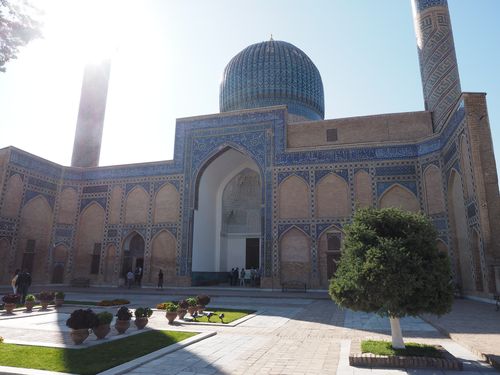
For international visitors, the Gur-e-Amir offers insight into Timurid culture and the architectural achievements of Central Asia. Its design, particularly the ribbed turquoise dome and intricate tilework, has influenced later Islamic architecture, including the mausoleums of the Mughal Empire.
State of Conservation and Preservation Challenges
The preservation of the Gur-e-Amir faces multiple challenges. The building materials — especially glazed tiles and carved stucco — are vulnerable to weathering, pollution, and temperature fluctuations. While restoration efforts have improved structural stability, concerns remain about long-term sustainability.
Tourism, though economically beneficial, exerts pressure on the site. Increased foot traffic, urban encroachment, and occasional overexposure to artificial lighting may accelerate degradation. Conservation experts must balance heritage protection with public access and urban development.
The monument was inscribed in 2001 on UNESCO’s World Heritage List as part of the Historic Centre of Samarkand, granting it international recognition and protection. This designation has facilitated access to technical support and funding, while also imposing obligations in terms of conservation standards and historical integrity.
The Architecture of the Gur-e-Amir Mausoleum: Innovation, Influence, and Dynastic Symbolism
The Gur-e-Amir, or “Tomb of the Emir,” is one of the most architecturally significant monuments in Central Asia and a foundational work in the Timurid architectural tradition. Constructed in the early 15th century in Samarkand, the mausoleum not only marks the final resting place of Tamerlane (Timur), but also serves as a model of innovation in structural design, decorative art, and symbolic spatial organization. Its legacy extends far beyond its immediate context, influencing monumental Islamic architecture for centuries, particularly in the Mughal Empire.
Technological and Architectural Innovations
The Gur-e-Amir showcases some of the most advanced architectural techniques developed in Central Asia during the late medieval period. One of the most striking innovations is the double-shell dome structure, which allowed for both grandeur in exterior appearance and structural efficiency inside. The outer dome, rising to a height of approximately 32 meters, provides visual prominence, while the inner dome, anchored on a series of muqarnas and squinches, ensures a stable transition from the square plan of the chamber to the circular base of the dome.
The dome rests on an octagonal drum, which is vertically fluted, enhancing its visual height and dynamism. Internally, a sophisticated system of arches and pendentives distributes the weight of the dome, allowing for a large, open central chamber. This approach reflects a fusion of Persian vaulting techniques with local architectural experimentation.
In terms of environmental adaptation, the structure integrates features that promote natural ventilation and temperature regulation. Openings at the upper levels of the chamber, fitted with ganch (plaster latticework), allow for air circulation while diffusing light. These passive ventilation features are particularly effective in the continental climate of Samarkand, marked by hot summers and cold winters.
Urbanistically, the mausoleum was originally part of a larger religious and educational complex, including a madrasa and a khanaqah (Sufi lodge), which together created a dynastic precinct. Though much of this ensemble has disappeared, the original layout demonstrates a thoughtful approach to sacred urban planning.
Materials and Methods of Construction
The structural core of the Gur-e-Amir is built with fired brick, the most common and durable material available in the region. The bricks, laid in thick walls, form the base of the load-bearing structure and the intricate vaults. Brick was chosen not only for its abundance and workability but also for its thermal insulation properties and resistance to seismic activity, which is common in the region.
The surfaces of the monument were originally covered in glazed ceramic tiles using the mosaic faience technique, whereby small, shaped pieces of glazed tile were assembled to create intricate calligraphic and geometric compositions. This technique, while labor-intensive, allowed for a high degree of precision and richness in color. The dominant hues—turquoise, cobalt blue, and white—evoke the heavens and contribute to the spiritual ambiance of the site.
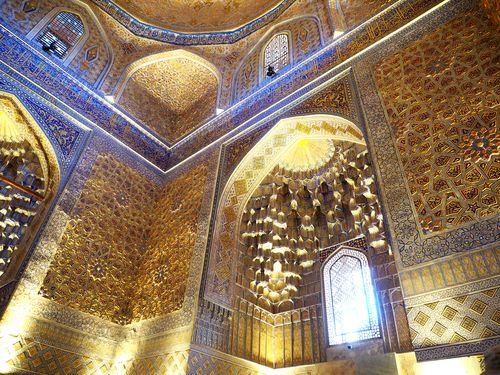
Inside, gilded and painted stucco was applied in high-relief patterns, often layered with gold leaf and pigments derived from lapis lazuli and other minerals. The interior dome was adorned with radial designs and floral motifs, creating a visual impression of divine order radiating from the center of the tomb.
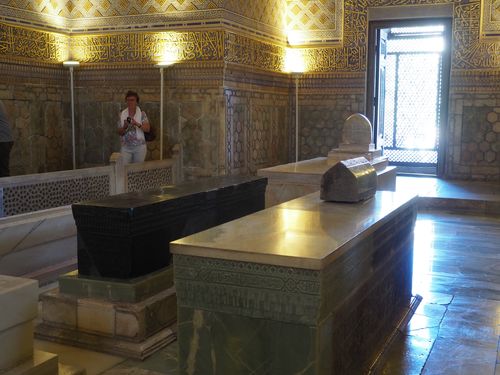
The central gravestone, believed to mark the resting place of Timur, is carved from a single block of dark jade (nephrite), likely imported from distant regions such as Mongolia or China. The use of such a rare and precious material underscores the political and symbolic importance of the site.
Architectural and Artistic Influences
The Gur-e-Amir embodies a synthesis of diverse artistic traditions, making it a quintessential example of Timurid cosmopolitanism. Its structural and decorative features draw from Persian, Mongol, and Central Asian influences, while also integrating elements from regions as far as Anatolia and the Indian subcontinent.
The layout and domed structure reflect Persian funerary architecture, especially Ilkhanid precedents such as the Dome of Soltaniyeh. At the same time, the monumental scale and emphasis on verticality reveal the Mongol legacy of imperial visibility and dominance.
Artisans from across the empire—Herat, Shiraz, Isfahan, and Tabriz—contributed to the construction, resulting in a rich exchange of techniques and motifs. This mobility of craftsmen was a hallmark of Timurid patronage, which sought to centralize cultural production in Samarkand as a manifestation of Timur’s imperial project.
The ornamentation of the Gur-e-Amir is particularly notable for its use of calligraphy, including verses from the Qur’an rendered in Thuluth and Kufic scripts, as well as floral and geometric motifs drawn from both Islamic and pre-Islamic traditions. The integration of text and image reflects the Timurid ideology, where art served both aesthetic and didactic purposes.
Organization and Structural Layout
The plan of the Gur-e-Amir centers on a large octagonal chamber crowned by the iconic dome. The entrance leads through a monumental iwan (vaulted portal) into a transitional vestibule, which opens onto the main tomb chamber. Originally, the entrance was framed by twin minarets, though these have been partially destroyed over time.
The interior space is dominated by the tombs of Timur and his descendants, arranged in a formal pattern on a raised platform. The ceiling of the dome is decorated with concentric medallions and radial motifs, creating a sense of upward movement and celestial order.
The mihrab niche, though symbolic in a non-liturgical space, is finely decorated and indicates the Qibla direction. Arches around the chamber connect with ancillary spaces, some of which may have served ritual or ceremonial purposes.
Unique to this structure is the integration of both structural functionality and decorative sophistication. The muqarnas (stalactite vaulting) not only serve an aesthetic function but also absorb and distribute structural stress.
Notable Statistics and Anecdotes
The Gur-e-Amir dome rises to about 35 meters, with the base chamber measuring roughly 15 meters in diameter. The tiled drum of the dome is fluted, an unusual feature that enhances its visual rhythm and distinguishes it from contemporary domes in the region.
One of the most famous anecdotes concerns the so-called curse of Tamerlane’s tomb. In 1941, Soviet anthropologists opened Timur’s grave just days before Nazi Germany launched Operation Barbarossa. A popular legend emerged linking the disturbance of the tomb with the outbreak of war, suggesting a supernatural warning. Though widely dismissed by scholars, the tale persists in local memory and adds a mystical layer to the site’s perception.
Another lesser-known detail is that the mausoleum was not originally intended for Timur, but for his grandson Muhammad Sultan. The shift in function transformed the architectural narrative from a princely tomb to a dynastic sanctuary, reinforcing the importance of succession and imperial continuity.
Recognition and Conservation Challenges
Architecturally, the Gur-e-Amir is globally recognized as a forerunner to the Mughal architectural tradition. Its influence is visible in later monuments such as the Humayun’s Tomb and the Taj Mahal, both of which echo its domed silhouette, symmetrical planning, and decorative schemes.
The monument is part of the UNESCO World Heritage Site designated as the “Historic Centre of Samarkand” since 2001. This status highlights its international cultural value and has facilitated efforts for preservation and sustainable tourism.
Nevertheless, the monument faces ongoing conservation challenges. The ceramic tiles are particularly vulnerable to climate fluctuations and pollution, while the urban context—with roads and modern infrastructure encroaching on the site—poses additional threats. Conservation teams work to balance public access with the need for structural protection, often guided by a combination of historical documentation and modern preservation techniques.
In contemporary Uzbekistan, the Gur-e-Amir functions not only as a tourist attraction but also as a powerful symbol of national identity. Its architectural brilliance continues to captivate visitors and scholars alike, ensuring that it remains a central point of reference in the study of Islamic and Central Asian architecture.