Français (France)
  Nederlands (nl-NL)
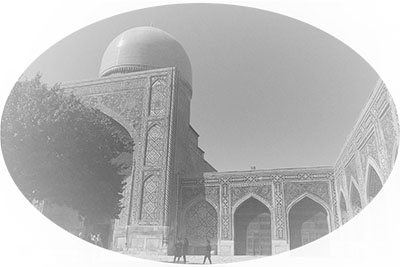
 The Tilla Kari Madrasa is a prominent building on Registan Square in Samarkand, Uzbekistan. Built in the 17th century, it forms part of a monumental ensemble that defines one of Central Asia’s most significant urban spaces. The structure served both educational and religious purposes, combining the functions of a madrasa and a mosque. Due to its position and scale, it plays a key role in the overall balance and coherence of the Registan complex. Today, it stands as an important component of Samarkand’s historical heritage, recognized for its cultural and symbolic significance.


Monument profile
Madrasa Tilla Kari
Monument category: Madrasa
Monument family: Mosque, Minaret or Madrasa
Monument genre: Religious
Cultural heritage: Islamic
Geographic location: Samarkand • Uzbekistan
Construction period: 17th century AD
This monument in Samarkand is inscribed on the UNESCO World Heritage List since 2001 and is part of the serial property "Samarkand – Crossroad of Cultures".See the UNESCO monuments featured on this site
• Links to •
• List of videos about Samarkand on this site •
Samarkand, the city of Amir Timur • Uzbekistan
• References •
Wikipedia FR: Madrassa Tilla Kari
UNESCO: Samarkand – Crossroad of Cultures
Tilla Kari Madrasa in Samarkand: Foundation, Institutional Role and Historical Evolution
Construction under Yalangtush Bakhodur and urban reconfiguration
The Tilla Kari Madrasa was constructed between 1646 and 1660 on the northern side of Registan Square in Samarkand under the patronage of Yalangtush Bakhodur, the city’s governor under the Ashtarkhanid dynasty. Its foundation formed part of a deliberate program to complete the spatial organization of the Registan, which already included the Ulugh Beg Madrasa and the Sher-Dor Madrasa. The new structure was intended to define the northern boundary of the square and establish a coherent architectural ensemble. The project incorporated a dual institutional function from the outset, combining a madrasa with a congregational mosque. This decision responded to the need for a large central place of worship within the urban core, replacing earlier facilities that had become insufficient. The scale and ambition of the construction reflect the political authority of Yalangtush Bakhodur and his role in shaping both the religious and civic landscape of Samarkand.
Educational institution and integrated religious function
The madrasa functioned as a center for advanced religious education, accommodating students engaged in theological and legal studies. Its internal organization included residential cells and teaching spaces arranged around a central courtyard, allowing for a structured academic environment. A defining feature of the Tilla Kari Madrasa is the integration of a large mosque within the complex, which distinguished it from the other madrasas on the Registan. This mosque served as a principal venue for communal prayers, including major gatherings. The coexistence of educational and liturgical functions required coordinated administration, linking scholarly activity with religious authority. The institution maintained a role in sustaining the intellectual and religious life of Samarkand during a period when political influence was shifting away from the city. The presence of both functions in a single complex reinforced its significance within the urban framework.
Decline, partial abandonment and changes in use
From the eighteenth century onward, the madrasa experienced a gradual decline associated with the reduced political prominence of Samarkand. Educational activity diminished, and the institutional structure that had supported the madrasa weakened. The mosque function continued in a reduced capacity, but without the intensity of earlier periods. Maintenance became irregular, leading to deterioration of structural elements and interior spaces. By the nineteenth century, the complex no longer fulfilled its original educational role, and parts of the building were either abandoned or used intermittently. The loss of sustained institutional use contributed to further degradation, although the overall layout and primary structures remained intact. Despite these changes, the madrasa retained its physical presence within the Registan and continued to define the northern side of the square.
Restoration campaigns and current status
Restoration efforts began in the twentieth century with the aim of stabilizing the structure and preserving its historical significance. During the Soviet period, interventions focused on structural consolidation and the partial reconstruction of damaged areas, particularly within the mosque section. These works sought to maintain the integrity of the monument as a historical and architectural entity, even though its original functions were not reinstated. After the independence of Uzbekistan, further restoration campaigns were undertaken as part of broader heritage preservation initiatives affecting the Registan. These interventions emphasized the conservation of original spatial organization and the reinforcement of existing structures. The Tilla Kari Madrasa is now part of the Registan ensemble included in the UNESCO World Heritage site “Samarkand – Crossroads of Cultures,” inscribed in 2001. It no longer operates as a madrasa or active mosque but serves as a major historical monument open to visitors and integrated into the cultural representation of the city.
Global historical context in the seventeenth century
The construction of the Tilla Kari Madrasa in the mid-seventeenth century coincides with significant political transformations in several regions. In Europe, the Peace of Westphalia in 1648 concluded the Thirty Years’ War and redefined territorial arrangements. In Mughal India, the reign of Shah Jahan was marked by major architectural projects. In China, the Qing dynasty established control following the fall of the Ming in 1644. Within the Ottoman Empire, administrative and military adjustments were underway. These developments provide a chronological framework situating the construction of the madrasa within a period of global political reorganization.
Spatial Configuration and Structural Composition of the Tilla Kari Madrasa in Samarkand
Position within the Registan and overall plan organization
The Tilla Kari Madrasa occupies the northern side of Registan Square, where it defines the upper boundary of the ensemble and establishes a continuous architectural front. Its placement aligns with the axial organization of the square, maintaining visual continuity with the Ulugh Beg and Sher-Dor madrasas. The building follows a rectangular plan structured around a large central courtyard, which serves as the primary organizing element. This courtyard is enclosed on all sides by arcaded galleries, creating a continuous circulation path. The main entrance is located on the southern façade and opens directly onto the courtyard through a monumental portal. The plan integrates residential, educational, and religious spaces within a unified layout, with clearly defined zones corresponding to each function.
Elevation, façade composition and volumetric articulation
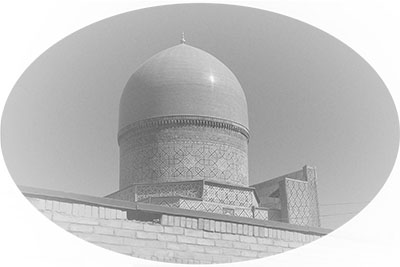
The principal façade is dominated by a large central pishtaq, which projects forward and establishes the vertical axis of the building. This portal is flanked by lateral wings composed of repetitive arcades arranged on two levels. These arcades correspond to the arrangement of student cells behind them, creating a direct relationship between interior organization and external appearance. The façade presents a balanced composition, with the central portal acting as the primary focal point and the flanking sections providing horizontal continuity. On the courtyard side, the same rhythm of arcades is maintained, forming a consistent architectural envelope. The mass of the mosque, located on the western side, rises above the surrounding structures and introduces a vertical emphasis through its domed volume. This differentiation in height distinguishes the mosque from the rest of the complex and reinforces its functional hierarchy.
Internal spatial organization and functional hierarchy
The central courtyard functions as the main circulation hub, from which all internal spaces are accessed. It is surrounded by covered galleries that provide access to individual student cells arranged on two levels. These cells are uniformly distributed and open onto the galleries through doorways or small arches, forming a repetitive spatial pattern. The teaching areas are integrated within this arrangement, without distinct separation from the residential units. The mosque occupies a distinct position on the western side of the complex and consists of a large domed hall preceded by a transitional space. Its dimensions and vertical scale set it apart from the surrounding structures. The spatial hierarchy is clearly defined, with the mosque representing the primary volume, the courtyard serving as the central organizing space, and the cells forming the peripheral layer. Circulation is structured to ensure direct access between these components without disrupting the overall coherence of the plan.
Construction techniques, materials and decorative systems
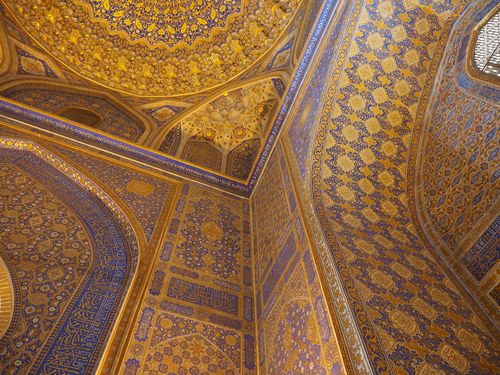
The structure is built primarily from baked brick, which forms the load-bearing walls and supports the system of vaults and domes. The galleries are covered with barrel vaults or small domical units, resting on arches that distribute structural loads across the walls. The use of brick allows for both structural stability and the application of decorative surfaces. Exterior and interior surfaces are clad with ceramic tiles arranged in geometric and epigraphic compositions. The mosque interior features a particularly dense decorative program, including gilded surfaces that give the building its name. These gilded elements are applied to architectural surfaces such as walls, arches, and vaults, creating a highly articulated interior environment. Decorative elements are integrated into the structural framework rather than applied as independent layers, ensuring continuity between construction and ornamentation.
Structural modifications, restoration interventions and current condition
The madrasa has undergone structural deterioration affecting both masonry and decorative surfaces, particularly in exposed areas of the galleries and upper levels. Restoration campaigns carried out during the twentieth century focused on stabilizing the load-bearing walls and reconstructing damaged vaults. Interventions also addressed the restoration of the mosque interior, where decorative elements were partially reconstituted. These works aimed to preserve the original spatial configuration while reinforcing the structural integrity of the building. Later conservation efforts continued this approach, emphasizing the retention of existing fabric and the careful integration of reconstructed elements. The current condition of the madrasa reflects a combination of preserved original structures and restored components, with the overall architectural organization remaining legible. The building continues to present a coherent spatial system, with its principal volumes and circulation patterns intact.