

 Français (France)
  Nederlands (nl-NL)
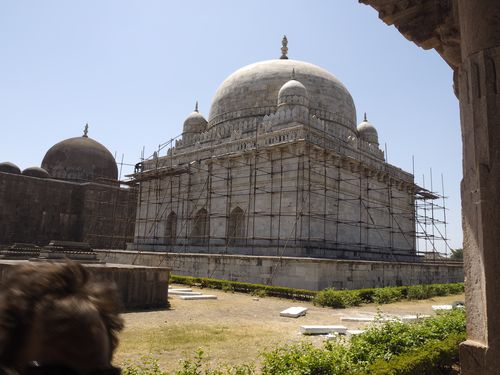
 The Mausoleum of Hoshang Shah, located in Mandu, Madhya Pradesh, India, is a notable example of medieval Indian funerary architecture. Built from white marble, it stands out for its harmonious proportions and refined simplicity. Dedicated to Hoshang Shah, a ruler of Malwa, it is regarded as one of the earliest marble mausoleums in India. Its design is said to have inspired Mughal architecture, including the Taj Mahal.


Monument profile
Hoshang Shah Mausoleum
Monument category: Mausoleum
Monument family: Tomb, Necropolis, Mausoleum or Cenotaph
Monument genre: Funerary
Cultural heritage: Islamic
Geographic location: Mandu • Madhya Pradesh • India
Construction period: 15th century AD
• Links to •
• Dynasties that contributed to the construction of the monument •

• This monument illustrates the following theme •
Architecture • Mausoleums : Muslim Mausoleums
• List of videos about Mandu on this site •
Mandu, ghost capital • Madhya Pradesh, India
Hoshang Shah’s Mausoleum: A Testament to Political Power and Cultural Synthesis
The Mausoleum of Hoshang Shah, located in Mandu, Madhya Pradesh, India, is a prominent example of early Islamic funerary architecture in South Asia. Constructed in the mid-15th century, this monument serves as both a symbol of political ambition and a reflection of the social dynamics of its time. Its architectural brilliance and historical significance make it a landmark of the Malwa Sultanate, blending local traditions with foreign influences.
Political and Social Motivations Behind Its Construction
Hoshang Shah, the first formally recognized sultan of the Malwa Sultanate, commissioned the mausoleum to consolidate his legacy and assert the legitimacy of his rule. At a time of fragmented power in medieval India, monumental architecture was often used as a statement of authority and permanence.
The mausoleum also reflects the integration of Islamic and local cultural practices, symbolizing the Malwa Sultanate's efforts to establish a cohesive society in a region marked by diverse traditions. As a funerary structure, it followed Islamic customs while incorporating Indian artistic sensibilities, demonstrating a nuanced balance of political power and social harmony.
Historical Events and Regional Impact
The mausoleum's completion around 1440 marked a turning point in the architectural narrative of medieval India. It is widely believed that Mughal architects, particularly those involved in designing the Taj Mahal, studied this structure for inspiration, particularly its use of white marble and harmonious proportions.
Mandu itself, as a fortified city and the capital of the Malwa Sultanate, played a crucial role in regional politics. It was strategically located on trade routes, facilitating cultural and economic exchanges. The mausoleum thus became a focal point for these interactions, symbolizing the region's prosperity and artistic achievements.
With the annexation of Mandu by the Mughal Empire in the 16th century, the city lost its status as an independent power center, but the mausoleum continued to be revered as a cultural landmark. Over time, it became a historical site representing the transition from regional sultanates to the centralized Mughal administration.
Global Context and Comparisons
The mid-15th century was a period of significant architectural activity worldwide. While the Malwa Sultanate was building the Mausoleum of Hoshang Shah, Europe was experiencing the early Renaissance, characterized by monumental structures like Florence Cathedral. Similarly, in East Asia, the Ming dynasty was constructing the Forbidden City.
The Mausoleum of Hoshang Shah shares similarities with these global examples in its use of advanced materials, innovative engineering, and its function as a political statement. However, it also stands apart due to its integration of Persian, Islamic, and Indian styles, showcasing a unique cultural synthesis.
Transformations Over the Centuries
The mausoleum has undergone notable transformations, reflecting the changing power dynamics and external influences over centuries. During the Mughal period, it was maintained as an architectural model. However, with the decline of the Mughals and the rise of British colonial rule, Mandu's prominence faded, and the mausoleum fell into partial neglect.
Modern restoration efforts have focused on preserving the integrity of the marble structure and its intricate carvings. Despite these efforts, some decorative elements have eroded over time, a testament to both the monument’s age and the environmental challenges it faces.
Current State of Conservation and Preservation Challenges
The Mausoleum of Hoshang Shah remains in a relatively preserved state, thanks to restoration projects initiated in the 20th century. However, challenges persist, including weathering, pollution, and unmanaged tourism. The white marble, while striking, is particularly vulnerable to environmental damage, necessitating continuous maintenance.
Efforts to preserve the mausoleum must also address the need for sustainable tourism and community involvement to ensure long-term protection. Advances in digital documentation and heritage management can play a crucial role in safeguarding this historic site.
Conclusion
The Mausoleum of Hoshang Shah is not only a significant architectural achievement but also a reflection of the political and cultural landscape of the Malwa Sultanate. Its design, blending innovation and tradition, has left an indelible mark on Indian and global architectural history. Preserving this monument is essential for understanding the legacy of medieval India and its connections to the broader world. Through sustained conservation efforts, this remarkable site can continue to inspire and educate future generations.
The Mausoleum of Hoshang Shah: Architectural Innovation and Cultural Fusion
The Mausoleum of Hoshang Shah, located in Mandu, Madhya Pradesh, India, is a masterpiece of early Islamic funerary architecture that reflects the technological advancements and cultural aspirations of the Malwa Sultanate in the 15th century. This monument, celebrated for its pioneering use of white marble and its harmonious design, exemplifies the confluence of local and foreign artistic traditions, making it a significant landmark in Indian architectural history.
Technological Advancements and Construction Techniques
The construction of the mausoleum showcases the technical expertise and innovative spirit of the period. Built entirely from white marble, a rarity in India at the time, the structure demonstrates exceptional craftsmanship in the precise alignment of marble slabs and the seamless integration of elements. The material, sourced from nearby regions, was polished to a smooth finish, enhancing the monument’s aesthetic appeal and durability.
The symmetrical design, the accurate geometry of the domes, and the use of pointed arches are hallmarks of Islamic architecture. The large central dome, supported by robust columns and flanked by smaller domes, exemplifies an advanced understanding of load distribution and structural integrity. This level of engineering sophistication set a precedent for future architectural projects in India.
Artistic Fusion and Decorative Features
The Mausoleum of Hoshang Shah is a blend of Persian, Islamic, and local Indian styles, reflecting the cultural diversity of the Malwa Sultanate. The intricate latticework (“jali”), floral motifs, and geometric patterns carved into the marble echo Persian and Central Asian influences, while the simplicity of the structure reflects a regional aesthetic preference for understated elegance.
The central dome, topped with a finial, symbolizes the heavens, a common feature in Islamic funerary architecture. The interior of the mausoleum, bathed in soft light filtered through the jali windows, creates a serene atmosphere befitting its purpose as a final resting place.
Notable Structure and Layout
The mausoleum’s layout is a rectangular platform with the tomb chamber at its center, surrounded by an open courtyard. This design allows for a clear focus on the central dome, emphasizing its symbolic and architectural significance. The precision in symmetry and proportion reflects a mathematical rigor rarely seen in contemporary structures of the region.
A well-documented anecdote highlights the significance of this monument: architects from Shah Jahan’s court visited Mandu to study the mausoleum while designing the Taj Mahal. This indicates the mausoleum’s profound influence on one of the world’s most iconic buildings.
International Recognition and UNESCO Status
Although not yet inscribed as a UNESCO World Heritage Site, the Mausoleum of Hoshang Shah has garnered international recognition for its architectural and historical importance. Its status as an early example of marble architecture in India has made it a reference point in the study of Indo-Islamic art and design.
The UNESCO Asia-Pacific Heritage Awards for conservation efforts have brought attention to the monument, encouraging preservation initiatives. Such recognition has not only elevated its global profile but also highlighted the importance of protecting vulnerable heritage sites.
Challenges and Conservation Efforts
The mausoleum faces several modern challenges, including weathering of its marble surfaces, pollution-related discoloration, and structural vulnerabilities caused by natural aging. Unregulated tourism and urban encroachment further threaten the site’s integrity.
Conservation efforts have included surface cleaning, restoration of damaged carvings, and measures to stabilize the structure. However, consistent funding and community involvement are critical to ensuring the long-term preservation of this historic monument.
Conclusion
The Mausoleum of Hoshang Shah is a testament to the technological and artistic advancements of the Malwa Sultanate. Its pioneering use of marble, fusion of diverse artistic traditions, and lasting influence on subsequent architecture underscore its significance in Indian history. By preserving this monument, future generations can continue to appreciate its role as a bridge between the past and the present, as well as its contribution to the global heritage of architecture and design.