

 Français (France)
  Nederlands (nl-NL)
 Agra Fort, also known as the Red Fort of Agra, is a major historic fortress located in the city of Agra in the state of Uttar Pradesh, India. Most of the complex was constructed in the sixteenth century during the reign of the Mughal emperor Akbar and later expanded by his successors. The fortified enclosure served for several centuries as a principal political, administrative and military center of the Mughal Empire. Built mainly of red sandstone, the site includes numerous palaces, courtyards and official buildings reflecting the organization of an imperial capital. Agra Fort illustrates the strategic importance of the city in northern India and has been listed as a UNESCO World Heritage Site since 1983.
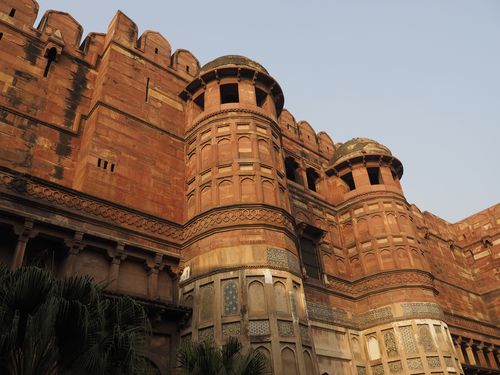
Agra • Agra's Red Fort: the defensive wall
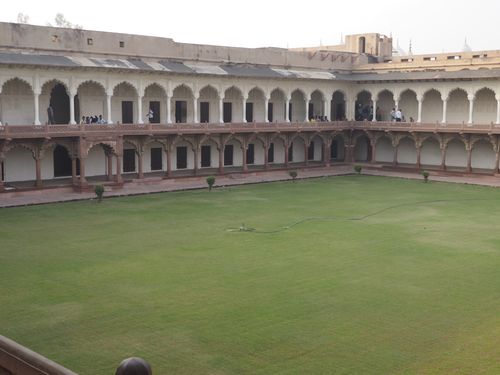
Agra • Agra's Red Fort: courtyard
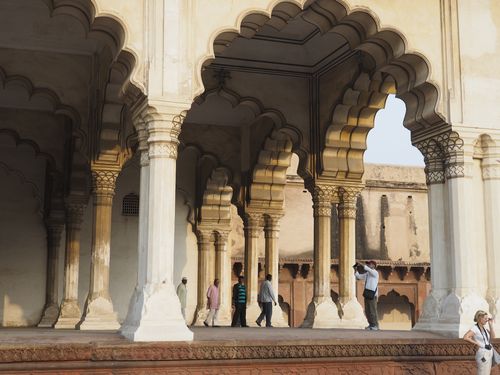
Agra • Agra's Red Fort: terrace
Agra's Red Fort

Online sources
- UNESCO World Heritage Centre - Agra Fort. Available at: https://whc.unesco.org/en/list/251
Books and Publications
History of Agra Fort
Political and social context of construction
Agra Fort, commonly known as the Red Fort of Agra, was constructed during a formative period in the consolidation of the Mughal Empire in northern India. Its reconstruction in durable red sandstone began in 1565 under the reign of the Mughal emperor Akbar (r. 1556–1605), who sought to establish a stable imperial capital capable of supporting the administrative, military, and ceremonial functions of a rapidly expanding empire.
Before Akbar’s project, Agra already possessed a fortified structure associated with earlier rulers of the Delhi Sultanate, particularly the Lodi dynasty in the early sixteenth century. However, these earlier defenses were largely built in brick and were not suited to the scale of imperial ambitions that emerged after the Mughal conquest of northern India. Akbar’s decision to rebuild the fort in stone reflected both practical and symbolic objectives. The new complex would provide a secure seat of power while simultaneously projecting the authority and permanence of Mughal rule.
At the time of its construction, the Mughal Empire was consolidating control over a diverse and politically fragmented region. Akbar pursued policies designed to integrate various regional elites into the imperial administration. Among the most significant of these policies was the alliance with Rajput rulers, whose military and political cooperation helped stabilize Mughal authority in northern and western India. The construction of Agra Fort therefore took place in a context of strategic diplomacy as well as military expansion.
The fort served multiple functions within this political framework. It operated as a royal residence, a military stronghold, and the administrative center of the empire. Court ceremonies, imperial councils, and diplomatic receptions were conducted within its walls. By concentrating political power within a fortified urban complex, Akbar created an architectural expression of centralized imperial authority.
Major historical events at the site
Throughout the late sixteenth and seventeenth centuries, Agra Fort remained one of the principal centers of Mughal political life. Successive emperors expanded and modified the complex in accordance with their own architectural preferences and political needs.
During the reign of Jahangir (1605–1627), the fort continued to function as an imperial residence and administrative headquarters. Jahangir maintained the political structures established by his father while overseeing a court culture that emphasized ceremonial display and artistic patronage.
More substantial architectural changes occurred during the reign of Shah Jahan (1628–1658). Known for his preference for refined architectural forms and the extensive use of white marble, Shah Jahan commissioned the construction of several new palaces and pavilions within the existing red sandstone enclosure. These additions transformed parts of the fortress into an elaborate palace complex while preserving its defensive functions.
One of the most dramatic episodes in the history of Agra Fort occurred during the Mughal war of succession in 1658. Shah Jahan’s son Aurangzeb seized power after defeating his brothers in a series of military confrontations. Shah Jahan was subsequently confined within the fort by Aurangzeb and spent the final years of his life there. According to historical accounts, he resided in one of the marble palaces from which the Taj Mahal, the mausoleum built for his wife Mumtaz Mahal, could be seen across the Yamuna River.
During the eighteenth century, the gradual decline of Mughal political authority affected the control and maintenance of the fort. Regional powers, including the Marathas, intermittently occupied the city of Agra as the centralized Mughal administration weakened. These changes reflected the broader fragmentation of imperial power across northern India.
In 1803, Agra Fort was captured by the British East India Company during its campaigns against the Maratha confederacy. From that moment onward, the fort entered a new phase in its history as a colonial military installation. Many structures inside the complex were modified or demolished to accommodate the requirements of British garrisons.
The fort also played a role during the Indian uprising of 1857, when widespread revolts against British rule erupted across northern India. Although Agra itself remained under British control for much of the conflict, the fort served as a defensive refuge for colonial authorities and troops.
Global context during the period of construction
The construction of Agra Fort occurred during a period of significant political centralization and monumental building projects in many parts of the world. In the sixteenth century, powerful empires and kingdoms were consolidating authority through the creation of fortified capitals and ceremonial palaces.
In the Ottoman Empire, monumental architectural programs under rulers such as Suleiman the Magnificent transformed cities like Istanbul into imperial centers defined by grand mosques and administrative complexes. In Europe, monarchies such as those of Spain and France invested heavily in fortified residences and royal palaces designed to symbolize the stability of centralized rule.
The Mughal Empire participated in this broader pattern of imperial architecture. Monumental complexes such as Agra Fort functioned not only as defensive structures but also as visible representations of political authority. Their scale and architectural sophistication reflected the resources and administrative capacity of early modern empires.
Transformations of the monument over time
Over the centuries, Agra Fort underwent numerous transformations reflecting changes in political authority and urban development. Under the Mughal emperors, alterations generally involved the addition of new buildings within the enclosure rather than the restructuring of the defensive walls themselves.
The most significant modifications occurred during the reign of Shah Jahan, whose architectural projects introduced marble pavilions, refined audience halls, and landscaped palace gardens. These changes shifted the internal character of the fort from a predominantly military stronghold to a combined palace and administrative complex.
During British colonial rule, many Mughal structures inside the fort were demolished to create open parade grounds and barracks. Although the outer defensive walls and several important palaces survived, the overall layout of the complex was altered substantially during the nineteenth century.
Following Indian independence in 1947, the fort gradually lost its remaining military functions. Government authorities initiated conservation programs aimed at preserving the surviving Mughal structures and restoring the monument as a historical site.
Urban development in Agra during the twentieth century further transformed the surrounding environment. The city expanded into a major tourist destination largely because of the nearby Taj Mahal. As a result, Agra Fort became part of a broader heritage landscape that includes several major Mughal monuments along the Yamuna River.
Cultural role and modern significance
Today, Agra Fort is recognized as one of the most important historical monuments in India. It provides a comprehensive record of the political and ceremonial life of the Mughal Empire at the height of its power. The complex reflects the administrative organization, court rituals, and architectural ambitions of several generations of Mughal rulers.
For visitors and scholars alike, the fort offers insight into the structure of imperial governance in early modern South Asia. Its palaces, audience halls, and defensive systems illustrate the interplay between political authority and architectural design.
The monument also plays a significant role in the cultural identity of the region. As one of the principal historical sites in Agra, it contributes to the city’s status as a major center of heritage tourism. The fort is frequently included in historical narratives about the Mughal period and remains an important educational resource for understanding India’s precolonial past.
Conservation and contemporary challenges
Agra Fort was inscribed on the UNESCO World Heritage List in 1983 in recognition of its outstanding historical and architectural significance. This designation acknowledges the monument as a key example of Mughal imperial architecture and urban planning.
Despite this international recognition, the preservation of the fort faces several challenges. Air pollution generated by industrial activity and heavy urban traffic has raised concerns about the long-term impact on the sandstone surfaces of the fort’s walls and buildings. Environmental protection measures have been introduced in the region in order to reduce these effects.
Tourism also presents both opportunities and difficulties for conservation. Large numbers of visitors contribute to the local economy but require careful management to prevent damage to historic structures. Preservation efforts therefore focus on balancing public access with the protection of fragile architectural elements.
Ongoing restoration projects carried out by heritage authorities aim to stabilize structures, repair weathered stone surfaces, and improve the management of the site. Through these efforts, Agra Fort continues to serve not only as a monument of the Mughal Empire but also as a significant component of India’s cultural heritage and historical memory.
Architecture of Agra Fort
General conception and defensive design
Agra Fort represents one of the most significant examples of Mughal imperial architecture and military engineering of the sixteenth and seventeenth centuries. The complex combines the functions of a fortified citadel, an administrative center, and an imperial palace. Built primarily during the reign of Emperor Akbar from 1565 onward, the fort reflects both the military requirements of the early Mughal state and the ceremonial needs of a growing imperial court.
The fort occupies a strategic position along the right bank of the Yamuna River and covers an area of approximately 38 hectares. Its overall plan forms an irregular semicircle whose curved side follows the course of the river, while the straight side faces the city. The design integrates natural topography into the defensive system, allowing the river to function as an additional protective barrier.
The outer walls of the fort extend for roughly 2.5 kilometers and rise to heights approaching 20 meters. These massive ramparts are reinforced by a sequence of semicircular bastions placed at regular intervals. Their structure was designed to withstand artillery attacks, which had become an increasingly important factor in warfare by the sixteenth century. The defensive system also includes a double line of fortification in certain sections, with internal passageways that allowed soldiers to circulate quickly along the ramparts.
Entrances to the fort were carefully engineered to maximize defensive control. The two principal gateways, the Delhi Gate and the Amar Singh Gate, incorporate angled passageways and multiple defensive chambers. These design features prevented invading forces from advancing directly into the interior of the complex and created narrow spaces where defenders could concentrate their resistance.
Materials and construction techniques
The dominant material used in the construction of Agra Fort is red sandstone, quarried in large quantities from regions of northern India. This stone was widely employed in Mughal architecture during the reign of Akbar because of its durability and structural strength. Its warm color also contributed to the monumental visual identity of imperial buildings.
The outer fortifications consist of large sandstone blocks precisely cut and assembled in regular courses. Behind the outer stone surfaces lies a core of rubble masonry bonded with lime mortar. This composite construction method provided substantial structural stability while reducing the quantity of finely dressed stone required for the project.
The massive thickness of the walls was an essential element of the defensive design. In many sections, the ramparts measure several meters in thickness, enabling them to absorb the impact of artillery fire. The parapets include crenellations and projecting balconies that allowed defenders to observe approaching forces and respond effectively.
During the reign of Shah Jahan in the seventeenth century, the architectural character of the fort changed in several areas through the introduction of white marble structures. Marble, sourced from quarries in Rajasthan, was used for palaces, pavilions, railings, and decorative surfaces. This contrast between red sandstone and white marble became one of the most recognizable visual features of Mughal architecture.
The construction techniques employed in the fort demonstrate the advanced craftsmanship of Mughal builders. Stone blocks were carefully shaped and fitted with precision joints, while arches and vaults distributed structural loads efficiently across walls and columns. These methods allowed architects to create large open halls without relying on excessive internal supports.
Spatial organization and internal layout
Inside the defensive enclosure, the architectural organization of Agra Fort reflects the hierarchical structure of Mughal political life. The complex was divided into distinct zones corresponding to different administrative and residential functions.
The areas closest to the principal gates contained administrative and ceremonial buildings connected to the public functions of the imperial court. Deeper inside the complex were the private palaces and residential quarters of the emperor and members of the royal household. This layered spatial arrangement ensured both security and ceremonial order.
One of the most prominent structures within the complex is the Diwan-i-Am, or Hall of Public Audience. This large rectangular pavilion served as the setting for official assemblies where the emperor addressed petitions and administrative matters. The structure consists of a broad colonnaded hall supporting a flat roof, creating an expansive space capable of accommodating large gatherings.
Further within the palace zone lies the Diwan-i-Khas, or Hall of Private Audience. This more refined structure was used for meetings between the emperor and high-ranking nobles or foreign envoys. Its architecture is characterized by delicate columns, marble surfaces, and carefully proportioned spaces that emphasize formality and prestige.
The residential sector of the fort contains several palace buildings constructed along the riverfront. These structures were designed to take advantage of cooling breezes from the Yamuna. Their arrangement creates a sequence of terraces and courtyards that open toward the river, combining comfort with scenic views.
Gardens also formed an essential component of the internal layout. Following the Mughal tradition of formal garden design, these spaces were organized according to geometric patterns and often included water channels and reflecting pools.
Architectural influences and artistic synthesis
The architecture of Agra Fort reflects the cosmopolitan nature of the Mughal Empire. Its forms and decorative elements result from a synthesis of several architectural traditions.
Persian and Central Asian influences are evident in the use of monumental gateways, symmetrical courtyards, and the widespread employment of arches and vaulted spaces. These features were introduced into the Indian subcontinent by earlier Islamic dynasties and were further developed by the Mughal rulers.
At the same time, many elements of the fort’s architecture draw upon indigenous Indian building traditions. Bracketed balconies, projecting pavilions, and intricately carved columns show clear connections with Rajput and earlier regional architectural styles. The Mughal architects adapted these features into a unified imperial aesthetic.
Decorative motifs also reflect this cultural synthesis. Geometric patterns and stylized floral carvings appear on many surfaces, demonstrating the influence of Islamic ornamental traditions. In marble structures built under Shah Jahan, intricate inlay work using semi-precious stones was introduced, creating elaborate decorative compositions.
These artistic elements were not purely ornamental but also served to emphasize the authority and sophistication of the Mughal court. The combination of diverse artistic traditions symbolized the inclusive political vision that characterized much of the Mughal imperial project.
Climatic adaptation and technical innovation
Architectural solutions within Agra Fort also reveal careful adaptation to the climate of northern India. The region experiences intense summer heat, monsoon rains, and cooler winter conditions, requiring buildings capable of maintaining comfortable internal environments.
Courtyards form a central element of the design strategy. By organizing buildings around open spaces, architects encouraged natural air circulation that helped regulate interior temperatures. Covered arcades and shaded corridors provided protection from direct sunlight while maintaining ventilation.
The thick sandstone walls also contributed to thermal stability by slowing the transfer of heat between exterior and interior spaces. During the hottest months, these massive walls helped keep palace interiors relatively cool.
Water management systems played an additional role in environmental control. Channels and reservoirs distributed water throughout the palace complex, supplying both gardens and decorative fountains. Flowing water enhanced cooling through evaporation and created an atmosphere of refinement consistent with Mughal garden aesthetics.
Dimensions and notable characteristics
Agra Fort is among the largest fortified palace complexes constructed during the Mughal period. The defensive walls extend approximately 2.5 kilometers around the perimeter, punctuated by numerous bastions and towers. The overall enclosure covers about 38 hectares, making it comparable in scale to other major Mughal capitals.
Historical accounts indicate that the original complex contained several hundred buildings, including palaces, administrative halls, barracks, and service structures. Many of these buildings were later removed during the colonial period, yet the surviving monuments still illustrate the architectural diversity that once characterized the site.
The Delhi Gate is often considered one of the most impressive fortified entrances in Mughal architecture. Its monumental proportions and elaborate defensive arrangements demonstrate the importance placed on controlling access to the imperial citadel.
Legends surrounding the fort include stories of concealed passageways connecting the fortress to other strategic points in the city. Although the historical evidence for such tunnels remains uncertain, these narratives contribute to the cultural memory associated with the monument.
Architectural significance and conservation challenges
The architectural importance of Agra Fort lies in its ability to combine military engineering with palace architecture on an exceptional scale. The complex illustrates the evolution of Mughal design from the robust sandstone structures of Akbar’s reign to the refined marble pavilions favored by Shah Jahan.
This architectural synthesis contributes significantly to the fort’s recognition as a monument of global historical value. Its design provides insight into the political organization, artistic ambitions, and technical capabilities of the Mughal Empire during its formative centuries.
Today the monument forms part of a protected heritage landscape in the city of Agra. However, its preservation faces several challenges linked to environmental conditions and urban growth. The red sandstone used in many structures is particularly vulnerable to atmospheric pollution and weathering.
Conservation authorities continue to implement restoration programs aimed at stabilizing structures, repairing damaged stone surfaces, and managing visitor access. These measures seek to ensure that the architectural integrity of the fort can be preserved despite the pressures created by tourism and urban expansion.
Through these ongoing efforts, Agra Fort remains one of the most important surviving examples of Mughal architectural achievement. Its massive fortifications, carefully organized palace spaces, and richly decorated buildings collectively illustrate the architectural sophistication of one of the early modern world’s most powerful empires.