

 Français (France)
  Nederlands (nl-NL)
 Hindola Mahal is a prominent monument located in the historic town of Mandu, in the Indian state of Madhya Pradesh. Built in the late 15th century, it formed part of the royal palace complex of this former fortified capital. Its name, meaning “Swinging Palace,” refers to the distinctive inward-sloping exterior walls that give the structure its characteristic appearance. The building is generally associated with administrative or ceremonial functions, possibly serving as a royal audience hall. Today, Hindola Mahal stands as an important landmark illustrating the political significance and urban layout of Mandu during the medieval period in central India.
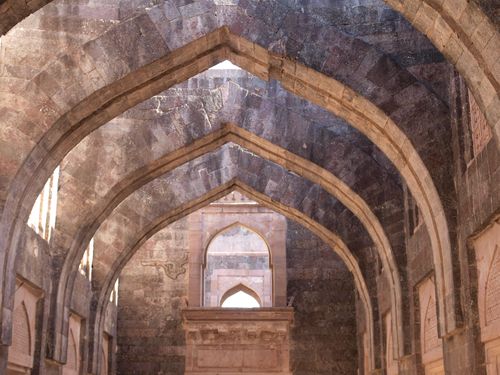
Mandu • Hindola Mahal
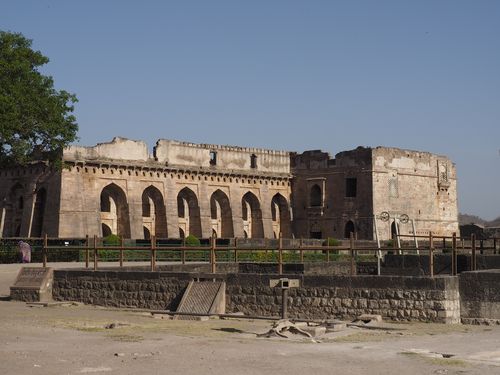
Mandu • Hindola Mahal
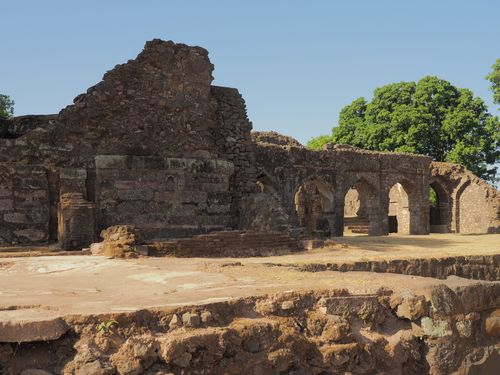
Mandu • Hindola Mahal
Monument profile
Hindola Mahal
Monument category: Palace
Monument family: Palace and Annexes
Monument genre: Residential
Cultural heritage: Islamic
Geographic location: Mandu • Madhya Pradesh • India
Construction period: 15th century AD
• Links to •
• Dynasties that contributed to the construction of the monument •

• List of videos about Mandu on this site •
Mandu, ghost capital • Madhya Pradesh, India
History of the Hindola Mahal in Mandu
Political and social context of construction
The Hindola Mahal was built in the late fifteenth century, at a time when Mandu functioned as the capital of the Sultanate of Malwa. This period followed the gradual fragmentation of the Delhi Sultanate, which allowed regional powers to assert their autonomy and develop distinct political and cultural identities. Under the Khalji rulers of Malwa, Mandu emerged as a strategically located capital, controlling important trade routes between northern India and the Deccan plateau. The construction of monumental buildings was a deliberate political strategy aimed at expressing sovereignty, administrative order, and dynastic legitimacy.
The Hindola Mahal is generally associated with the reign of Ghiyath al-Din Khalji, whose court invested heavily in architecture as a means of projecting authority. The monument is believed to have served as a hall for public audiences, official assemblies, or courtly ceremonies. In a political environment marked by rivalry with neighboring sultanates such as Gujarat and by tensions with Rajput polities, the architectural display of stability and control was essential. The Hindola Mahal thus reflects both the administrative needs of the state and the symbolic ambitions of its rulers.
Major historical events affecting the monument
During its early history, the Hindola Mahal formed part of an active and functioning palatial complex. However, the stability of the Malwa Sultanate was relatively short-lived. Internal power struggles weakened the Khalji dynasty, and Mandu became vulnerable to external intervention. In the early sixteenth century, the city experienced military conflicts, most notably the invasion by the Sultanate of Gujarat in 1531. These events disrupted court life and diminished the political centrality of Mandu.
Following the incorporation of Malwa into the Mughal Empire in the mid-sixteenth century, the administrative role of Mandu declined. The city was no longer a regional capital, and many of its monumental buildings, including the Hindola Mahal, lost their original functions. Rather than being deliberately destroyed, the monument entered a phase of reduced use and gradual neglect. Under later regimes, including Maratha control in the eighteenth century, Mandu remained a peripheral settlement. The Hindola Mahal survived largely because it was not repurposed extensively, escaping major structural alterations.
Global context at the time of construction
The construction of the Hindola Mahal coincided with a broader global pattern of monumental architecture linked to state formation and political consolidation. In the Islamic world, large halls for audiences and administration were common features of royal complexes, serving as settings for governance and ceremony. At the same time, in Europe, monarchies invested in palaces and civic buildings that emphasized order, symmetry, and authority.
Within the Indian subcontinent, regional sultanates such as Malwa, Gujarat, and the Deccan states developed architectural languages that combined local traditions with transregional Islamic forms. The Hindola Mahal fits within this wider movement of monumental construction, reflecting a shared understanding of architecture as an instrument of power. Its distinctive form demonstrates how global architectural ideas were adapted to local materials, climatic conditions, and political contexts.
Transformations over time
Over the centuries, the Hindola Mahal underwent relatively few architectural modifications, primarily because its functional relevance diminished early on. The absence of continuous occupation limited intrusive alterations, but natural decay affected the structure. Environmental factors, including monsoon rains and temperature fluctuations, contributed to the erosion of masonry and the loss of surface finishes.
During the colonial period, British administrators and scholars developed an interest in Mandu as a historic site. The Hindola Mahal was documented, cleared of debris, and stabilized as part of early conservation efforts. These interventions aimed to preserve the monument as an example of medieval Indo-Islamic architecture rather than to restore it to an active function. As a result, the building’s appearance today reflects both its original construction and the impact of centuries of abandonment and partial conservation.
Urban context and changing perceptions
As Mandu’s urban fabric contracted over time, the Hindola Mahal shifted from being a component of a dense political center to a landmark within a landscape of ruins. This transformation altered how the monument was perceived and used. No longer integrated into daily administrative life, it became a historical artifact, valued for its form and for the insight it provides into the city’s past.
In the modern era, Mandu has been redefined as a heritage destination. The Hindola Mahal plays a central role in this reimagined identity, serving as a focal point for visitors seeking to understand the political and cultural history of Malwa. Its isolation from contemporary urban development has, paradoxically, enhanced its visual impact and symbolic presence.
Contemporary role and cultural significance
Today, the Hindola Mahal functions primarily as a protected historical monument. It is not associated with religious rituals or regular social ceremonies, but it holds considerable cultural significance as a symbol of Mandu’s medieval heritage. For local communities, it represents a tangible link to a period when the region exercised political autonomy and cultural influence.
At the national level, the monument contributes to broader narratives about the diversity of India’s historical experience, illustrating the role of regional sultanates in shaping architectural and political traditions. Educational initiatives, guided visits, and cultural tourism have reinforced its status as a site of learning and memory rather than of active use.
Conservation challenges and heritage status
The current state of conservation of the Hindola Mahal reflects ongoing challenges faced by large masonry monuments. Environmental exposure remains a primary concern, particularly water infiltration and the gradual weakening of mortar joints. Tourism, while economically beneficial, introduces additional pressures through foot traffic and the need for visitor infrastructure.
Conservation policies implemented by Indian heritage authorities emphasize structural stabilization, controlled access, and minimal intervention. Although Mandu is not inscribed on the UNESCO World Heritage List, it appears on India’s tentative list, highlighting its potential international significance. This status encourages careful management and underscores the importance of the Hindola Mahal within a wider ensemble of historic structures. Preserving the monument involves balancing accessibility with long-term protection, ensuring that its historical value is transmitted to future generations.
Architecture of the Hindola Mahal (Mandu, Madhya Pradesh)
A monumental hall within a palatial landscape
Hindola Mahal is best understood as a purpose-built public hall integrated into Mandu’s wider royal enclave. Unlike residential pavilions or religious buildings, it is organized around a dominant interior volume intended for assembly, courtly ceremony, and formal audiences. This functional emphasis shaped its architectural priorities: structural stability over delicate finish, a clear spatial hierarchy over intricate compartmentalization, and a strong exterior silhouette that could communicate authority at a distance. In Mandu’s plateau setting—where palaces, waterworks, gates, and pavilions form a dispersed yet coherent monumental landscape—the building reads as a civic-ceremonial anchor, designed to be approached, entered, and experienced as a single, legible architectural statement.
Engineering logic and technological choices of its time
The defining feature of Hindola Mahal is its dramatically inward-sloping side walls and buttresses, the visual cue behind the “Swinging Palace” nickname. Technically, walls built with a pronounced batter (a deliberate inward tilt) behave like massive buttressing elements: they resist lateral thrust and translate outward forces into compressive loads directed down toward the ground. This matters for a large hall whose roof structure—whether flat, timber-framed, or supported by major arches—would have generated significant horizontal forces. The building therefore embodies a pragmatic engineering mentality: use geometry and mass to stabilize large spans, rather than relying on thin walls or extensive external bracing.
Openings are arranged in a disciplined rhythm along the long sides. They are not merely decorative; they reduce weight in the upper wall zones, bring controlled daylight into the hall, and enable cross-ventilation. In a warm climate with seasonal humidity, such a system supports thermal comfort without mechanical means. The hall’s height further enhances stack effect, allowing warmer air to rise and escape through higher voids while cooler air can circulate at occupant level. This approach—large shaded volume plus carefully placed apertures—belongs to a broader set of passive climatic strategies seen across Indo-Islamic architecture.
Materials and construction methods
Hindola Mahal is a masonry structure, executed in locally available stone and bonded with lime-based mortars typical of the period. Thick load-bearing walls are central to its stability, and the building’s survival owes much to the inherent durability of stone construction combined with conservative structural proportions. Lime mortar, beyond binding, also allows a degree of flexibility and breathability compared with harder modern cements, helping masonry cope with moisture movement and thermal expansion.
Construction likely proceeded with careful staging: heavy side walls and buttresses established as primary supports, then major arches and roof elements set to define the hall’s span. The technical achievement is not in exotic materials but in the controlled assembly of mass—accurate wall geometry, consistent bonding, and the disciplined repetition of arches and recesses. Surface finishes such as plaster would have protected masonry from weathering and unified appearance. Even where such finishes are now lost, the underlying tectonic clarity remains: the building’s “aesthetic” is inseparable from how it stands up.
Spatial organization and structural form
The plan is commonly described as T-shaped, with a main longitudinal hall and a transverse projection that appears to have been expanded or modified over time. The principal hall forms the spatial and structural core. Its long elevations are articulated by a sequence of recessed arches: at lower levels these read as doorways and deep niches, while above they accommodate openings that admit light and air. This layered elevation is typical of architecture that must combine enclosure with environmental performance—deep reveals create shade and reduce glare, while perforated elements or high windows can ventilate without fully exposing the interior.
Inside, the hall is defined by the cadence of large supporting arches. These arches establish a structural grid and a ceremonial rhythm: each bay becomes a unit of perception, making the space feel ordered and processional. Such interior ordering supports multiple uses—gatherings, ceremonial receptions, administrative sessions—without relying on fixed furnishings. The architecture itself provides the spatial “protocol,” guiding movement and attention through proportion and repetition.
Roof form is a key but debated element in interpretive descriptions, because what survives today does not always fully reveal the original covering system. What is clear is that the hall’s structure required substantial support, and that the interplay between large arches and battered walls was central to managing thrust and load. Parapets and battlement-like roofline elements also contribute to the building’s fortress-like impression, blending civic monumentality with defensive visual language.
Artistic influences and stylistic character
Hindola Mahal sits within the architectural world of the Malwa Sultanate, where local construction traditions met broader Indo-Islamic forms. The repeated use of arches, the emphasis on large public interior space, and the preference for robust massing resonate with the architectural vocabulary of contemporary sultanates. At the same time, the building’s distinct silhouette and its reliance on extreme wall batter give it a regional identity that is not merely derivative.
Ornamentation is generally restrained compared with later imperial Mughal works. This restraint does not imply a lack of artistic intent; rather, the monument’s visual power comes from form: the dramatic inclination of the walls, the sculptural depth of the recessed arches, and the strong contrast between solid masonry and controlled voids. Decorative detail, where present, tends to reinforce architectural lines rather than compete with them. The result is an architecture of disciplined expression—monumental, functional, and immediately recognizable.
Notable figures, measurements, and “known for” elements
Accounts commonly highlight the extraordinary thickness of the lateral walls—often reported at around three meters—excluding the additional mass of the sloping buttresses. The main hall is likewise frequently described as a large, high volume, on the order of several tens of meters in length and approaching a dozen meters in height. Such dimensions, combined with the unusual buttress geometry, explain why the building reads as an engineering statement as much as a ceremonial hall. Another notable feature is the series of recessed arches along the long sides, which integrates access, shade, and ventilation into a single compositional system.
The popular nickname “Swinging Palace” is itself an architectural anecdote: it compresses a complex structural idea into an easily memorable image. While the building does not “swing,” the metaphor directs attention to the walls’ inclination—the feature that most clearly distinguishes Hindola Mahal from adjacent structures in Mandu’s palatial ensemble.
Conservation and architectural significance today
Architecturally, Hindola Mahal matters because it demonstrates how late medieval builders in central India could solve large-span, large-volume problems with geometry, mass, and passive environmental control. Its battered walls and buttresses are not merely picturesque; they are a coherent response to structural thrust, material behavior, and climatic context. This combination gives the building international relevance as a case study in pre-modern engineering design.
Preservation challenges are typical of exposed masonry monuments: moisture infiltration during monsoons, erosion of joints, biological growth, and gradual surface loss. Conservation policies generally prioritize stabilizing the fabric, managing water, and limiting interventions that would obscure original construction logic. The monument’s value lies precisely in the clarity of its structural and spatial ideas; protecting that clarity—while allowing access—remains the central conservation task.