

 Français (France)
  Nederlands (nl-NL)
 The Suparshvanatha Jain Temple is a Jain religious monument located in Mandu, within the state of Madhya Pradesh. Dedicated to Suparshvanatha, the seventh Tirthankara of Jainism, the temple reflects the long-standing presence of Jain communities in Mandu. It forms part of the city’s multi-religious heritage, alongside Islamic and Hindu monuments. Today, the site is mainly valued for its spiritual significance and its contribution to understanding the religious diversity that shaped Mandu over time.

Mandu • Jain Mandavgarh Suparshvanatha temple
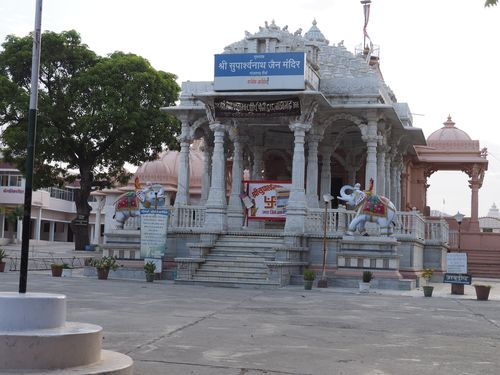
Mandu • Jain Mandavgarh Suparshvanatha temple

Mandu • Jain Mandavgarh Suparshvanatha temple
Monument profile
Jain Mandavgarh Suparshvanatha temple
Monument category: Jain temple
Monument family: Temple
Monument genre: Religious
Cultural heritage: Jain
Geographic location: Mandu • Madhya Pradesh • India
Construction period: Unknown era
• Links to •
• List of videos about Mandu on this site •
Mandu, ghost capital • Madhya Pradesh, India
History of the Suparshvanatha Jain Temple at Mandavgarh
Political and social context of construction
The Suparshvanatha Jain Temple at Mandavgarh was constructed in a historical context that predates Mandu’s rise as an Islamic capital and reflects the long-standing presence of Jain communities in central India. Before the establishment of the Malwa Sultanate, Mandavgarh functioned as a fortified settlement and regional stronghold, integrated into networks of trade and pilgrimage. Jain merchants and financiers played a significant role in these networks, facilitating the circulation of goods, capital, and religious ideas across western and central India.
The temple was built to serve the devotional and communal needs of a Jain population that was both economically influential and socially organized. Unlike monuments sponsored directly by royal courts, Jain temples were often funded through collective patronage by merchant guilds and prominent lay devotees. This model of sponsorship reflects the Jain emphasis on individual merit and communal responsibility. Nevertheless, the construction of a permanent stone temple required a political environment that permitted religious plurality and protected mercantile interests. The existence of such a temple at Mandavgarh suggests a period of relative stability and tolerance, during which Jain institutions could function alongside Hindu and, later, Islamic traditions.
The dedication of the temple to Suparshvanatha, the seventh Tirthankara, situates the monument within a well-established doctrinal framework. Suparshvanatha had been venerated for centuries before the temple’s construction, particularly in regions where Jain communities were closely tied to commerce. The temple thus served not only as a place of worship but also as a focal point for social cohesion, reinforcing Jain identity within a multi-religious environment.
Major historical events affecting the site
The history of the Suparshvanatha Jain Temple has been shaped by the successive political transformations of Mandu. From the fourteenth century onward, Mandavgarh was transformed into Mandu, the capital of the Malwa Sultanate. This transition brought large-scale urban redevelopment, including the construction of mosques, palaces, and fortifications. Older religious structures, including Jain and Hindu temples, became part of an evolving urban and symbolic landscape.
Unlike some temples that were destroyed or repurposed during periods of political upheaval, the Suparshvanatha temple appears to have survived in a reduced but continuous form. Its persistence can be attributed to the pragmatic accommodation often extended to Jain communities, whose economic roles were valuable to successive regimes. While the temple may have experienced phases of neglect, there is no clear evidence of systematic destruction. Instead, its history reflects gradual decline linked to demographic changes and shifting political priorities.
The sixteenth-century Mughal conquest of Malwa marked a significant turning point. Mandu lost its status as a royal capital and became a provincial town. Many monuments fell into disuse as administrative and economic activity shifted elsewhere. For the Jain temple, this period likely entailed reduced patronage and limited maintenance, accelerating physical deterioration. Subsequent centuries under Mughal, Maratha, and British authority did little to reverse this trend, though the temple was not subjected to radical alteration.
Global context at the time of construction
The construction of the Suparshvanatha Jain Temple corresponds to a broader historical phase in which religious communities across Asia invested in permanent monumental architecture. In India, this period saw the proliferation of Hindu, Buddhist, and Jain temples, each serving as anchors for ritual practice, education, and community life. Jain temple building was particularly active in regions linked to long-distance trade, where mercantile wealth could be mobilized for religious patronage.
Globally, similar developments were underway. Across Eurasia, religious institutions increasingly expressed their authority and continuity through durable stone architecture, whether in the form of churches, monasteries, mosques, or temples. These structures functioned not only as spiritual centers but also as repositories of collective memory. The Suparshvanatha temple fits into this wider pattern, illustrating how Jain communities participated in a shared architectural impulse to materialize faith and identity.
Within the Indian subcontinent, Jain architecture contributed to a diverse sacred landscape. While stylistically distinct from Buddhist monastic complexes or Hindu temple towns, Jain temples shared a commitment to spatial clarity, ritual order, and symbolic geometry. The Mandavgarh temple represents the diffusion of these principles into central India, beyond the core Jain regions of Gujarat and Rajasthan.
Transformations and changes over time
Over the centuries, the Suparshvanatha Jain Temple underwent a series of incremental transformations rather than dramatic reconstructions. These changes were primarily driven by maintenance needs, evolving ritual practices, and the availability of resources. Certain architectural elements may have been repaired or simplified, while others suffered from weathering and structural stress.
As Mandu’s urban importance declined, the temple became increasingly detached from a living cityscape. This relative isolation had ambivalent consequences: on one hand, it shielded the monument from redevelopment pressures; on the other, it limited the community presence that traditionally ensured upkeep. During the colonial period, Mandu was reclassified as a historical site rather than an active urban center. The temple, like many other monuments, entered a phase of passive preservation, valued more for its antiquity than for its religious function.
In the twentieth century, the temple was incorporated into broader heritage frameworks, which emphasized stabilization and documentation over active restoration. These interventions altered the context in which the monument was experienced, shifting its role from a primarily devotional space to a historical artifact within an archaeological landscape.
Contemporary role and cultural significance
Today, the Suparshvanatha Jain Temple is primarily regarded as a testament to Mandu’s religious plurality and layered history. It offers a counterpoint to the more prominent Islamic monuments that dominate popular narratives of the site. For historians and visitors alike, the temple underscores the fact that Mandu’s identity was shaped by multiple traditions long before and after its period as a sultanate capital.
For Jain communities, the temple retains symbolic importance even if regular ritual activity is limited. It forms part of a wider mental and cultural map of Jain sacred geography, linking Mandu to other historic sites of Jain worship in central and western India. Occasional visits, commemorative acts, and educational tours help sustain this connection, reinforcing the temple’s role as a marker of continuity.
Current condition and preservation challenges
The preservation of the Suparshvanatha Jain Temple faces challenges common to many historic stone monuments. Environmental factors such as erosion, seasonal humidity, temperature fluctuations, and vegetation growth contribute to the gradual degradation of masonry and sculptural elements. The absence of continuous ritual use reduces day-to-day maintenance, while tourism introduces new pressures related to access and wear.
Conservation policies at Mandu emphasize minimal intervention, focusing on structural stabilization and the prevention of further damage. This approach aims to preserve the material authenticity of the temple while acknowledging limited resources. Mandu’s inclusion on tentative heritage lists has increased awareness of its overall significance, but this status does not guarantee comprehensive protection for each individual monument.
In this context, the Suparshvanatha Jain Temple remains a vulnerable yet invaluable component of Mandu’s heritage. Its survival provides insight into the resilience of Jain religious architecture and the capacity of minority traditions to endure within changing political and cultural landscapes. As a historical monument, it contributes to a more nuanced understanding of central India’s past, revealing the complex interactions between faith, commerce, and power across centuries.
Architecture of the Suparshvanatha Jain Temple at Mandavgarh, Mandu
Technological and architectural innovations of its period
The Suparshvanatha Jain Temple at Mandavgarh reflects a mature phase of stone-based temple building in central India, where innovation is expressed through refinement rather than radical experimentation. The monument exemplifies a design logic that balances structural stability, ritual clarity, and environmental comfort. Instead of large, risky spans, the temple relies on compact volumes and carefully distributed loads—an approach well suited to stone construction and to the long-term durability expected of Jain sacred buildings.
A key “innovation” is the disciplined orchestration of thresholds: worshippers move through a sequence of spaces that gradually transitions from the exterior to the sanctum. This is not only a ritual device; it also functions as a climatic strategy. Intermediate zones—porches, short halls, or semi-enclosed passages—temper heat, filter glare, and reduce the direct penetration of wind-driven rain during the monsoon. The building’s mass, with relatively thick walls and controlled openings, helps moderate temperature fluctuations, keeping interior conditions more stable across daily and seasonal cycles.
Structural reliability is reinforced by conservative geometry. Vertical supports—walls and pillars—are positioned to create short, predictable spans for roofs and ceilings. This reduces bending stresses in stone elements and limits the risk of progressive failure. Where corbelled systems are used, they demonstrate an empirical understanding of counterweight and incremental projection: each course steps inward to close the span gradually, keeping thrusts manageable and directing loads downward into robust supports.
Materials and construction methods
Local stone is the primary material, chosen for availability, strength, and the ability to take fine carving—an essential requirement for Jain temple aesthetics, where architectural members and iconographic detail often belong to the same carved fabric. Stone also carries a symbolic dimension: permanence in material aligns with the temple’s role as a long-lived focal point for community devotion and merit-making patronage.
Construction typically proceeds by laying accurately dressed blocks in regular courses, with joints carefully fitted to ensure continuity of load transfer. Mortar may appear, but the structural performance depends largely on precise cutting and stable bedding rather than on thick binding layers. The integration of sculptural work into structural members—pillars, brackets, lintels, and ceiling panels—suggests a coordinated workflow in which carving was planned in relation to architectural assembly, not merely applied as decoration.
Roofing methods in such temples commonly involve stone slabs and/or corbelled vaulting-like forms, both of which require careful management of weight and support spacing. Stone slabs impose significant dead load; their safe use depends on short spans and reliable bearing surfaces. Corbelling reduces reliance on long monolithic beams, but demands rigorous control of stepping and balance. In either case, the result is a building whose structural logic is visible: the relationship between support and load is legible, and the architecture communicates stability through proportion.
Because Mandu sits on a plateau exposed to intense monsoon rainfall, water management is also fundamental. Even when the original drainage details are partly lost, the temple’s design typically includes practical measures such as slightly raised plinths, defined thresholds, and roof edges shaped to shed water away from vulnerable joints. These features are technical decisions with aesthetic consequences: plinths strengthen the monument’s grounded presence, while crisp rooflines and mouldings create shadow bands that articulate the elevation.
Architectural and artistic influences
The temple’s architectural vocabulary is firmly Jain, yet it also reflects regional practices of the Malwa area and broader currents in central Indian temple design. Jain temples generally emphasize axial orientation toward the sanctum, a coherent progression of spaces, and a strong relationship between structure and ornament. The Suparshvanatha dedication places the monument within a long-standing devotional framework in which a Tirthankara image occupies the spiritual and spatial center of the building.
Regional influence is most apparent in the handling of stone, the proportional preferences of pillars and openings, and the degree of ornamentation. Compared with some richly elaborate Jain complexes in western India, a Mandavgarh temple can present a more restrained exterior massing, while still maintaining fine craftsmanship where it matters most—around entrances, on pillars, and within the sanctum zone. Such restraint should not be read as simplicity; it can reflect local taste, resource constraints, and the temple’s role within a multi-religious landscape where several architectural traditions coexisted.
Cross-cultural influence is best framed as shared craftsmanship rather than direct borrowing. In Mandu, Hindu, Jain, and later Islamic building traditions existed within overlapping material economies and artisan communities. Techniques of stone cutting, pillar shaping, and the creation of moulded profiles often circulate across religious boundaries, even as each tradition maintains distinct spatial and iconographic rules. The temple’s ornament—geometric framing, floral bands, and carefully carved details—serves both an aesthetic and didactic purpose, reinforcing ideals of discipline, purity, and spiritual ascent without relying on monumental height.
Spatial organization and structural layout
The temple is organized as a ritual sequence with a clear hierarchy. Approach and entry typically lead to a transitional space—often a porch or vestibule—followed by a hall-like zone that accommodates movement, gathering, and preparatory devotion. The innermost sanctum (garbhagriha) forms the focal point, housing the principal image and concentrating ritual attention. This layered plan expresses a core Jain principle: spiritual focus increases as one moves inward.
Pillars are critical both structurally and spatially. They subdivide halls into bays, carry roof loads, and create a rhythmic interior that guides circulation. Their placement is rarely arbitrary: it supports a balanced roof system and frames sightlines toward the sanctum. Ceilings, frequently treated with concentric or patterned carving, reinforce this orientation by drawing the gaze upward and inward, making the interior an orchestrated environment rather than a neutral container.
Certain architectural elements common in other religious traditions are notably absent or minimized. Minarets are not part of Jain temple typology, and large domes are not usually the primary spatial device. Instead, emphasis lies on controlled horizontality, proportion, and sculptural articulation of structural members. The building’s identity is therefore inward-facing: it invites attention to the sanctum, the carved details, and the ritual choreography rather than to a skyline silhouette.
Notable measurements, construction features, and associated narratives
Published summaries do not always provide consistent, precise dimensions for this temple, and exact figures typically depend on detailed survey work. Nevertheless, several “measurable” architectural qualities can be described with confidence. First is scale: the temple is likely modest compared with major Jain pilgrimage complexes, which aligns with a local or regional devotional function. Second is proportional discipline: the relative sizes of porch, hall, and sanctum are calibrated to support a coherent progression, with the sanctum treated as the spatial and symbolic culmination.
Another notable feature is craftsmanship embedded in structure. Tool marks, carving crispness, and the regularity of pillar spacing can reveal a well-organized construction process and specialized labor. Even without an inscription naming donors or craftsmen, such evidence often points to patronage by merchant networks capable of funding skilled artisans and sustaining a multi-stage building project.
Local memory sometimes associates Jain temples with guild patronage and community endowments. While these narratives are not always verifiable in detail, they fit the broader historical pattern of Jain temple financing: collective donations, merit-based patronage, and periodic maintenance funded by lay supporters. This background helps explain why architectural refinement can be high even when overall scale remains restrained.
Heritage significance and conservation considerations
Architecturally, the Suparshvanatha Jain Temple contributes to Mandu’s layered heritage by demonstrating that the site’s religious history is not limited to the sultanate period. Its value lies in representativeness: it embodies Jain spatial principles—sanctum-centered planning, structural clarity, and integrated sculpture—within the regional material culture of Malwa. In a landscape dominated, in popular perception, by Islamic monuments, the temple provides an essential counterbalance and enriches the understanding of Mandu as a multi-religious historical environment.
Conservation issues are largely material and environmental. Stone weathers through erosion, micro-fracturing, and surface loss, processes accelerated by monsoon moisture followed by intense drying. Vegetation growth in joints can widen cracks and dislodge blocks, while inadequate drainage—especially at roof edges, parapets, or wall heads—can lead to infiltration and long-term weakening. Even moderate tourism introduces abrasion on steps and thresholds and increases the need for controlled access and monitoring.
Preservation strategies typically prioritize stabilization and minimal intervention: securing loose stones, managing vegetation, improving water runoff, and preventing further loss of carved elements. For a temple where sculpture is integral to structure, conservation must protect both: damage to a carved member can be simultaneously a loss of art and a structural vulnerability. In this sense, the temple’s architecture and its conservation needs are inseparable, and its continued legibility depends on maintaining the balance between robust stone fabric and the fine carved details that define its Jain identity.