

 Français (France)
  Nederlands (nl-NL)
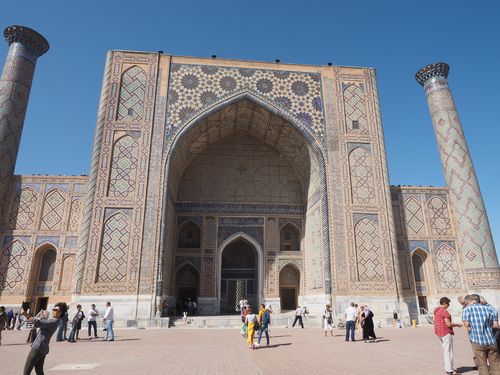
 The Ulugh Beg Madrasa, located in Samarkand, Uzbekistan, is one of the most significant landmarks of the historic city. Standing on Registan Square, it reflects Samarkand’s former importance as an intellectual and urban centre of Central Asia. The monument is associated with the ruler and scholar Ulugh Beg, whose name remains linked to learning and scientific development. Today, the madrasa is a major element of Uzbekistan’s cultural heritage and attracts visitors, researchers and travellers interested in the region’s past. It plays an essential role in the monumental identity and international reputation of Samarkand.


Monument profile
Madrasa Ulugh Beg
Monument category: Madrasa
Monument family: Mosque, Minaret or Madrasa
Monument genre: Religious
Cultural heritage: Islamic
Geographic location: Samarkand • Uzbekistan
Construction period: 15th century AD
This monument in Samarkand is inscribed on the UNESCO World Heritage List since 2001 and is part of the serial property "Samarkand – Crossroad of Cultures".See the UNESCO monuments featured on this site
• Links to •
• List of videos about Samarkand on this site •
Samarkand, the city of Amir Timur • Uzbekistan
• References •
Wikipedia EN: Ulugh Beg Madrasa, Samarkand
UNESCO: Samarkand – Crossroad of Cultures
The Ulugh Beg Madrasa in the History of Timurid Samarkand
Foundation under the Reign of Ulugh Beg
The Ulugh Beg Madrasa was built in Samarkand between 1417 and 1420 during the reign of Mirza Muhammad Taraghay, better known as Ulugh Beg, grandson of Timur. It was erected on what is now Registan Square and formed part of the urban consolidation programme pursued after the great Timurid conquests. At that time, Samarkand remained one of the principal political and cultural capitals of Central Asia.
Its patron was not merely a dynastic ruler. Ulugh Beg acquired a lasting reputation as a scholar-prince deeply interested in mathematics and astronomy. The creation of this madrasa therefore served a double purpose: to affirm Timurid legitimacy and to provide the capital with a prestigious institution of higher learning.
The choice of the Registan, a large civic space used for assemblies, announcements and commercial activity, increased the monument’s political visibility. The madrasa was not a peripheral school but a building placed at the centre of urban life.
Intellectual Function and Scientific Prestige
The Ulugh Beg Madrasa functioned as an institution for religious, legal and scientific education. Like other madrasas, it housed teachers, students and personnel responsible for administration and maintenance. Its historical distinction, however, lies in its close association with the rational sciences cultivated at the Timurid court.
Ulugh Beg gathered leading scholars linked to his intellectual circle, including Qadi Zada al-Rumi and later Ali Qushji. The madrasa belonged to the same scholarly environment that would culminate in the foundation of the famous astronomical observatory of Samarkand some years later. It thus formed one of the institutional pillars of an exceptional scientific programme within the fifteenth-century Islamic world.
Teaching activity was also tied to dynastic prestige. Patronage of theology, law, mathematics and astronomy allowed the ruler to present himself as a cultivated sovereign and guardian of intellectual order. The madrasa rapidly became one of the principal symbols of Ulugh Beg’s reign.
Developments after the Timurid Period
After the assassination of Ulugh Beg in 1449 and the political struggles that followed, Samarkand gradually lost part of its imperial centrality. The madrasa nevertheless continued to serve educational functions for several centuries, although its influence varied according to political stability and available resources.
Under later dynasties, especially the Shaybanids and subsequent regional powers, the Registan remained a major urban focus. The construction in the sixteenth and seventeenth centuries of new madrasas facing or adjoining the Ulugh Beg Madrasa transformed the square into a coherent monumental ensemble. The original building then acquired a foundational role within the composition of the site.
Like many monuments of Central Asia, it also suffered from earthquakes, structural ageing, changing economic conditions and uneven maintenance. Some parts were repaired, others altered or rebuilt according to the techniques of different periods.
Heritage Rediscovery and Present Status
From the nineteenth century onward, and especially during the Soviet period, the Ulugh Beg Madrasa became the subject of surveys, historical studies and restoration campaigns of varying scale. Authorities sought to stabilise the structure, recover parts of its decorative programme and present the Registan as a major symbol of regional history.
Since the independence of Uzbekistan in 1991, the madrasa has become one of the most representative monuments of national heritage. It plays a central role in the international image of Samarkand as both an ancient crossroads city and a centre of scholarship.
The monument is included in the UNESCO World Heritage property inscribed in 2001 under the official name Samarkand – Crossroads of Cultures. This designation recognises the exceptional historical value of the city and of its principal monumental ensembles, among which the Registan is one of the essential cores.
Today, the madrasa no longer fulfils its original academic role, but remains a place of historical transmission, tourism and symbolic representation of the Timurid past.
Global Historical Context
The madrasa was built in the early fifteenth century. In China, the Ming dynasty was consolidating power during the era of Zheng He’s maritime expeditions. In Western Europe, the Hundred Years’ War continued between the kingdoms of France and England. The Ottoman state was rebuilding after the defeat at Ankara in 1402. In the Andes, the Inca state was entering a phase of expansion.
Architectural Configuration of the Ulugh Beg Madrasa in Samarkand
Position on the Registan and Overall Composition
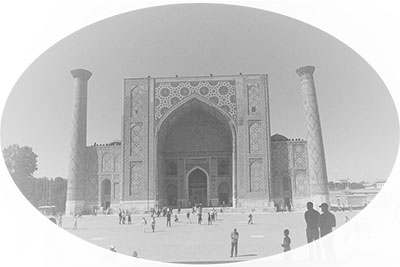
The Ulugh Beg Madrasa occupies the western side of Registan Square in Samarkand, a location that gives it a commanding urban presence. Rather than functioning as an isolated structure, the building was conceived as one side of a monumental civic ensemble. Its principal façade addresses the open square directly, transforming the madrasa into both an educational institution and an architectural boundary defining public space.
The plan follows a rectangular scheme organised around a large internal courtyard. This arrangement allows the exterior to present a monumental and unified face, while the interior accommodates the practical needs of study, residence and circulation. The contrast between the formal outer front and the more functional inner organisation is one of the defining characteristics of the monument.
Symmetry governs the entire composition. A central longitudinal axis runs from the main portal through the entrance passage into the courtyard. Lateral wings mirror one another, while the corners are emphasised by vertical elements historically associated with minarets. This balanced geometry gives the building visual stability and ceremonial clarity.
The scale of the façade was carefully calibrated for long-distance perception across the square. Broad horizontal dimensions are combined with a dominant vertical centre, allowing the madrasa to remain legible within the large urban setting of the Registan.
Monumental Portal, Elevations and Exterior Volumes
The principal façade is dominated by a monumental pishtaq, a projecting entrance frame surrounding a tall pointed arch recessed deep into the wall mass. This structure serves as the visual and symbolic focus of the entire composition. Its height rises above the adjoining wings, establishing a central vertical accent that reinforces the prestige of the institution.
On both sides of the portal, the façade extends in ordered ranges of openings arranged over several levels. These openings correspond largely to student cells and internal rooms. Their repetition creates a measured rhythm that contrasts with the dramatic scale and decorative concentration of the entrance block.
The corners were historically marked by slender minarets or tower-like vertical accents. Some of these elements were damaged, tilted or reconstructed over time, yet their original function was clear: to frame the façade and strengthen its vertical profile. Even where altered, they remain essential to the reading of the composition.
The massing of the building avoids excessive complexity. Broad wall surfaces, controlled height transitions and a strong central projection produce a disciplined monumentality. The madrasa impresses through proportion and order rather than through restless multiplication of forms.
Interior Organisation and Functional Logic
Passing through the portal leads into the central courtyard, which forms the organisational heart of the madrasa. This open space provides daylight, ventilation and spatial orientation. It also separates the quieter academic environment from the ceremonial urban front facing the square.
Around the courtyard are arranged two-storey ranges of hujras, or student cells. These modest chambers were intended for residence, study and private reading. Their repeated doors and windows create a continuous architectural rhythm along the inner elevations.
Larger rooms were integrated for teaching, discussion or administrative purposes. Some spaces likely served specialised scholarly functions, while others accommodated communal activities associated with the institution. The architectural hierarchy is therefore clear: the courtyard as centre, the cells as regular perimeter units, and larger chambers as punctuating elements.
Secondary iwans positioned on courtyard axes reinforce internal symmetry and provide transitional zones between covered and open areas. These vaulted recesses also act as visual anchors, giving the courtyard elevations depth and hierarchy.
Circulation is direct and intelligible. The building was designed to house a disciplined scholarly community, and its spatial logic reflects that purpose. Movement from entrance to courtyard and then to residential or teaching spaces occurs without ambiguity.
Materials, Decorative System and Construction Techniques
The principal structural material is fired brick, the dominant building medium of the region. Brick forms the load-bearing walls, vaults, arches and subsidiary domes. Its modular nature allowed builders to create precise geometries and controlled transitions between vertical walls and curved roofing systems.
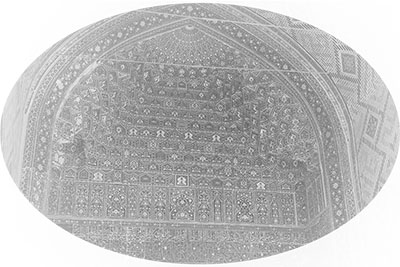
Exterior and selected interior surfaces were enriched with glazed ceramic revetments and mosaic faience. These decorative layers cover major areas of the portal, spandrels, frames and selected wall zones. Blue, turquoise, white and ochre tones create a luminous contrast with the earthen colour of the brick core.
Decoration follows architectural lines rather than obscuring them. Ceramic bands trace arches, frame niches, mark cornices and articulate structural divisions. Calligraphic inscriptions function not only as text but also as compositional devices, forming horizontal registers visible from a distance.
Geometric ornament is especially significant in a monument associated with Ulugh Beg, whose reputation as mathematician and astronomer shaped the intellectual identity of his reign. Repeating star patterns, polygonal schemes and measured proportional systems suggest an ornamental culture closely linked to geometry.
The craftsmanship required careful coordination between masons, tilemakers, calligraphers and designers. The result is an integrated surface system in which structure and ornament remain closely related.
Alterations, Restoration and Architectural Preservation
Like many monuments in Samarkand, the Ulugh Beg Madrasa suffered from earthquakes, settlement, climatic erosion and long periods of uneven maintenance. Corner towers experienced structural movement, while decorative surfaces lost portions of their original ceramic skin.
Restoration campaigns undertaken from the nineteenth century onward, and especially during the twentieth century, aimed to consolidate masonry, stabilise leaning elements, repair foundations and recover damaged decorative zones. Some interventions prioritised structural survival, while others sought visual reintegration of missing portions.
Modern conservation must address the ageing of brickwork, salt damage, water infiltration and the fragility of ceramic coatings. Visitor pressure on the Registan also requires careful management so that tourism does not accelerate wear.
Despite these challenges, the madrasa retains exceptional architectural power. It remains simultaneously a medieval institution of learning, a masterpiece of Timurid urban design and one of the defining façades of Samarkand.