

 Français (France)
  Nederlands (nl-NL)
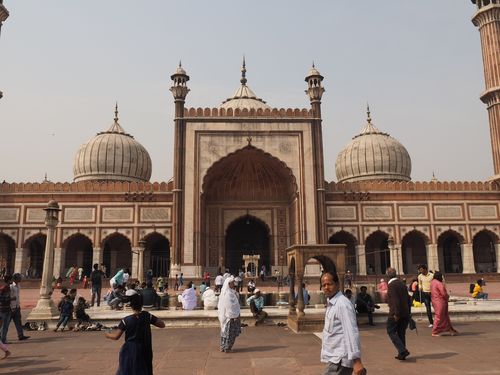
 The Jama Masjid Mosque is one of the most significant religious monuments in Delhi, India, and a prominent landmark of the historic capital. Located in the former imperial city of Shahjahanabad, it has served for centuries as an important center of Islamic worship and community life. The complex includes a large prayer courtyard, surrounding arcades, and several structures associated with religious activities. Its considerable capacity allows large congregations to gather during daily prayers and major Islamic celebrations. Today, Jama Masjid continues to function as an active place of worship while also representing a major cultural and historical reference point within the urban landscape of Delhi.

Monument profile
Jama Masjid Mosque
Monument category: Mosque
Monument family: Mosque, Minaret or Madrasa
Monument genre: Religious
Cultural heritage: Islamic
Geographic location: Delhi • Delhi (NTC) • India
Construction period: 17th century AD
• Links to •
• Dynasties that contributed to the construction of the monument •

• List of videos about Delhi on this site •
Delhi • Capital of Empires and Spiritualities • India
• References •
Wikipedia EN: Jama Masjid, Delhi
Britannica: Jama Masjid of Delhi
• Sources •
Michell, George. Mughal Architecture & Gardens. Antique Collectors' Club, 2011. Asher, Catherine B. Architecture of Mughal India. Cambridge University Press, 1992. Blake, Stephen. Shahjahanabad: The Sovereign City in Mughal India, 1639–1739. Cambridge University Press, 2002. Archaeological Survey of India (ASI), Reports on Conservation.
History of Jama Masjid Mosque in Delhi
Foundation of the Mosque and Imperial Patronage
The Jama Masjid of Delhi was constructed during the reign of the Mughal emperor Shah Jahan in the mid-seventeenth century. Its construction formed part of the broader urban development program associated with the establishment of the imperial capital of Shahjahanabad. The mosque was conceived as the principal congregational mosque of the new city and was intended to serve the religious needs of the Muslim population living within the capital.
Construction began in 1650 and continued for approximately six years. The project was financed directly by the imperial treasury and supervised by officials of the Mughal court. Historical accounts describe the participation of large numbers of craftsmen and laborers who worked on the construction of the mosque and its surrounding structures. The building was completed in 1656 and formally inaugurated as the principal mosque of the city.
The location of the mosque within Shahjahanabad was carefully selected. It stands on a raised site in the western part of the city, not far from the Red Fort, which served as the imperial residence. This placement ensured that the mosque would occupy a visible and prominent position within the urban layout of the Mughal capital. The elevated platform on which the mosque was constructed further reinforced its presence in the surrounding cityscape.
The Jama Masjid was intended to function as the central location for the Friday congregational prayers. In Islamic tradition, the principal mosque of a city hosts the communal prayer and sermon attended by large groups of worshippers. By establishing such a mosque in the new capital, Shah Jahan reinforced the connection between imperial authority and the institutional structure of Islamic worship.
Religious and Institutional Role in Mughal Delhi
Following its completion, the Jama Masjid quickly became a major religious institution within Shahjahanabad. The mosque hosted the weekly Friday prayers and served as a focal point for the Muslim population of the city. Its large courtyard and prayer hall allowed thousands of worshippers to gather during regular prayers and major religious festivals.
The imam appointed to the mosque held an important religious position within the capital. The Friday sermon delivered in the mosque traditionally included references to the reigning sovereign, a practice that symbolically connected religious authority with imperial legitimacy. This ceremonial aspect reinforced the mosque’s status within the political and religious structure of the Mughal court.
The proximity of the mosque to the Red Fort strengthened its institutional significance. Members of the imperial household and court officials could attend religious ceremonies at the mosque, especially during major Islamic celebrations such as Eid al-Fitr and Eid al-Adha. The mosque thus functioned both as a place of worship and as a setting where imperial presence could be publicly displayed.
During the seventeenth and eighteenth centuries, the mosque remained an active center of religious activity. Scholars and students associated with Islamic learning were present in the surrounding neighborhoods, and the area around the mosque developed into an important environment for religious instruction and intellectual exchange.
Political Upheavals and Changes in the Nineteenth Century
The political circumstances of Delhi changed significantly during the eighteenth and nineteenth centuries. The authority of the Mughal Empire weakened progressively as regional powers and external forces challenged imperial control. Despite these political shifts, the Jama Masjid continued to function as the principal mosque of the city.
The invasion of Delhi by the Persian ruler Nadir Shah in 1739 disrupted the political life of the city and caused widespread violence and looting in many districts. Although the mosque itself did not suffer major structural destruction during this event, the occupation of the city affected the social and religious environment in which it operated.
The most dramatic transformation in the history of the mosque occurred during the Indian Rebellion of 1857. During this uprising against British rule, Delhi became one of the central theaters of conflict. Religious and public spaces within the city, including the Jama Masjid, became points where groups of insurgents gathered.
When British forces regained control of Delhi later that year, the mosque came under direct colonial authority. For a period after the suppression of the rebellion, the Jama Masjid was closed for regular worship. British authorities briefly used the site for military purposes and considered the possibility of demolishing the mosque as part of punitive measures against the population of the city.
This proposal was ultimately abandoned. The mosque was eventually returned to the Muslim community, and religious activities resumed. Nevertheless, the events of 1857 marked a profound rupture in the political context surrounding the monument and signaled the definitive end of Mughal imperial authority in Delhi.
Global Historical Context during the Construction of the Mosque
The construction of Jama Masjid during the early 1650s coincided with significant political developments in other parts of the world. In Europe, the Peace of Westphalia in 1648 concluded the Thirty Years’ War and reshaped diplomatic relations among European states. In China, the Qing dynasty consolidated its control after the collapse of the Ming dynasty in 1644. In the Ottoman Empire, imperial authority continued to dominate political structures across Anatolia, the Middle East, and parts of southeastern Europe.
Evolution in the Modern Period and Contemporary Significance
During the twentieth century, Jama Masjid remained one of the most important mosques in Delhi. After the independence of India in 1947, the monument continued to serve as a major center of Islamic worship in the capital. Daily prayers and large congregational gatherings during religious festivals maintained the mosque’s central role in the religious life of the city.
The mosque also became a well-known historical landmark within the urban landscape of Delhi. Visitors interested in the historical heritage of the Mughal period frequently include the mosque among the principal sites of the old city. Despite this visibility, the building continues to function primarily as an active place of worship.
The administration of the mosque has historically been associated with a hereditary line of imams connected to the institution since the Mughal period. This continuity has contributed to preserving certain ceremonial and institutional traditions linked to the mosque’s original foundation.
Maintenance and conservation activities have been carried out periodically to address structural wear and environmental deterioration affecting the stone surfaces and architectural elements of the complex. These interventions focus on stabilizing the historic structures and maintaining the functional conditions required for religious use.
Jama Masjid is not individually listed as a UNESCO World Heritage Site. Nevertheless, it remains closely associated with the historical fabric of Old Delhi and continues to represent one of the most prominent religious monuments constructed during the Mughal period in the city.
Architecture of Jama Masjid Mosque in Delhi
Site Placement and Overall Spatial Layout
Jama Masjid in Delhi occupies a prominent elevated platform within the historic urban fabric of Shahjahanabad, the Mughal capital established in the seventeenth century. The mosque stands on a natural rise that was further reinforced by an artificial plinth, creating a clear separation between the sacred precinct and the surrounding urban environment. This elevated position enhances the visual prominence of the monument within the dense fabric of Old Delhi and establishes a clear architectural boundary between the mosque complex and the surrounding streets.
The entire complex follows a rectilinear plan organized around a vast central courtyard. This courtyard constitutes the principal spatial element of the mosque and determines the overall circulation within the monument. The orientation of the complex follows the direction of the qibla toward Mecca, with the main prayer hall located along the western edge of the courtyard. The rectangular enclosure of the mosque is defined by continuous arcaded galleries and boundary walls that create a unified architectural composition.
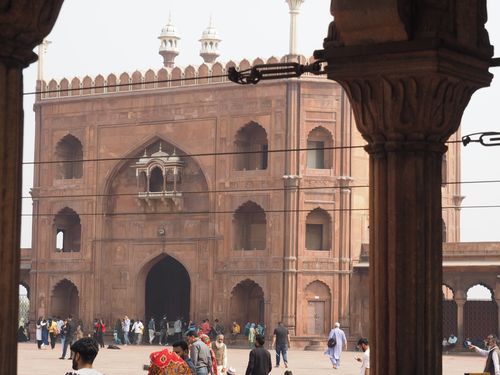
Three monumental gateways provide access to the courtyard from the east, north, and south. Each entrance is approached by a broad flight of steps that rises from street level to the elevated platform. These staircases create a gradual transition from the urban environment to the religious precinct. The eastern gateway is the largest and most ceremonially emphasized entrance, consisting of a tall central arch framed by flanking towers and crowned by decorative architectural elements.
The elevated plinth on which the mosque rests plays a structural and visual role. It provides a stable base for the construction and creates a horizontal platform that organizes the circulation of visitors across the site. The difference in elevation between the surrounding streets and the courtyard reinforces the monumentality of the mosque and contributes to the perception of the building as a dominant architectural landmark.
Organization of the Courtyard and Prayer Hall
The central courtyard of Jama Masjid measures roughly 100 by 90 meters and forms the primary congregational space of the mosque. The paving of the courtyard is composed of large stone slabs arranged in geometric patterns that organize the alignment of worshippers during prayer. The scale of this open space allows the mosque to accommodate large numbers of people during communal gatherings and major religious celebrations.
At the center of the courtyard stands a rectangular ablution tank used for ritual purification before prayer. The tank is integrated into the geometric layout of the courtyard and functions as a focal point within the open space. The symmetry of the courtyard is reinforced by the alignment of the entrances and the architectural axis leading toward the prayer hall.
The prayer hall occupies the entire western side of the complex and forms the most architecturally elaborate section of the mosque. The façade of the prayer hall is articulated by a sequence of tall arches that open toward the courtyard. These arches create a deep arcade that serves as a transitional space between the courtyard and the interior prayer area.
The central arch of the façade is larger and higher than the adjacent arches, establishing a clear visual emphasis on the central axis of the mosque. Behind the façade lies a large covered prayer hall divided into several bays by rows of structural supports. The interior space is organized so that worshippers align themselves in rows facing the qibla wall.
The mihrab, a niche indicating the direction of Mecca, is located in the center of the qibla wall and forms the focal point of the interior space. The spatial arrangement of the prayer hall directs attention toward this element, reinforcing the orientation of the congregation during prayer.
Arcaded galleries surrounding the courtyard extend the capacity of the mosque. These galleries provide shaded areas that function as auxiliary prayer spaces during periods of large attendance.
Materials and Construction Techniques
The construction of Jama Masjid relies primarily on the combined use of red sandstone and white marble. Red sandstone forms the structural framework of the monument, including the outer walls, gateways, staircases, and major architectural masses. The stone blocks were carefully cut and assembled into thick masonry walls capable of supporting the large structural loads of the mosque.
White marble appears in selected architectural elements and decorative surfaces. The material is used in the paving of certain areas, in ornamental panels, and in parts of the façade. The contrast between the deep red sandstone and the bright white marble produces a strong visual effect that defines the architectural character of the building.
Structural systems within the mosque are based on a combination of load-bearing masonry walls and arcaded support systems. Stone columns and piers support a sequence of arches that distribute the weight of the roof structures. These arches allow the creation of wide interior spaces while maintaining structural stability.
The roofing system of the prayer hall consists of a combination of vaulted elements and domed structures. The domes rest on transitional structural elements that distribute the weight onto the supporting walls and piers below. This structural arrangement allows the domes to rise prominently above the roofline while maintaining equilibrium within the building’s overall mass.
The elevated platform beneath the mosque serves an important structural function. By distributing the load of the complex across a stable base, the platform ensures the long-term stability of the building and protects the structure from ground-level moisture and erosion.
Architectural Features and Visual Composition
The architectural identity of Jama Masjid is defined by several prominent structural elements. Three large domes rise above the roof of the prayer hall. These domes are clad in white marble and display alternating dark and light bands that emphasize their curvature. Their placement along the roofline creates a balanced composition that reinforces the central axis of the mosque.
Two minarets flank the prayer hall façade. These towers rise to a height of approximately forty meters and consist of vertically stacked cylindrical sections separated by projecting balconies. Constructed of alternating bands of red sandstone and white marble, the minarets form vertical counterpoints to the horizontal lines of the courtyard and arcades.
The façade of the prayer hall is composed of a series of large pointed arches framed by decorative stonework. The surfaces of the arches incorporate calligraphic inscriptions and geometric motifs carved into marble panels. These inscriptions form part of the decorative program of the mosque and emphasize the central entrance of the prayer hall.
Wide staircases leading to the three entrances contribute to the monument’s architectural presence. The broad steps amplify the scale of the structure and create an approach sequence that gradually reveals the courtyard and prayer hall.
Perforated stone screens appear in selected architectural elements, allowing light and air to pass through while maintaining visual separation between interior spaces. These screens introduce patterns of filtered light within the architectural composition.
Flat roof terraces extend above several parts of the structure and provide additional circulation routes. Small domed kiosks positioned at architectural corners contribute vertical accents that complement the larger domes and minarets.
Architectural Changes and Conservation
The architectural configuration of Jama Masjid has remained largely intact since its completion in the seventeenth century. Unlike many Mughal palace complexes that experienced extensive structural alterations, the mosque preserved its principal layout and architectural elements.
Maintenance and repair works have been carried out periodically to address structural wear affecting sandstone masonry and marble surfaces. Restoration interventions have included the replacement of deteriorated stone blocks, the cleaning of marble elements, and the stabilization of structural components exposed to environmental weathering.
During the nineteenth century, following the events of the Indian Rebellion of 1857, the mosque was temporarily closed and briefly used for military purposes by colonial authorities. However, the building itself was not subjected to large-scale structural modifications during this period.
In the modern era, conservation efforts focus on preserving the historic fabric of the monument. Maintenance programs aim to prevent erosion of stone surfaces, manage structural stress caused by visitor traffic, and protect decorative elements from environmental damage.
The continued use of the mosque for daily worship has influenced conservation strategies. Preservation measures seek to maintain both the architectural integrity of the monument and the functional requirements of an active religious site. Through these efforts, the architectural structure of Jama Masjid continues to reflect the spatial organization and material composition established at the time of its construction in the seventeenth century.