

 Français (France)
  Nederlands (nl-NL)
 The Red Fort of Delhi is a large fortified complex located in Delhi, the capital of India, within the National Capital Territory of Delhi. The monument represents one of the most prominent historical landmarks of the city and remains a significant reference point within the urban landscape of the former imperial capital. Surrounded by extensive red sandstone walls, the complex includes monumental spaces, pavilions and open areas associated with the political history of the region. Today the fort holds an important symbolic role in national life and serves as the setting for official state ceremonies. The site is also recognized internationally as a major heritage monument.
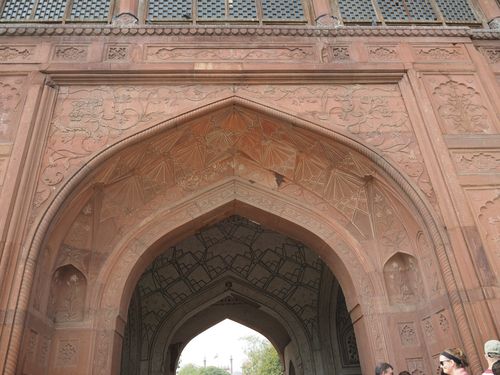
Delhi • Red Fort
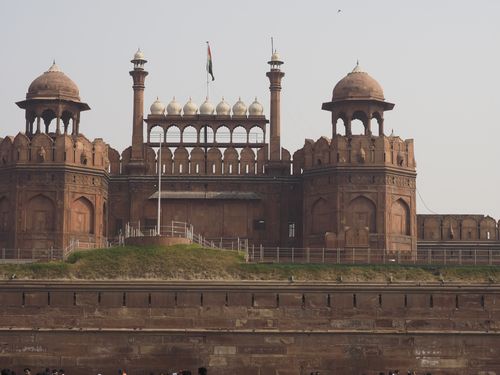
Delhi • Red Fort
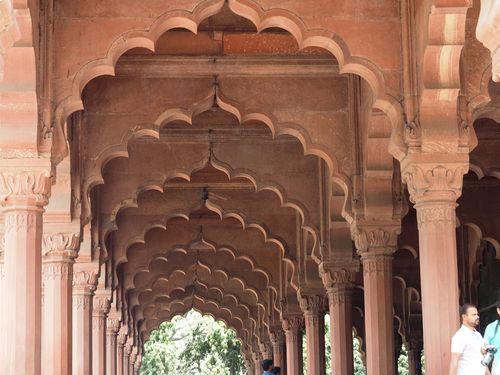
Delhi • Red Fort
Delhi's Red Fort


History of the Red Fort of Delhi
Foundation of the Fort and Creation of Shahjahanabad
Construction of the Red Fort of Delhi began in 1638 under the Mughal emperor Shah Jahan, during a period when the imperial court decided to transfer its political center from Agra to a newly planned capital. The new city, Shahjahanabad, was conceived as a carefully organized imperial capital, and the Red Fort formed the core of this urban project. The complex was designed to function simultaneously as a royal residence, an administrative center, and the ceremonial seat of Mughal authority.
The chosen location stood along the western bank of the Yamuna River. This placement allowed the imperial palace complex to incorporate the river into its hydraulic infrastructure while also providing a natural boundary along the eastern side of the fortifications. The construction of the fort required extensive planning and labor, involving the coordination of imperial architects, engineers, and craftsmen working under the supervision of the Mughal court. Major structures of the complex were largely completed by 1648, the year in which Shah Jahan formally transferred his court to the new capital.
From its inception, the Red Fort was intended to symbolize the political stability and authority of the Mughal Empire. The architectural and spatial organization of the complex supported this function by providing formal spaces for public audiences, diplomatic ceremonies, and imperial administration. The fort also contained the residential quarters of the emperor, members of the royal household, and numerous officials attached to the imperial court.
The Red Fort as the Seat of Mughal Power
For more than a century after its completion, the Red Fort served as the principal residence of successive Mughal emperors and the administrative center of the empire. Political authority was exercised within its walls through a structured system of courtly ceremonies and official audiences held in designated palace pavilions.
Public audiences took place in the Diwan-i-Am, where the emperor received petitions and addressed representatives of the imperial administration. More confidential political consultations occurred in the Diwan-i-Khas, which served as the setting for meetings with senior officials, diplomats, and selected members of the nobility. These ceremonial practices reinforced the role of the fort as the visible center of imperial governance.
The complex also housed various administrative functions associated with the management of the Mughal state. Court officials, military commanders, and representatives from provincial administrations regularly attended the imperial court within the fort’s precincts. Decisions concerning taxation, military campaigns, diplomatic relations, and provincial governance were communicated from this center of authority.
The political situation of the empire began to change during the eighteenth century as the power of the Mughal court gradually weakened. In 1739, the Persian ruler Nadir Shah invaded northern India and captured Delhi. The Red Fort was occupied during this invasion, and the imperial treasury was looted. Valuable objects and regalia were removed from the palace complex, marking a severe blow to the prestige and resources of the Mughal court.
Following this episode, the authority of the Mughal emperors continued to decline. Although the imperial family remained in residence at the Red Fort, real political power increasingly shifted to regional rulers and to external political actors, including the expanding influence of the British East India Company.
The Fort during the Revolt of 1857 and the End of Mughal Rule
The historical role of the Red Fort changed dramatically during the uprising of 1857, a major revolt against British authority in northern India. At that time, the last Mughal emperor, Bahadur Shah II, still resided within the palace complex, although his political power had become largely symbolic.
During the uprising, rebel forces proclaimed Bahadur Shah II as the symbolic leader of the revolt and used the Red Fort as a political focal point for resistance against British rule. The city of Delhi became one of the principal centers of the conflict.
When British forces retook Delhi later that year, the Red Fort was seized by the colonial army. Bahadur Shah II was arrested, tried within the fort itself, and eventually exiled to Rangoon. This event marked the formal end of the Mughal dynasty and the disappearance of the imperial court that had occupied the fort for more than two centuries.
Following the suppression of the revolt, the British administration transformed the Red Fort into a military installation. Large sections of the palace complex were demolished to create open parade grounds and barracks for colonial troops. Numerous residential structures, gardens, and service buildings were destroyed during this process, significantly altering the original spatial organization of the Mughal palace complex.
Despite these extensive modifications, several ceremonial buildings survived, allowing the site to retain part of its architectural and historical significance.
Global Historical Context during the Construction of the Fort
The construction of the Red Fort in the mid-seventeenth century coincided with significant political developments in other parts of the world. In Europe, the Thirty Years’ War ended in 1648 with the Peace of Westphalia, which reshaped political relations among European states. In East Asia, the Qing dynasty consolidated its rule over China after the fall of the Ming dynasty in 1644. In the Ottoman Empire, imperial authority continued to dominate political structures across southeastern Europe and parts of the Middle East.
The Red Fort after Indian Independence and Its Contemporary Role
After the independence of India in 1947, the Red Fort acquired a new symbolic role within the political life of the country. The monument became the site where the Prime Minister of India addresses the nation each year on 15 August, the anniversary of independence. This annual ceremony transformed the fort into one of the principal national symbols associated with the emergence of the modern Indian state.
The complex also became an important historical site visited by large numbers of visitors each year. Government authorities initiated conservation programs aimed at stabilizing the remaining Mughal structures and protecting the surviving architectural elements of the palace complex.
The Red Fort was inscribed on the UNESCO World Heritage List in 2007 under the official designation “Red Fort Complex.” This recognition acknowledges the historical importance of the monument as the principal palace of the Mughal emperors and as a site closely connected with major political events in the history of Delhi and the Indian subcontinent.
Current conservation efforts focus on preserving the remaining buildings, stabilizing sections of the fortifications, and protecting the architectural remains that survived the transformations of the colonial period. Management of the site also includes measures intended to regulate visitor access and reduce the impact of tourism on the historic structures.
Architecture of the Red Fort of Delhi
Site Layout and Fortification System
The Red Fort of Delhi occupies a large fortified precinct in the northeastern sector of the historic city of Shahjahanabad. The complex extends along the western bank of the Yamuna River, whose course originally formed the eastern boundary of the site. The positioning of the fort allowed water from the river to be incorporated into the palace’s hydraulic systems and garden layouts. The overall plan of the complex is roughly rectangular and organized along a principal west–east axis linking the main entrance gates to the residential sectors of the imperial palace.
The fortifications extend for approximately 2.4 kilometers and form a continuous defensive perimeter surrounding the palace complex. The outer walls reach heights ranging from roughly 18 to more than 30 meters depending on the topography and the defensive requirements of different sections. The ramparts are constructed primarily of red sandstone masonry, which gives the monument its characteristic color and visual identity.
The defensive structure consists of massive curtain walls reinforced by regularly spaced bastions and semi-circular towers. These elements project outward from the main wall line and strengthen the structural stability of the fortifications while allowing surveillance of the surrounding terrain. The upper sections of the walls include parapets and battlements that once provided protected positions for defenders. Walkways integrated into the ramparts permitted movement along the defensive perimeter.
Two principal gateways control access to the interior of the complex. The Lahore Gate, located on the western side, forms the ceremonial entrance to the fort. The Delhi Gate, situated on the southern wall, provided an additional controlled entry point. Both gateways are designed as monumental architectural compositions that integrate defensive and ceremonial functions. Each gateway includes flanking towers and a sequence of passageways designed to regulate entry into the fortified enclosure.
Axial Planning and Spatial Organization of the Palace Complex
The interior organization of the Red Fort follows a carefully structured sequence of spaces aligned along the main axis extending from the Lahore Gate toward the eastern residential areas of the palace. This axial arrangement organizes circulation through the complex and establishes a progression from public ceremonial spaces to increasingly private imperial quarters.
Immediately beyond the Lahore Gate lies the Chatta Chowk, a vaulted corridor that originally functioned as a covered market serving members of the court and visitors entering the fort. The passage consists of a linear sequence of arched bays supporting a continuous roof. Shops were installed within recessed niches along the walls, creating a structured commercial space integrated into the entrance sequence.
The corridor leads to an open courtyard that forms the transitional space between the commercial passage and the ceremonial administrative buildings of the palace. From this courtyard, the axial route directs visitors toward the principal audience halls that formed the political center of the imperial complex.
The Diwan-i-Am, or Hall of Public Audience, stands on a raised platform overlooking the courtyard. The building is composed of a large rectangular pavilion supported by a grid of columns arranged in regular rows. These columns support a system of arches that define a sequence of open arcades around the central audience space. The arrangement allows large assemblies to gather beneath a roofed structure while maintaining visual access to the emperor seated in the central throne niche.
Farther along the axis stands the Diwan-i-Khas, the Hall of Private Audience. This pavilion occupies a more elevated and architecturally refined setting. The structure consists of a rectangular marble pavilion supported by slender columns and surrounded by open arcades. The central interior chamber was designed to accommodate small gatherings of high-ranking officials and diplomatic representatives. The organization of the pavilion emphasizes symmetry and axial alignment with the surrounding gardens.
Beyond the audience halls lie the residential sections of the palace complex. These areas consist of a series of pavilions, apartments, and gardens arranged along terraces that once faced the Yamuna River. The spatial organization of this sector integrates residential buildings with landscaped courtyards and water channels.
Materials, Structural Techniques, and Construction Methods
The Red Fort demonstrates the systematic use of two principal building materials: red sandstone and white marble. Red sandstone forms the structural core of the fortifications and many of the outer palace buildings. The stone blocks were cut with precision and assembled in thick masonry walls capable of supporting the weight and height of the defensive structures.
Within the ceremonial and residential areas of the palace complex, white marble is used extensively for architectural refinement. Columns, railings, platforms, and decorative panels are often executed in marble, creating a visual contrast with the darker red sandstone of the fortifications. This combination of materials contributes to the hierarchical visual organization of the complex, distinguishing defensive structures from imperial ceremonial spaces.
Structural systems within the palace pavilions rely largely on post-and-beam arrangements combined with arches. Stone columns support flat stone slabs or arch-supported roofing systems that distribute weight across multiple supports. This structural method allows the creation of wide covered halls while maintaining an open architectural character.
Several buildings also incorporate chhatris, or domed kiosks, placed on roof terraces. These small domed structures add vertical accents to the horizontal lines of the pavilions and contribute to the skyline of the palace complex. Balustraded terraces and elevated platforms further articulate the spatial hierarchy of the site.
Hydraulic engineering forms an integral component of the architectural design. A water channel known as the Nahr-i-Bihisht, or “Stream of Paradise,” ran through several of the palace pavilions. This channel supplied water to fountains and basins and structured the layout of the gardens. The integration of running water into the architecture reinforced both the aesthetic composition and the environmental cooling of the palace spaces.
Architectural Elements and Decorative Features
The architectural character of the Red Fort is defined by a combination of structural elements that organize circulation and visual perspectives within the complex. Arcades supported by slender columns form repeated architectural modules throughout the ceremonial buildings. These arcades provide shaded spaces that remain open to surrounding courtyards and gardens.
Many pavilions incorporate cusped arches supported by carved columns. These arches create a rhythmic sequence along the façades of the audience halls and residential structures. The articulation of columns and arches produces deep shadow lines that emphasize the architectural geometry of the buildings.
Elevated platforms play an important role in defining the hierarchy of spaces within the complex. Audience halls, residential pavilions, and garden terraces are frequently raised above the surrounding ground level. Access to these platforms is provided by staircases positioned along the main axes of circulation.
Balustrades carved from marble frame terraces and walkways, while perforated stone screens, or jalis, appear in certain sections of the palace architecture. These screens allow air circulation and filtered light to enter interior spaces while maintaining privacy within residential quarters.
Roof terraces form another defining architectural feature of the palace complex. The flat roofs of many pavilions function as accessible platforms connected by stairways and passages. These terraces create additional circulation routes and viewing points within the palace compound.
Architectural Transformations and Conservation
The present architectural configuration of the Red Fort differs significantly from the layout of the palace complex during the Mughal period. Following the suppression of the uprising of 1857, British colonial authorities converted the site into a military installation. Large sections of the imperial residential quarters were demolished to create open parade grounds and barracks.
These alterations removed many structures that once occupied the central sections of the palace complex, particularly the residential pavilions and garden enclosures situated between the ceremonial halls and the riverfront. The destruction of these buildings significantly simplified the spatial organization of the complex.
Despite these losses, several major architectural elements survived, including the principal gates, the Diwan-i-Am, the Diwan-i-Khas, and portions of the original palace terraces. These structures remain the most visible components of the Mughal architectural layout.
In the twentieth century, conservation programs began to address structural deterioration affecting the fortifications and palace buildings. Restoration work has focused on stabilizing sandstone masonry, repairing marble surfaces, and preserving the surviving decorative elements.
Current conservation efforts also involve managing visitor access in order to reduce structural stress on historic surfaces. Protective measures are directed toward maintaining the remaining architectural components of the complex while preventing further degradation caused by environmental conditions and intensive tourism.