

 Français (France)
  Nederlands (nl-NL)
 The Ulugh Beg Observatory in Samarkand, Uzbekistan, is one of the oldest scientific landmarks in history. Built in the 15th century under the leadership of Ulugh Beg, a renowned astronomer and mathematician, it represents the peak of medieval scientific achievement in Central Asia. The observatory housed a massive sextant, enabling remarkably accurate astronomical calculations for its time. Today, it stands as a vital reminder of the region’s intellectual heritage and a key site for the study of astronomy’s historical development.
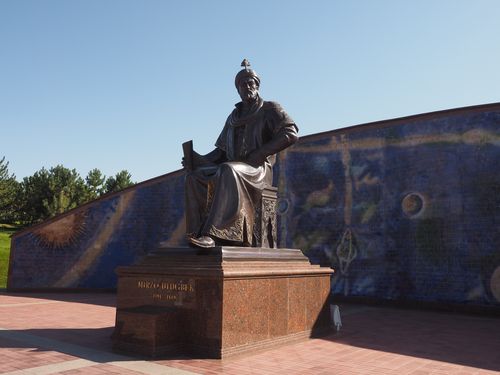
Samarkand • Ulugh Beg Observatory: statue of Ulugh Beg
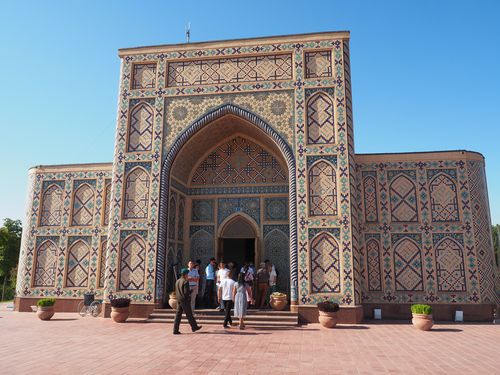
Samarkand • Ulugh Beg Observatory: museum
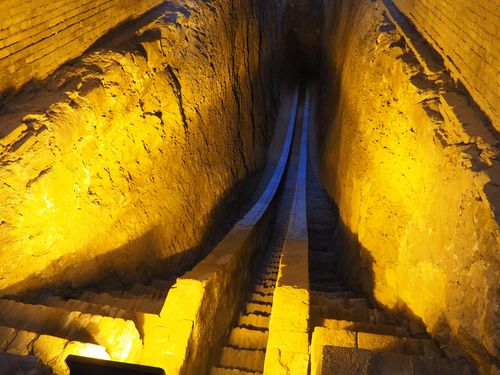
Samarkand • Ulugh Beg Observatory: the wall sextant
Monument profile
Ulugh Beg Observatory
Monument category: Observatory
Monument family: Historic University or Observatory
Monument genre: Cultural or scientific
Cultural heritage: Islamic
Geographic location: Samarkand • Uzbekistan
Construction period: 15th century AD
This monument in Samarkand is inscribed on the UNESCO World Heritage List since 2001 and is part of the serial property "Samarkand – Crossroad of Cultures".See the UNESCO monuments featured on this site
• Links to •
• List of videos about Samarkand on this site •
Samarkand, the city of Amir Timur • Uzbekistan
• References •
Wikipedia FR: Observatoire astronomique d'Ulugh Beg
University of Washington: Samarkand: Ulugh Beg's Observatory
UNESCO: Category of Astronomical Heritage: tangible immovable Ulugh Beg‘s observatory, Uzbekistan
The Ulugh Beg Observatory in the Scientific History of Samarkand
Foundation under the Reign of Ulugh Beg
The Ulugh Beg Observatory was constructed in Samarkand during the 1420s under the rule of Mirza Muhammad Taraghay, better known as Ulugh Beg, grandson of Timur. At that time Samarkand remained one of the principal political and cultural centres of the Timurid realm. Unlike many rulers whose monumental programmes focused mainly on mosques, palaces or mausoleums, Ulugh Beg devoted exceptional attention to mathematics and astronomy.
The observatory was created for a specific purpose: to establish a permanent institution capable of producing highly accurate celestial observations. The project combined dynastic prestige with scholarly ambition. By financing a large scientific complex, Ulugh Beg presented himself as a cultivated sovereign whose authority rested not only on lineage, but also on knowledge.
The site was chosen on elevated ground near the city, where horizon visibility and available space favoured the installation of large fixed instruments. From its foundation, the monument represented both intellectual policy and royal patronage.
Scientific Activity and Intellectual Importance
The observatory gathered several distinguished scholars, including Qadi Zada al-Rumi, Jamshid al-Kashi and later Ali Qushji. It functioned as a collaborative research centre where theoretical calculation, repeated measurement and technical expertise were closely linked.
Its most famous instrument was a monumental meridian sextant built into the structure itself. Because of its exceptional scale, it allowed precise measurements of stellar positions, planetary movements and solar parameters. Observations conducted there contributed to a refined estimate of the length of the solar year and improved astronomical tables.
The principal scholarly outcome of the institution was the Zij-i Sultani, a major set of astronomical tables completed under Ulugh Beg’s patronage. These tables were regarded among the most accurate of the fifteenth century and circulated widely beyond Central Asia.
The observatory therefore served far more than a symbolic role. It was a productive scientific institution whose work influenced later astronomical traditions in Islamic lands and neighbouring regions.
Decline after the Death of Ulugh Beg
The observatory’s fortunes changed rapidly after the assassination of Ulugh Beg in 1449. Political instability and dynastic conflict weakened support for the scholarly programme associated with his reign. Without sustained patronage, the institution gradually lost resources and central importance.
In the following decades, the site was abandoned and eventually dismantled. Materials from the superstructure were likely reused elsewhere, a common fate for disused monuments. Most of the visible building disappeared, while the memory of the observatory survived mainly through scholarly writings and references to Ulugh Beg’s scientific achievements.
Although the structure declined, its intellectual legacy endured. The astronomical tables and methods associated with Samarkand continued to circulate and were studied for generations.
Archaeological Rediscovery and Present Status
The physical remains of the observatory were identified in the early twentieth century through archaeological investigation. Excavations revealed foundations and, most importantly, surviving sections of the monumental subterranean sextant. These discoveries confirmed the technical sophistication and unusual scale of the original complex.
During the Soviet period, and later after the independence of Uzbekistan in 1991, the site was preserved and developed as a place of historical interpretation. A museum dedicated to Ulugh Beg and the history of astronomy was established nearby, linking the ruins with the broader scientific culture of Timurid Samarkand.
The observatory is included within the UNESCO World Heritage property inscribed in 2001 under the official name Samarkand – Crossroads of Cultures. Its inclusion recognises not only architectural remains, but also Samarkand’s importance as a centre of learning.
Today the site stands as one of the clearest material testimonies to pre-modern scientific research in Central Asia.
World Historical Context
The main phase of construction belongs to the first half of the fifteenth century. In China, the Ming dynasty sponsored the maritime expeditions of Zheng He. In Western Europe, the Hundred Years’ War was approaching its final phase. The Ottoman state was rebuilding after the crisis that followed the defeat of 1402. In the Andes, the Inca state was expanding regionally.
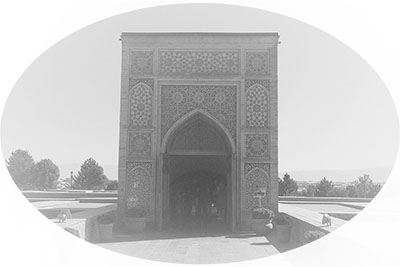
Architectural Configuration of the Ulugh Beg Observatory in Samarkand
Site Position and Overall Layout
The Ulugh Beg Observatory was established on elevated ground to the northeast of historic Samarkand, outside the densest urban fabric of the Timurid capital. This location was not incidental. It provided clearer horizons, reduced visual obstruction, and sufficient open space for a scientific complex whose dimensions exceeded those of ordinary workshops or scholarly residences. The chosen site also limited interference from surrounding construction and allowed accurate alignment with cardinal directions.
Archaeological evidence and historical descriptions indicate that the building had a predominantly circular or polygonal form approaching a circle. This plan differed markedly from the rectangular courtyard schemes common in religious schools or palatial structures of the period. The geometry was directly related to the observatory’s purpose: a radial envelope organised around a central astronomical axis.
The structure rose several storeys above ground. Its height likely served practical rather than ceremonial aims, creating levels for observation, calculation rooms and access to instruments. The monument therefore combined the scale of a prestigious public building with the specialised requirements of a technical institution.
Spatial Organisation and Instrumental Core
The defining architectural element of the observatory was its colossal meridian sextant, sometimes described as a giant arc instrument fixed permanently within the structure. This device occupied the central north-south axis of the complex and effectively determined the organisation of the entire building.
Part of the instrument descended into a deep masonry trench below ground level. By extending the radius downward, builders increased measuring precision while maintaining structural stability. The surviving subterranean sections remain among the most remarkable features of the site today.
Rooms surrounding this central axis were secondary in hierarchy but essential in function. They likely housed scholars, manuscript work, calculations, instrument storage and administrative tasks. Instead of a ceremonial hall serving as the spatial focus, the observatory revolved around a measuring apparatus. This reversal of conventional architectural priorities makes the building highly distinctive.
Upper levels may have supported additional observational platforms or housed smaller devices requiring elevated positions. Internal circulation was therefore closely linked to scientific workflow, connecting workrooms, stairways and instrument zones in a practical sequence.
Materials, Construction Methods and Exterior Appearance
Like many major buildings in Samarkand, the observatory was constructed primarily of fired brick. Brick was well suited to Central Asian conditions and allowed precise geometric execution, curved walls, vaulting systems and thick load-bearing masses. Its modular format was especially useful for a circular plan requiring repeated adjustments in angle and curvature.
Mortar-bonded masonry formed the walls, foundations and the retaining surfaces of the instrument trench. Because observational accuracy depended partly on structural stability, careful setting-out and durable construction were fundamental. Settlement or distortion could compromise measurements, so craftsmanship had scientific consequences.
The exterior appearance is imperfectly known because the upper portions were largely destroyed. However, it is probable that selected façades incorporated plastered surfaces and limited ceramic decoration in keeping with Timurid elite architecture. Ornamentation was likely more restrained than on mosques or madrasas, since the building’s prestige derived as much from purpose as from display.
Entrances and stair systems would have required clear functional planning, enabling movement between ground floors, upper levels and the central measuring axis. The overall image was probably one of disciplined monumentality rather than decorative exuberance.
Proportions, Structural Logic and Architectural Specificity
The estimated dimensions of the observatory suggest a building of substantial diameter and commanding presence. This was not a modest scholarly annex but a major institutional monument. Its broad circular mass distinguished it visually from the axial façades and enclosed courtyards of nearby Timurid architecture.
The structural logic was unusual for its time. In many monuments, architecture frames ritual, residence or dynastic ceremony. Here, architecture served measurement. Wall thicknesses, orientation lines, vertical levels and internal voids were subordinated to astronomical function. The building can therefore be understood as a scientific machine expressed in masonry form.
Exact alignment with the meridian was essential. The plan had to correspond accurately to celestial coordinates, requiring surveying knowledge during construction. Precision in orientation transformed geography into part of the design process.
This combination of monumentality, mathematical planning and technical use gives the observatory a rare typological identity. Few fifteenth-century buildings were so completely determined by scientific instrumentation.
Ruin, Excavation and Conservation
After the political decline that followed Ulugh Beg’s death, the observatory lost patronage and gradually fell into disuse. Its upper structures were dismantled or collapsed over time, leaving only buried foundations and the subterranean portions of the giant sextant relatively protected.
Twentieth-century excavations revealed the surviving core of the instrument and clarified the original scale of the complex. Conservation campaigns focused on stabilising exposed masonry, controlling erosion and presenting the remains in an intelligible form for visitors.
Modern preservation faces specific challenges: weathering of ancient brick, water penetration, visitor circulation and the difficulty of interpreting a largely vanished superstructure. Because much of the monument survives below grade or only in foundations, archaeological presentation is as important as structural conservation.
Even in fragmentary condition, the Ulugh Beg Observatory retains exceptional architectural significance. It demonstrates how a complete building could be designed around precision observation, turning architecture into a direct extension of scientific inquiry.