

 Français (France)
  Nederlands (nl-NL)
 Map of videos including a monument related to the theme featured on this page
• Use the markers to explore the content •
The monuments featured in this theme all belong to the broader category of Buddhist architecture and more specifically to the typology of stupas. Though geographically dispersed and diverse in form and chronology, they share a common role: to manifest the presence of the Buddha and convey his teachings across space and time. Whether ancient or modern, modest or monumental, stupas serve as spiritual landmarks, ritual centers, and devotional symbols.
From the early Sujata Stupa in Bodhgaya to the contemporary Global Vipassana Pagoda in Mumbai, through the sacred plains of Bagan and the Himalayan chörtens of Ladakh, each site offers a regional variation of a universally recognizable form. This selection of sixteen monuments reveals both the doctrinal unity behind stupa design and the rich diversity of local adaptations. It invites the reader to follow a historical and geographical journey across Asia, illustrating the broad dissemination of Buddhism and the vitality of a tradition continuously reinterpreted.

The Asian Stupa: Sacred Memory and Architectural Transformation
From funerary monument to Buddhist symbol
The stupa developed from the funerary mounds of ancient India. Within Buddhism, it became a monument built to preserve relics or commemorate places and events connected with the Buddha, his disciples, or the transmission of his teachings. Its religious function does not necessarily depend on an accessible interior. The constructed mass itself serves as a focus for memory, veneration, and the accumulation of merit.
The Sujata Stupa near Bodhgaya recalls the offering traditionally made to the Buddha before his enlightenment, while the Dhamek Stupa at Sarnath marks the setting associated with his first sermon. Such monuments anchor episodes of Buddhist history in specific locations. They transform the landscape into a sacred geography traversed by pilgrims and structured through circumambulation, offerings, meditation, and other devotional practices.
A symbolic structure open to reinterpretation
Despite considerable regional diversity, many stupas share a recognisable vertical organisation. A geometric base supports a solid body, which may be hemispherical, cylindrical, or bell-shaped, followed by axial elements suggesting spiritual ascent. The progression from the ground towards the summit can be understood as an ordered representation of the cosmos or the path to awakening. Terraces and surrounding passages simultaneously direct ritual movement around the monument.
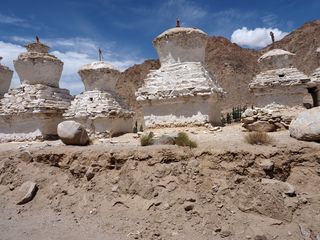
This general structure has never constituted an unchanging formula. The massive brick-and-stone cylinder of the Dhamek Stupa differs markedly from the gilded, tapering pagodas of Myanmar. The chörtens of Ladakh translate the stupa into the architectural vocabulary of Tibetan Buddhism. Their whitewashed volumes and distinctive crowning elements punctuate roads,, monasteries, mountain passes, and villages across the high plateau.
Continuity and renewal in India
The Indian examples illustrate the continuity of the stupa from places associated with the formative history of Buddhism to modern religious foundations. At Bodhgaya and Sarnath, the monuments are closely tied to accounts of the Buddha’s life and teaching. They locate sacred memory while demonstrating how successive communities have maintained, rebuilt, and reinterpreted significant sites over long periods.
Modern stupas extend these functions into different political and urban settings. The Vishwa Shanti Stupa at Rajgir and the Dhauli Shanti Stupa in Odisha belong to the twentieth-century movement of peace pagodas. Their white surfaces, Buddha images, and prominent locations communicate a message of non-violence. In Patna, Buddha Smriti Park combines relics, commemoration, and contemporary urban design. In Mumbai, the Global Vipassana Pagoda adopts a form inspired by Burmese architecture while enclosing a large meditation hall. The stupa therefore becomes both a religious symbol and a functional building.
The Burmese model: kingship, relics, and merit
In Myanmar, the term pagoda commonly refers both to a reliquary stupa and to the wider sacred complex surrounding it. Bagan demonstrates the coexistence of solid stupas and accessible temples, constructed mainly between the eleventh and thirteenth centuries. Their abundance reflects the importance of religious foundations in expressing royal authority and generating merit. The Shwezigon Pagoda at Nyaung U established an influential composition of superimposed terraces, a bell-shaped body, and a tall axial finial.
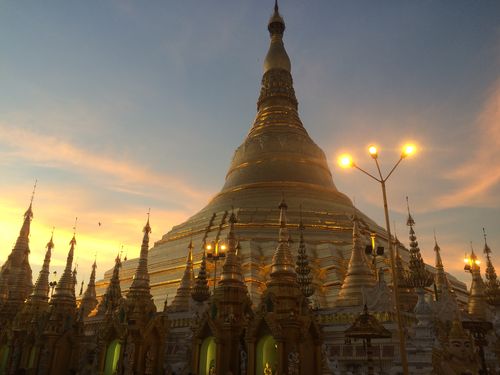
This formula reaches a monumental scale at the Shwedagon Pagoda in Yangon and the Shwe Maw Daw Pagoda in Bago. Height, gilding, and successive donations make the continuity of devotion materially visible. These pagodas are not isolated structures but centres of active compounds containing pavilions, altars, and images. At Mandalay, Kuthodaw Pagoda surrounds its central stupa with hundreds of small shrines containing the Buddhist canon inscribed on stone slabs. Religious architecture thus becomes a means of preserving and transmitting sacred texts.
Urban settings and collective identities
In Laos, stupas show how a widely shared Buddhist form can acquire distinctive local meanings. Pha That Luang in Vientiane is characterised by layered volumes, angular elements, and gilded surfaces. It functions as a major religious monument while also representing national history and identity. That Dam, in the same city, offers a contrasting image. Its dark surface, vegetation, and relatively unrestored condition connect it with urban memory and local legends.
At Luang Prabang, the stupa of Wat Chom Si overlooks the city from Mount Phousi. Its significance derives as much from its elevated location and the route leading to it as from the structure itself. Boudhanath in Kathmandu similarly organises its surroundings. Its large white dome, square tower with painted eyes, and constant circulation of worshippers make it the focal point of a district profoundly shaped by Tibetan Buddhist religious life.
Materials, reconstruction, and changing uses
The variety of Asian stupas also reflects local materials and successive building histories. Brick is prevalent in many ancient monuments, sometimes combined with carved stone facing. White plaster protects and visually unifies Himalayan chörtens, while the gilding of Southeast Asian pagodas communicates sacred value, political patronage, and donations from worshippers. Repairs, enlargements, and reconstructions belong to the continuing lives of these monuments rather than representing merely later alterations.
From modest territorial landmarks to extensive dynastic complexes, the selected monuments demonstrate that the stupa is not a single architectural type. Its unity lies in several complementary purposes: preserving relics, commemorating events, transmitting teachings, and organising ritual practices. Its forms nevertheless express distinct historical, aesthetic, and technical traditions. This capacity for adaptation explains the enduring presence of the stupa across widely separated regions, societies, and periods of Buddhist Asia.


A Survey of Asia’s Principal Stupa Traditions
India
Bihar, Bodhgaya • Sujata Stupa The brick-built Sujata Stupa stands at Bakraur, near Bodhgaya. It is associated with Sujata, who, according to Buddhist tradition, offered food to the Buddha after his period of extreme asceticism. The monument commemorates an episode preceding his enlightenment and illustrates the memorial function of early Indian stupas.
Bihar, Patna • Buddha Smriti Park Opened in central Patna in 2010, this commemorative park is organised around the Patliputra Karuna Stupa. The structure houses Buddhist relics received from several countries. Its contemporary design combines the stupa’s traditional reliquary purpose with that of a modern urban space dedicated to remembrance, religious practice, and public gathering.
Bihar, Rajgir • Vishwa Shanti Stupa Standing on Ratnagiri Hill, this peace pagoda was constructed by the Japanese Buddhist organisation Nipponzan-Myōhōji. Its white structure incorporates niches containing gilded representations of the Buddha. The monument connects Rajgir, an ancient centre of Buddhism, with a modern international movement promoting peace and non-violence.
Ladakh, High Plateau • Chörtens of Ladakh Chörtens mark roads, mountain passes, villages, and monastic sites throughout Ladakh. Adapted to the traditions of Tibetan Buddhism, they generally consist of whitewashed geometric volumes supporting an axial crown. They may preserve relics, commemorate religious teachers, identify sacred locations, or serve as focal points for circumambulation and devotional practice.
Maharashtra, Mumbai • Global Vipassana Pagoda Completed near Mumbai in the early twenty-first century, this pagoda draws on forms associated with Burmese architecture. Its large dome contains a hall designed for collective Vipassana meditation. The building reinterprets the reliquary stupa as an accessible interior space, combining traditional Buddhist symbolism with the practical requirements of a contemporary meditation centre.
Odisha, Dhauligiri • Dhauli Shanti Stupa Constructed in the twentieth century on the hills at Dhauli, this white stupa belongs to the international network of peace pagodas. Its location is associated with the Kalinga War and the tradition of Emperor Ashoka’s conversion to Buddhism. Sculpted reliefs and Buddha images complement its rounded mass and elevated position.
Uttar Pradesh, Sarnath • Dhamek Stupa The Dhamek Stupa marks the place traditionally associated with the Buddha’s first sermon after his enlightenment. Its imposing cylindrical body is built of brick and partly faced with carved stone, reflecting several construction phases. Geometric and vegetal patterns on the lower section preserve evidence of the site’s ancient artistic development.
Laos
Luang Prabang • Wat Chom Si Stupa The stupa of Wat Chom Si stands at the summit of Mount Phousi in central Luang Prabang. Its elevated position makes it both an urban landmark and the destination of a religious route. Its gilded silhouette demonstrates how the stupa was incorporated into the monastic and ceremonial landscape of Lao Buddhism.
Vientiane • Pha That Luang Stupa Pha That Luang is a major Buddhist monument and a national symbol of Laos. Reconstructed during the reign of King Setthathirath in the sixteenth century, it is distinguished by layered volumes, angular forms, and gilded surfaces. The complex remains associated with important Buddhist ceremonies as well as official national events.
Vientiane • That Dam Stupa That Dam, or the Black Stupa, stands within the urban fabric of Vientiane. Its dark surface, vegetation, and relatively unrestored appearance contrast with the gilding of Pha That Luang. Surrounded by local legends, it shows how an ancient stupa can remain a place of collective memory outside an active monastic complex.
Myanmar
Bagan • Temples of Bagan Bagan contains thousands of Buddhist monuments, constructed mainly between the eleventh and thirteenth centuries. The archaeological landscape includes both solid stupas and temples with accessible interiors. Their variety reflects the importance of religious foundations in affirming royal authority, housing sacred images or relics, and enabling patrons to acquire spiritual merit.
Bago • Shwe Maw Daw Pagoda The Shwe Maw Daw Pagoda dominates Bago with its tall gilded spire. Its architectural history includes successive enlargements, restorations, and reconstructions following earthquake damage. The monument remains an important pilgrimage centre and provides a monumental example of the bell-shaped stupa tradition that became characteristic of Burmese Buddhist architecture.
Mandalay • Kuthodaw Pagoda Built under King Mindon in the nineteenth century, Kuthodaw Pagoda centres on a gilded stupa inspired by the Shwezigon. Hundreds of small shrines around it contain marble slabs inscribed with the Buddhist canon. The complex therefore combines reliquary architecture, royal patronage, religious scholarship, and the material preservation of sacred texts.
Nyaung U • Shwezigon Pagoda Constructed during the Bagan period, Shwezigon became a major model for the Burmese stupa. Square terraces support a rounded, bell-shaped body and a tall axial finial, now covered in gold. Associated with relics of the Buddha, the pagoda retains an active role as a destination for pilgrimage, offerings, and communal worship.
Yangon • Shwedagon Pagoda Located on Singuttara Hill, Shwedagon is Yangon’s principal Buddhist sanctuary. Its monumental gilded stupa, surrounded by numerous pavilions and shrines, is the result of successive alterations. Buddhist tradition associates it with relics of the Buddha. The extensive complex continues to function as a major religious, social, and civic centre.
Nepal
Kathmandu • Boudhanath Stupa Boudhanath is one of the principal centres of Tibetan Buddhism in the Kathmandu Valley. Its large white dome supports a square structure painted with the Buddha’s eyes and crowned by a tiered spire. Ritual circumambulation shapes both religious practice and the activity of the monasteries, shops, and residences surrounding the monument.