

 Français (France)
  Nederlands (nl-NL)
 The Dhauli Shanti Stupa is a Buddhist monument located on Dhauligiri Hill in the state of Odisha, India, near the city of Bhubaneswar. The site forms part of a group of historical locations connected with the development of Buddhism in eastern India. Today the monument serves as a place of remembrance and reflection visited by pilgrims and travelers interested in the religious and cultural history of the region. The site also provides a wide view over the surrounding plains and the Daya River. The Dhauli Shanti Stupa contributes to the recognition and preservation of the Buddhist heritage of Odisha.
Monument profile
Dhauli Shanta Stupa
Monument category: Stupa
Monument family: Pagoda or stupa
Monument genre: Religious
Cultural heritage: Buddhist
Geographic location: Dhauligiri • Odisha • India
Construction period: 20th century AD
• Links to •
• This monument illustrates the following theme •
Buddhist architecture • Stupas : Diversity of Stupas in Asia
• List of videos about Dhauli on this site •
Dhauli, Odisha • From Ashoka’s Edicts to the Shanti Stupa
Dhauli Shanti Stupa: Historical Development of a Modern Peace Monument at Dhauligiri
Foundation of the Monument and Historical Context of Its Creation
The Dhauli Shanti Stupa stands on the summit of Dhauligiri hill, approximately eight kilometers south of Bhubaneswar in the Indian state of Odisha. The hill overlooks the plain crossed by the Daya River, an area traditionally associated with the Battle of Kalinga, fought around 261 BCE between the Mauryan Empire under Emperor Ashoka and the independent kingdom of Kalinga. Historical tradition links this battle to a decisive transformation in Ashoka’s political outlook. After witnessing the scale of human suffering caused by the conflict, the emperor adopted a policy of governance based on the ethical principles of dhamma. The rock edicts carved into the hillside near Dhauli record Ashoka’s reflections on the consequences of the war and his commitment to moral rule.
The construction of the Dhauli Shanti Stupa occurred more than two thousand years after these events. The monument was built in the twentieth century as part of a global initiative undertaken by the Japanese Buddhist organization Nipponzan Myohoji. Founded by the monk Nichidatsu Fujii, this movement sought to promote international peace through the construction of monuments known as Peace Pagodas or Peace Stupas. Beginning in the 1950s, similar structures were erected in several countries as visible symbols of non-violence inspired by Buddhist teachings.
Dhauligiri was selected because of its strong historical association with the Battle of Kalinga and the transformation attributed to Ashoka. The construction of a stupa at this location was intended to connect the memory of that historical episode with a modern message advocating reconciliation and the rejection of war. The project was realized through cooperation between Japanese Buddhist organizations and Indian authorities. The Dhauli Shanti Stupa was completed and inaugurated in 1972, transforming the hill into a commemorative site that links ancient history with contemporary ideals of peace.
Symbolic Function and Role of the Monument
The Dhauli Shanti Stupa was conceived primarily as a commemorative structure rather than as a traditional reliquary monument. Its purpose is closely connected to the interpretation of the Battle of Kalinga as a turning point in Ashoka’s reign. In historical narratives associated with the Mauryan emperor, the conflict is often presented as the moment when Ashoka abandoned territorial conquest and adopted policies based on moral governance and respect for life.
The Peace Stupa at Dhauli forms part of a broader international program initiated by Nipponzan Myohoji in the decades following the Second World War. The construction of these monuments was intended to express a universal message of peace through a form derived from Buddhist architectural tradition. By placing a stupa on the hill historically associated with Ashoka’s transformation, the organizers sought to create a visible link between ancient historical memory and contemporary peace movements.
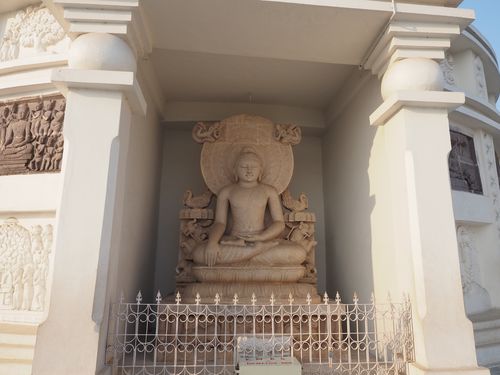
The monument also functions as a site of Buddhist devotion and reflection. Relief panels installed on the structure depict episodes from the life of the Buddha and scenes illustrating the spread of Buddhist teachings. These visual narratives reinforce the symbolic association between the monument and the ethical principles traditionally attributed to Ashoka after the Kalinga war.
The presence of the stupa has also increased the historical visibility of Dhauli as a site associated with the Mauryan period. Visitors attracted by the monument often explore the nearby Ashokan inscriptions and other archaeological features of the hill. In this way, the Peace Stupa contributes to the interpretation of the site as a place where historical memory, religious symbolism, and modern commemorative practices intersect.
Evolution of the Site and Changing Uses
Since its inauguration in 1972, the Dhauli Shanti Stupa has become the dominant landmark on Dhauligiri hill. The site now combines elements belonging to different historical periods. At the base of the hill are the rock edicts attributed to Ashoka, which date to the third century BCE and provide one of the most important sources for understanding Mauryan imperial administration. The hill also contains a sculpted elephant figure carved into the rock, an element often associated with Mauryan symbolism.
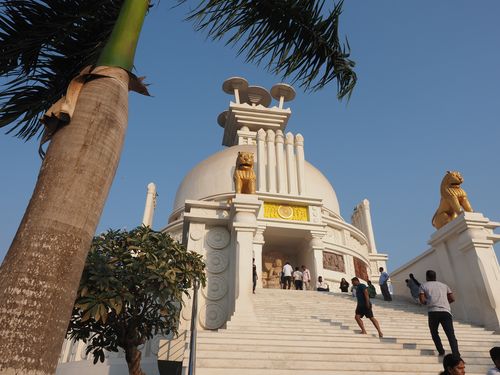
The development of the Peace Stupa led to the gradual transformation of the hill into a destination for visitors and pilgrims. Roads and stairways were constructed to allow access to the summit, while open terraces and viewing areas were created around the monument. These modifications altered the character of the hill, turning it into a space where historical commemoration and tourism coexist.
The monument attracts several categories of visitors. Buddhist pilgrims visit the site because of its association with Ashoka and the message of non-violence represented by the stupa. Tourists interested in Indian history also come to explore the Mauryan inscriptions and the surrounding landscape linked to the Battle of Kalinga. Public events, religious gatherings, and peace ceremonies are occasionally held at the site, reinforcing its function as a symbolic space dedicated to reflection on the consequences of war.
In addition to the Peace Stupa, the hill contains several Hindu temples built during more recent periods. This coexistence of structures from different religious traditions reflects the evolving cultural landscape of the region. The stupa therefore forms part of a broader historical environment shaped by multiple phases of religious and commemorative activity.
Current Role and Preservation of the Monument
Today the Dhauli Shanti Stupa is one of the most visited historical sites in the Bhubaneswar region. Local authorities in Odisha have developed infrastructure intended to manage visitor access while preserving the integrity of the site. Maintenance of the monument itself is carried out with the participation of Buddhist organizations associated with Nipponzan Myohoji.
The nearby Ashokan rock edicts are protected by conservation measures due to their exceptional historical value. These inscriptions provide direct evidence of Mauryan political ideology and represent some of the earliest written documents relating to imperial governance in South Asia. Their preservation is therefore an important component of the site’s heritage management.
The Peace Stupa contributes to the interpretation of the historical landscape of Dhauli. Although the monument itself is modern, its presence emphasizes the historical narrative linking the Battle of Kalinga to Ashoka’s transformation and the subsequent association of the site with ideals of peace and ethical governance.
The Dhauli Shanti Stupa is not individually inscribed on the UNESCO World Heritage List. Nevertheless, the hill of Dhauli is widely recognized for its historical significance due to the presence of Ashoka’s inscriptions and its association with one of the most consequential episodes of Mauryan history.
Global Historical Context at the Time of the Events Associated with the Site
The Battle of Kalinga in the third century BCE took place during a period marked by the presence of several major political powers across Eurasia. In the Mediterranean world, Hellenistic kingdoms formed after the conquests of Alexander the Great controlled large parts of the Near East. In China, the period of the Warring States was approaching its end and would soon lead to the unification of the Chinese empire under the Qin dynasty. In the Italian peninsula, the Roman Republic was expanding its influence following the Punic Wars against Carthage. In Mesoamerica, several pre-classical societies were developing in regions that would later see the emergence of major Maya cities.
Architecture of the Dhauli Shanti Stupa at Dhauligiri
Topographical Setting and Spatial Layout of the Site
The Dhauli Shanti Stupa is constructed on the summit of Dhauligiri hill, a prominent elevation overlooking the plains crossed by the Daya River south of Bhubaneswar in the Indian state of Odisha. The architectural conception of the monument is closely connected to this topographical situation. The hill forms a natural platform rising above the surrounding landscape, allowing the stupa to dominate the horizon and remain visible across a wide radius. The placement of the monument at the highest point of the hill transforms the structure into the principal visual marker of the site.
Before construction, the summit area was levelled to create a stable circular terrace capable of supporting the structure and accommodating visitor circulation. This artificial platform separates the monument from the irregular slope of the hill while maintaining the visual continuity of the natural terrain. The terrace extends outward from the base of the stupa to form a wide circumferential walkway. This open paved area functions both as a circulation zone for visitors and as the ritual path for circumambulation around the monument.
Approach to the stupa is organised through a road ascending gradually along the hillside, followed by stairways and paved pathways that lead to the summit terrace. The architectural sequence created by this ascent gradually reveals the monument. The dome appears progressively as visitors climb the hill, eventually occupying the central field of vision when the terrace is reached. This controlled visual progression emphasizes the monument’s symbolic prominence within the landscape.
The open configuration of the terrace allows unobstructed views in multiple directions across the surrounding valley. The architectural composition therefore integrates the monument with the broader landscape, using elevation and spatial openness to reinforce the stupa’s monumental presence.
Structural Composition and Volumetric Organization
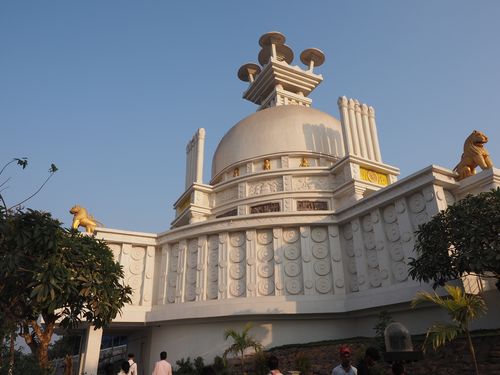
The Dhauli Shanti Stupa is composed of a clearly defined set of geometric volumes arranged along a central vertical axis. The architectural form follows the established typology of the Buddhist stupa while employing modern construction methods and simplified geometric surfaces.
The base of the monument consists of a circular platform raised slightly above the surrounding terrace. This platform defines the boundary between the exterior circulation space and the core architectural mass of the monument. The perimeter of the base provides a continuous pathway allowing visitors to walk around the structure, reinforcing the circular spatial organization characteristic of stupas.
Above the base rises the hemispherical dome that forms the dominant architectural element of the monument. The dome is proportioned to create a smooth and continuous curvature that visually emphasizes symmetry and balance. Its large scale establishes the primary silhouette of the monument and defines its presence within the surrounding landscape.
The upper section of the structure is crowned by a vertical architectural element representing a stylized interpretation of the traditional chattravali. This element consists of a cylindrical shaft topped by a sequence of circular discs arranged vertically. The stacked discs function symbolically as parasols, a motif traditionally associated with Buddhist stupas as a sign of spiritual authority and protection.
The vertical crowning element reinforces the axial symmetry of the structure. By extending upward from the apex of the dome, it visually anchors the entire composition and directs attention toward the central vertical axis of the monument.
The architectural experience of the monument is entirely external. The stupa does not contain an accessible interior chamber, and visitors interact with the structure through movement around the outer perimeter and observation of the sculptural panels installed on the exterior surfaces.
Construction Techniques and Material Characteristics
The Dhauli Shanti Stupa was constructed using reinforced concrete as its principal structural material. This choice allowed the builders to create the large curved surfaces of the dome while maintaining structural stability and durability. The internal framework of the monument consists of concrete reinforced with steel elements that provide additional tensile strength and support the weight of the hemispherical shell.
The dome itself was formed using curved formwork systems designed to produce the continuous spherical geometry required for the structure. Once the concrete shell had cured, the exterior surface was coated with a smooth plaster finish and painted white. The white surface plays an important architectural role by accentuating the purity of the geometric form and reflecting sunlight across the dome’s curved surfaces.
The circular terrace surrounding the monument is constructed from reinforced concrete foundations covered with stone or masonry paving materials suitable for heavy visitor traffic. The stairways and access paths leading to the terrace are built using similar materials to ensure structural continuity and resistance to erosion on the hillside terrain.
Decorative sculptural panels mounted on the exterior of the dome are fabricated from carved stone or durable composite materials capable of withstanding prolonged exposure to weather conditions. These panels are attached to the outer surface of the dome using structural anchors that distribute their weight across the concrete shell.
The combination of reinforced concrete structural elements with carved stone decorative features creates a hybrid architectural system. Modern engineering techniques provide structural support, while the sculptural components introduce iconographic and symbolic elements associated with Buddhist artistic traditions.
Exterior Sculptural Elements and Iconographic Program
The decorative program of the Dhauli Shanti Stupa is concentrated primarily along the lower portion of the dome. Several sculpted relief panels are installed around the circumference of the monument at regular intervals. These panels depict episodes associated with the life of the Buddha as well as symbolic representations of Buddhist teachings.
One of the panels represents the birth of Siddhartha Gautama, illustrating the moment traditionally associated with the emergence of the historical Buddha. Another relief portrays the scene of enlightenment beneath the Bodhi tree, where the Buddha is shown seated in meditation. Additional panels depict episodes related to the teaching of the Dharma and the dissemination of Buddhist principles.
Among the sculptural compositions is a representation of Emperor Ashoka, linking the monument to the historical memory associated with the nearby site traditionally identified with the Battle of Kalinga. The inclusion of this figure reinforces the symbolic connection between the monument and the narrative of Ashoka’s renunciation of warfare.
The relief panels are framed by shallow architectural borders that follow the curvature of the dome. Their placement creates a rhythmic sequence along the base of the monument, allowing visitors walking around the structure to observe each scene in succession. This arrangement integrates the decorative elements with the spatial movement of circumambulation.
Despite the presence of these sculptural components, the overall architectural treatment of the monument remains deliberately restrained. Large portions of the dome are left unornamented, preserving the clarity of the hemispherical form. The contrast between the smooth white surface and the detailed relief carvings produces a visual balance between simplicity and narrative decoration.
Architectural Maintenance and Preservation of the Monument
Since its completion in 1972, the Dhauli Shanti Stupa has undergone periodic maintenance aimed at preserving both its structural integrity and its visual appearance. The white exterior coating of the dome requires regular renewal due to the effects of sunlight, rainfall, and atmospheric conditions. Repainting and surface restoration ensure that the monument retains the bright reflective appearance that defines its architectural identity.
The sculptural relief panels are also subject to conservation efforts. Exposure to weather and environmental pollutants can gradually erode the carved surfaces. Restoration work focuses on stabilizing the material and protecting the reliefs from further deterioration while preserving the original sculptural details.
The infrastructure surrounding the monument has been progressively improved to accommodate increasing visitor numbers. Stairways, pathways, and terrace surfaces have been reinforced to maintain safe circulation across the site. These interventions are designed to preserve the monument’s architectural dominance while ensuring the durability of the surrounding structures.
Vegetation management on the slopes of Dhauligiri hill forms another component of site maintenance. Regular trimming and landscape management preserve clear sightlines toward the monument and prevent plant growth from obstructing the visual relationship between the stupa and the surrounding terrain.
Through these ongoing maintenance measures, the architectural form and structural stability of the Dhauli Shanti Stupa have been preserved. The monument continues to occupy the summit of Dhauligiri as the central architectural feature of the site, maintaining the clarity of its geometric composition and its visual prominence within the landscape.