

 Français (France)
  Nederlands (nl-NL)
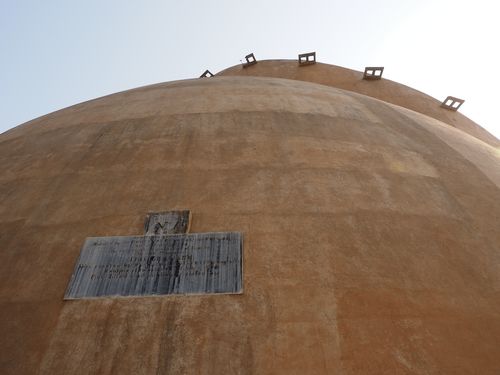
 Golghar is one of the best-known landmarks in Patna, the capital city of Bihar in India. This large circular structure occupies a prominent place in the urban landscape and reflects an important aspect of the region’s administrative history. Built during the late eighteenth century under British colonial rule, the monument was originally intended for grain storage as part of efforts to reduce the impact of recurring famines in northern India. Today, Golghar remains a major symbol of Patna and continues to attract visitors interested in the city’s historical development as well as local residents seeking views over the Ganges River and the surrounding districts.
Patna • Golghar

Patna • Golghar

Patna • Golghar
Monument profile
Golghar
Monument category: Granary
Monument family: Civil engineering structures (bridges, wells, etc.) and factories
Monument genre: Economic
Geographic location: Patna • Bihar • India
Construction period: 18th century AD
• Links to •
• List of videos about Patna on this site •
Patna, sacred city of Sikhism • Bihar, India
Golghar and Colonial Grain Storage Policy in Bihar
Construction After the Bengal Famine
Golghar was built in Patna during a period marked by severe food crises in eastern India under the administration of the British East India Company. The Bengal famine of 1770 caused massive mortality across Bengal and Bihar and exposed major weaknesses in the colonial system of food storage and distribution. In response, British authorities sought to establish large reserve granaries intended to secure grain supplies during future shortages.
The construction of Golghar was ordered under Governor-General Warren Hastings. The structure was designed by British engineer John Garstin and completed in 1786. Patna was selected because of its administrative importance and its position along the Ganges River, which facilitated the transport of agricultural goods and military supplies. The monument was intended to function as a central grain storage facility serving the surrounding region during emergencies.
Intended Function and Operational Difficulties
Golghar was conceived as a massive granary capable of storing large quantities of grain for colonial authorities. Its design reflected practical concerns related to storage capacity and structural stability rather than symbolic or ceremonial functions. Grain was intended to be poured into the structure from an opening at the top using external stairways.
Despite its ambitious purpose, the building revealed important operational limitations soon after completion. Historical accounts indicate that the entrance door opened inward, which created difficulties when the granary was filled close to capacity because the stored grain could block access to the exit. This design flaw reduced the practical efficiency of the structure and limited its long-term use as a fully operational storage facility.
As British infrastructure expanded during the nineteenth century through improved transportation networks and railway systems, colonial grain management increasingly relied on other logistical arrangements. Golghar gradually lost its original economic role, although it remained an important administrative landmark within Patna.
Transformation into a Historical Landmark
During the late colonial period and after Indian independence in 1947, Golghar ceased to function primarily as a storage structure and acquired greater historical and civic significance. Its unusual silhouette and elevated location overlooking parts of the city contributed to its transformation into one of Patna’s most recognizable monuments.
The stairways leading to the top became a public viewing point offering panoramic views of the Ganges River and the surrounding urban landscape. Over time, the structure developed a symbolic association with the colonial history of Bihar and with the memory of eighteenth-century famine policies implemented by the British administration.
Several restoration and maintenance campaigns were undertaken to preserve the monument and address structural deterioration caused by humidity, seasonal weather conditions, and aging materials. Conservation work has included repairs to the masonry, stabilization of damaged sections, and improvements to visitor access around the monument.
Golghar in the Context of the Late Eighteenth Century
The construction of Golghar took place during a period of major political and economic change in several parts of the world. In North America, the American War of Independence ended in 1783 with the recognition of the United States. In Europe, the final years of the reign of Louis XVI preceded the French Revolution of 1789. During the same period, the British East India Company was consolidating its administrative control over large territories in the Indian subcontinent.
Structural Design and Architectural Configuration of Golghar in Patna
Urban Position and Overall Spatial Organization
Golghar occupies an elevated and visually dominant position near the southern bank of the Ganges River in Patna. The monument was placed in an open area that originally facilitated the circulation, loading, and storage of grain supplies transported through the river network. Its isolated placement reinforces the perception of the structure as a singular architectural mass rather than part of a larger monumental complex.
The building follows a circular ground plan with no attached subsidiary wings or decorative entrance pavilions. Its composition is based almost entirely on the geometric impact of a massive dome-like structure rising directly from a broad base. The simplicity of the layout reflects the utilitarian purpose of the monument, which was conceived as a large granary during the late eighteenth century under British colonial administration.
The structure reaches a height of approximately 29 meters and presents unusually heavy proportions. The uninterrupted curved profile gives the monument a compact and almost monolithic appearance. Unlike religious domes that often incorporate external ornamentation, drum sections, or finials, the form of Golghar remains visually austere and technically focused.
Construction Techniques and Structural System
Golghar was constructed primarily with brick masonry bonded with lime mortar. The engineering concept relies on the thickness and continuity of the exterior walls rather than on an internal framework of columns or supporting chambers. The monument functions as a self-supporting shell designed to contain a very large uninterrupted internal volume.
The curved exterior surface distributes structural pressure downward toward the circular foundation, reducing lateral stress and contributing to the stability of the building. The dome-like profile also helped protect stored grain from excessive water accumulation during seasonal rains. The walls are exceptionally thick, both to reinforce structural resistance and to maintain relatively stable internal conditions for storage.
The external surfaces remain largely undecorated. Architectural detailing is minimal and limited mainly to the stairways and entrance openings. This absence of sculptural programs, reliefs, or ornamental façades distinguishes Golghar from many monumental constructions of the same period in India. The structure reflects the priorities of engineering efficiency and storage capacity rather than ceremonial representation.
External Stairways and Interior Configuration
One of the most distinctive architectural elements of Golghar is the pair of symmetrical spiral stairways that wrap around the outer surface of the dome. These staircases rise gradually toward the summit and create the monument’s most recognizable visual feature. Their curved alignment follows the contour of the structure and reinforces the sense of vertical movement despite the absence of towers or projecting upper sections.
The stairways were designed to permit access to the circular opening at the top of the monument, through which grain could be poured into the storage chamber below. Historical descriptions suggest that the dual staircase arrangement allowed workers carrying grain to move upward and downward separately, improving circulation efficiency during loading operations.
Inside, the monument consists largely of a single hollow chamber without major subdivisions or supporting pillars. The uninterrupted interior volume was intended to maximize storage capacity. The spatial organization remains extremely simple, with very limited internal architectural articulation. The absence of ventilation systems and the restricted number of openings created difficulties related to humidity and grain preservation.
The lower entrance system also became a significant architectural limitation. Historical accounts indicate that the door opened inward, creating practical problems when the interior was filled close to capacity because the stored grain could obstruct access to the exit. This design flaw reduced the functional efficiency of the structure despite its impressive scale.
Preservation and Architectural Condition
Golghar has retained most of its original structural form since its completion in 1786. Architectural interventions have mainly focused on conservation rather than alteration. Weathering, moisture infiltration, biological growth, and erosion of the masonry surface have required periodic restoration campaigns intended to stabilize the monument and protect the stairways and exterior shell.
Repairs have included reinforcement of damaged masonry sections, surface cleaning, drainage improvements, and visitor safety measures along the upper staircases. The surrounding area has also undergone urban redevelopment intended to improve accessibility and public circulation around the monument.
Today, the architectural identity of Golghar remains strongly associated with its massive circular volume, its external spiral stairways, and its highly unusual combination of utilitarian engineering and monumental scale within the urban landscape of Patna.