

 Français (France)
  Nederlands (nl-NL)
 Shechen Tennyi Dargyeling Monastery, located in Bodhgaya in the state of Bihar, is a prominent center of the Tibetan Nyingma Buddhist tradition. Established in the twentieth century as part of the Tibetan monastic diaspora, it forms part of a wider international network of affiliated institutions. The monastery serves as a venue for religious teachings, meditation retreats, and pilgrim reception. It contributes to the contemporary religious landscape of Bodhgaya, a major global Buddhist pilgrimage destination. Today, it functions as both a spiritual and educational institution within a diverse and internationally oriented community.
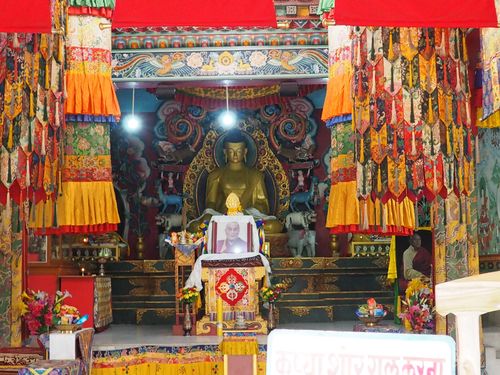
Bodhgaya • Shechen Tennyi Dargyeling Monastery

Bodhgaya • Shechen Tennyi Dargyeling Monastery

Bodhgaya • Shechen Tennyi Dargyeling Monastery
Monument profile
Shechen Tennyi Dargyeling Monastery
Monument categories: Pagoda, Buddhist temple
Monument families: Temple • Pagoda or stupa
Monument genres: Religious
Cultural heritage: Buddhist
Geographic location: Bodhgaya • Bihar • India
Construction period: 20th century AD
• Links to •
• List of videos about Bodhgaya on this site •
Bodhgaya, the Mahabodhi temple • Bihar, India
Bodhgaya, temples in town and life in a village • Bihar, India
• References •
Shechen: Shechen Monastery in Bodhgaya, India
Shechen Tennyi Dargyeling Monastery
Historical Development of a Nyingma Institution in Exile
Located in Bodhgaya, in the state of Bihar, Shechen Tennyi Dargyeling Monastery represents the Indian continuation of the historic Shechen monastic tradition of the Nyingma school of Tibetan Buddhism. Its establishment in Bodhgaya reflects the broader reconstitution of Tibetan religious institutions in exile during the second half of the twentieth century.
Political and Social Context of Foundation
The monastery’s creation must be understood within the geopolitical upheavals that followed the incorporation of Tibet into the People’s Republic of China and the events of 1959. The resulting displacement of monastic communities led to the relocation of numerous religious institutions to India, where the government granted asylum and land for settlement.
Shechen Tennyi Dargyeling was founded to preserve the doctrinal, ritual, and artistic heritage of the original Shechen Monastery in eastern Tibet. The responsible religious authorities sought to ensure the continuity of the Nyingma transmission lineage under radically altered political circumstances. The foundation was not the initiative of a secular ruler but of high-ranking lamas committed to institutional survival.
Socially, the monastery provided stability for monks in exile, offering structured education and ritual continuity. The project also addressed the need to consolidate Nyingma identity in an environment where other Tibetan schools—Kagyu, Gelug, and Sakya—were simultaneously reestablishing their presence.
Although no armed rivalries characterized this context, institutional competition for resources, recognition, and international patronage influenced the positioning of monastic foundations in Bodhgaya. Establishing a monastery in this pilgrimage center affirmed both doctrinal legitimacy and symbolic proximity to the place of the Buddha’s enlightenment.
Major Historical Developments
Unlike medieval monastic sites subject to warfare or dynastic transition, the Bodhgaya monastery evolved primarily through expansion and adaptation rather than destruction and reconstruction. Its growth reflects the progressive stabilization of the Tibetan diaspora in India.
Over time, additional buildings were constructed to accommodate an increasing number of resident monks, visiting teachers, and international practitioners. Educational programs expanded to include philosophical studies, ritual training, and cultural preservation initiatives.
The monastery’s history is closely linked to prominent lineage holders associated with Shechen. Their residence and teaching activities elevated the institution’s international profile. Rather than surviving through periods of decline, the monastery experienced phases of consolidation aligned with the global rise of interest in Tibetan Buddhism.
Modernization initiatives introduced electrical systems, improved sanitation, and communication infrastructure, integrating the monastery into contemporary urban life while maintaining its religious function.
Global Context of Establishment
The foundation of Shechen Tennyi Dargyeling coincided with broader twentieth-century movements of religious reorganization in exile. Across Asia and beyond, displaced communities reconstructed institutional frameworks outside their territories of origin.
Simultaneously, Western engagement with Tibetan Buddhism expanded significantly. Meditation centers affiliated with Nyingma masters appeared in Europe and North America, creating transnational networks. The Bodhgaya monastery became a central node in this global constellation.
The international recognition of the Mahabodhi Temple Complex as a UNESCO World Heritage site reinforced Bodhgaya’s status as a global pilgrimage center. In this context, the monastery’s establishment formed part of a wider revival of Buddhist monumental and institutional presence in India.
Transformations and Urban Evolution
Architectural additions over successive decades reflect functional growth. Residential quarters, teaching halls, and administrative facilities were incorporated to meet expanding needs. These changes did not represent shifts in religious orientation but adaptations to demographic and logistical realities.
The urbanization of Bodhgaya significantly altered the monastery’s surroundings. Increased pilgrimage traffic, tourism infrastructure, and improved road networks transformed what had once been a modest settlement into a densely built religious district.
Maintenance and renovation cycles addressed climatic stress, particularly the impact of monsoon rains and high humidity on painted surfaces and structural elements. The monastery did not experience episodes of abandonment; rather, it evolved incrementally in response to environmental and institutional pressures.
Contemporary Role and Cultural Significance
Today, Shechen Tennyi Dargyeling functions as an active center of monastic education and ritual practice. It hosts teachings, ceremonial events, and meditation retreats attended by practitioners from multiple countries.
The monastery contributes to Bodhgaya’s pluralistic religious identity, representing the Nyingma tradition alongside other Tibetan and international Buddhist institutions. It also embodies the cultural continuity of the Tibetan diaspora in India.
Annual commemorations of lineage masters and major ritual festivals reinforce communal cohesion. These gatherings attract participants from Asia, Europe, and the Americas, underscoring the monastery’s transnational reach.
In the broader Indian context, the monastery symbolizes religious hospitality and intercultural exchange, reflecting India’s role as host to displaced Tibetan institutions.
Conservation Status and Contemporary Challenges
Shechen Tennyi Dargyeling does not possess individual World Heritage designation, yet its location within the regulated heritage zone surrounding the Mahabodhi Temple subjects it to planning controls and conservation oversight.
Primary challenges include climatic deterioration, urban density, and visitor impact. High humidity accelerates paint degradation, while increased foot traffic places strain on flooring and infrastructure.
Preservation policies emphasize functional continuity rather than archaeological conservation. Regular maintenance, structural inspections, and repainting ensure the monastery remains operational and visually coherent.
Conclusion
Shechen Tennyi Dargyeling Monastery represents a significant chapter in the institutional reconstruction of Tibetan Buddhism in exile. Established in Bodhgaya during a period of geopolitical upheaval, it reflects the strategic relocation of religious authority to a site of global symbolic resonance. Its history is marked not by destruction and revival but by steady consolidation, expansion, and integration into international networks. The monastery stands as both a testament to cultural resilience and a participant in the evolving religious landscape of contemporary India.
Architectural features
Architectural Analysis of a Contemporary Nyingma Monastic Complex in Bodhgaya
Located in Bodhgaya, within the state of Bihar, Shechen Tennyi Dargyeling Monastery represents a modern architectural reinterpretation of the historic Shechen tradition of eastern Tibet. The complex combines structural technologies adapted to the climatic conditions of northern India with a symbolic and spatial vocabulary rooted in Nyingma monastic design.
Technological and Architectural Innovations
The monastery’s primary structural system relies on reinforced concrete, a material choice that reflects both contemporary building practice in India and the need for long-term durability. Unlike traditional Tibetan monasteries constructed in rammed earth, stone masonry, and timber framing, the Bodhgaya complex employs a modular concrete framework capable of supporting wide interior spans and multiple levels.
This structural strategy allows the main assembly hall to function as a large, uninterrupted ceremonial space. The reduction of load-bearing walls enhances sightlines toward the central shrine and accommodates substantial congregations during ritual events. Reinforced columns and slabs comply with modern seismic and safety regulations applicable in Bihar.
Climatic adaptation is integrated into the design. Wide projecting eaves mitigate solar exposure and shield façades from monsoon rainfall. Cross-ventilation is achieved through aligned openings and elevated ceiling heights that encourage thermal convection. In some areas, mechanical systems complement passive ventilation to maintain interior comfort during peak heat.
Urban integration also informed the architectural approach. The monastery’s horizontal massing avoids excessive vertical prominence, respecting the scale of surrounding international monasteries and regulatory constraints linked to proximity to the Mahabodhi complex.
Materials and Construction Methods
The structural frame of reinforced concrete is complemented by brick infill walls, providing thermal mass suitable for seasonal temperature variation. Exterior surfaces are coated with mineral plaster, enabling the application of traditional polychrome decoration.
Roof assemblies consist of concrete slabs layered with waterproof membranes and integrated drainage systems designed to handle intense monsoon precipitation. This represents a significant adaptation from traditional Tibetan flat roofs compacted with earth, which are less suited to the humid conditions of Bihar.
Interior finishes include stone or ceramic flooring selected for durability under high foot traffic. Decorative timber elements, including carved cornices and window frames, are either fabricated locally or assembled from prefabricated components. These elements reproduce the aesthetic of Himalayan monastic architecture while relying on contemporary structural substrates.
Electrical wiring, lighting systems, and sound infrastructure are integrated into the structural framework, ensuring functional efficiency without compromising visual coherence.
Architectural and Artistic Influences
The architectural language of the monastery reflects its affiliation with the Nyingma school. Cubic massing, hierarchical spatial organization, and vibrant color schemes correspond to Himalayan monastic precedents. Red, yellow, blue, green, and white pigments are applied according to established symbolic conventions.
Decorative friezes and geometric borders draw from eastern Tibetan models, particularly those associated with the original Shechen Monastery. Motifs such as lotus forms, protective emblems, and symbolic scrollwork are adapted to contemporary materials.
The complex does not incorporate Indian shikhara towers or Islamic domes. Instead, its profile emphasizes layered rooflines and volumetric gradation. In the context of Bodhgaya’s diverse international monastic district, this architectural identity distinguishes the monastery while participating in a broader dialogue of Buddhist styles.
Interior murals depict lineage masters and tantric iconography executed with modern pigments on prepared plaster surfaces. These works preserve iconographic accuracy while benefiting from contemporary conservation methods.
Spatial Organization and Structural Composition
The central prayer hall constitutes the architectural and symbolic core. Rectangular in plan and oriented toward an elevated shrine platform, it accommodates several hundred practitioners. Structural columns are spaced to balance load distribution with visual openness.
Adjacent to the main hall are teaching rooms, administrative offices, communal kitchens, and residential quarters for monks. Circulation corridors ensure functional separation between public ritual spaces and private monastic areas.
Courtyards provide natural illumination and ventilation while serving as transitional zones between buildings. This spatial configuration reflects both Tibetan cloister traditions and practical responses to climatic demands.
Staircases and galleries connect multiple levels, allowing vertical movement without interrupting ceremonial activities. The modular structural grid permits future reconfiguration if institutional needs evolve.
Distinctive Structural Characteristics
A defining feature of the monastery is its emphasis on horizontal composition rather than vertical dominance. Symbolic rooftop elements, such as the Dharma wheel flanked by deer, are mounted decoratively rather than structurally.
The reinforced concrete system ensures long-term stability while allowing decorative surfaces to be renewed independently. This separation between structure and ornament facilitates maintenance.
The integration of artificial lighting is designed to enhance ritual atmosphere without overshadowing natural illumination. Acoustic considerations influence ceiling height and interior proportions, supporting chant resonance.
Dimensions and Notable Features
Although precise measurements vary due to successive expansions, the main assembly hall occupies a substantial footprint relative to surrounding residential buildings. Ceiling heights exceed typical urban norms, reinforcing ceremonial scale.
The façade’s polychrome scheme requires periodic repainting due to exposure to humidity and ultraviolet radiation. Maintenance cycles are incorporated into institutional planning.
No medieval legends are attached to the monastery’s construction; its significance lies in its role as a contemporary continuation of a historic lineage rather than in antiquity.
International Recognition and Conservation Challenges
While the monastery does not hold individual World Heritage designation, its location within the protected zone of the Mahabodhi Temple Complex subjects it to regulatory oversight. Urban density and visitor influx necessitate continuous maintenance.
Climatic factors—particularly heavy rainfall and high humidity—affect painted surfaces and require ongoing conservation measures. Structural inspections ensure the integrity of reinforced concrete elements.
The architecture contributes to the global visibility of the Nyingma tradition by presenting a recognizable Himalayan aesthetic within a major international pilgrimage center.
Conclusion
Shechen Tennyi Dargyeling Monastery in Bodhgaya exemplifies the architectural adaptation of Tibetan monastic design to contemporary Indian conditions. Its reinforced concrete structure, climatic responsiveness, and symbolic ornamentation combine to create a functional yet culturally resonant complex. The building reflects both continuity with Himalayan architectural heritage and responsiveness to modern construction standards, establishing a durable institutional presence within the pluralistic religious landscape of Bodhgaya.