Français (France)
  Nederlands (nl-NL)
 00:00 • intro | 00:15 • Pha That Luang stupa | 05:03 • Wat That Luang Tai temple | 10:14 • Ho Pha Keo temple | 12:33 • Wat Impeng temple | 15:21 • That Dam Stupa | 16:00 • Wat Ong Teu Mahawihan temple | 20:11 • Wat Sisaket museum
Personal creation from visual material collected during my trip Laos and Bangkok (2022)
Map of places or practices in Vientiane on this site
• Use the markers to explore the content •
Vientiane and Its Sacred Architecture: Religious Heritage of Laos
A capital city shaped by temples and stupas
Vientiane, the capital of Laos on the banks of the Mekong River, offers a distinctive urban character within Southeast Asia. Less densely monumental than some neighboring capitals, it preserves a cityscape in which religious buildings remain essential landmarks. Golden stupas, Buddhist monasteries, royal sanctuaries and historic temple compounds continue to define the visual and cultural identity of the city.
This video presents a journey through some of Vientiane’s most significant sacred monuments. It shows that these buildings are not isolated relics, but living components of the capital’s history. They represent royal patronage, Buddhist devotion, political resilience and modern preservation efforts. Together, they form a coherent narrative of Laos through architecture.
From national monuments to neighborhood temples
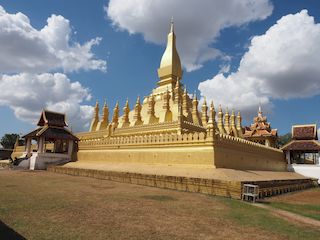
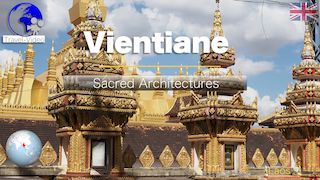
Pha That Luang is the most emblematic monument in Vientiane and one of the great symbols of Laos itself. This large gilded stupa dominates its ceremonial precinct and occupies a central place in national identity. Its rising terraces and elegant vertical composition express Buddhist concepts of spiritual ascent, while its brilliant surfaces give it exceptional visual presence. It remains an important pilgrimage and festival site, especially during major annual religious celebrations.
Nearby stands Wat That Luang Tai, part of the broader sacred environment surrounding the stupa. Like many Lao monasteries, it combines worship halls, monks’ quarters and ritual spaces. Such temple complexes traditionally function not only as places of prayer, but also as centers of learning, community life and cultural continuity.
Ho Phra Keo occupies a special position in the city’s heritage. Originally built as a royal temple to house the Emerald Buddha, it later lost that original role but remains one of the most refined monuments of Vientiane. Its architecture reflects the ceremonial world of the Lao monarchy, and today it is valued as an important historical site.
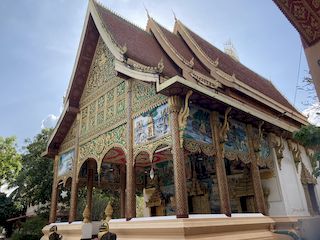
Wat Impeng represents another dimension of sacred Vientiane: the active urban temple integrated into everyday neighborhood life. It reflects the continuing role of monasteries in contemporary society, where religion, education and local identity often remain closely linked.
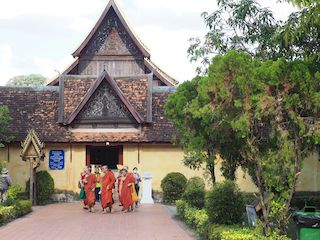
Wat Ong Teu Mahawihan is known for its religious importance and for its large Buddha image, which gives the temple both visual and spiritual prominence. It also recalls the importance of monastic scholarship and temple patronage in Lao history.
Wat Sisaket, now functioning as a museum, is one of the city’s most treasured monuments. Famous for its cloister walls containing numerous niches filled with Buddha images, it survived periods of destruction that affected other sacred sites in Vientiane. Its preservation makes it invaluable for understanding earlier architectural traditions.
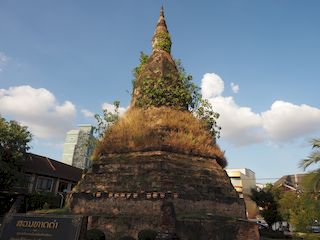
That Dam, or the Black Stupa, offers a different atmosphere. Darker, more austere and surrounded by legend, it suggests the deeper historical layers of the city and the persistence of memory beyond monumental grandeur.
Historical background: kingdoms, conflict and renewal
The sacred architecture of Vientiane is closely linked to the history of the Lao kingdom of Lan Xang, founded in the fourteenth century. During periods when Vientiane served as a royal capital, rulers sponsored temples, stupas and ceremonial buildings to express both religious merit and political legitimacy.
Later centuries brought regional conflict, particularly with Siam. In the nineteenth century, Vientiane suffered severe destruction during warfare, and many temples were damaged, abandoned or rebuilt. As a result, the city’s sacred heritage today often reflects successive phases of restoration rather than uninterrupted continuity.
During the French colonial period and after independence, renewed attention was given to preserving important monuments. Modern Laos has continued to maintain these sites as both religious centers and national heritage landmarks. The city therefore presents a dialogue between ancient foundations, historical trauma and cultural recovery.
Architectural language of Lao Buddhism
Lao temples are often recognized by their sweeping multi-tiered roofs that descend low over verandas and galleries, creating graceful horizontal lines. Rich decorative programs may include gilded motifs, floral patterns, serpent forms and mythological guardians derived from Buddhist and regional traditions.
Stupas hold particular significance. They may enshrine relics, commemorate sacred events or symbolize the enduring presence of Buddhism in public space. Their forms vary, yet verticality and layered composition remain common themes, suggesting both protection and transcendence.
Color also plays a major role. Gold, red and deep wood tones contribute to the ceremonial atmosphere of temple compounds. Courtyards, gateways, walls and stairways create a gradual transition from ordinary urban life into sacred space, reinforcing the symbolic threshold between the secular and the spiritual.
What the videos on this site make especially clear
Videos built largely from carefully selected and animated photographs are especially effective for sacred architecture. They allow viewers to study monuments with greater calm and clarity than is often possible during a brief visit.
In Vientiane, this approach helps compare very different building types: the compact vertical mass of a stupa, the extended horizontality of a monastery, the refined ornament of a royal temple, or the intimate scale of a neighborhood shrine. Slow transitions reveal rooflines, decorative pediments, columns, statues and surface textures in detail.
This format also clarifies the urban setting of the monuments. The viewer can understand how temples organize streets, open spaces and visual perspectives across the capital. By moving from one site to another, the video gradually builds a broader understanding of Vientiane’s religious landscape.
A key to understanding Laos
The sacred architecture of Vientiane tells the story of Buddhist faith, royal ambition, historical upheaval and cultural preservation. Through stupas, monasteries and temple museums, the capital reveals a national identity deeply shaped by religion and memory. Visitors wishing to explore further can continue with the detailed pages dedicated to each monument and discover the full richness of Laos’s architectural heritage.

Music:
- - YouTube video library - English Country Garden - Aaron Kenny
- - YouTube video library - Forest Lullabye - Asher Fulero
- - YouTube video library - Gently Onwards
- - YouTube video library - No.2 Remembering Her - Esther Abrami
- - YouTube video library - Sweetly My Heart - Asher Fulero
- - YouTube video library - Waiting - Andrew Langdon
Disclaimer: Despite its appropriateness, copyright issues prevent the use of laotian traditional music in "Vientiane, Sacred Architectures • Laos", hence the use of royalty-free music. Despite our careful selection, some might regret this decision, which is necessary to avoid potential lawsuits. Although difficult, this decision is the only viable solution.
Links to related pages






Audio Commentary Transcript
Great Stupa, Pha That Luang
Vientiane, the capital of Laos, is a major center of Buddhism. Among its many religious monuments, Pha That Luang stands out. Erected in the 16th century, this golden stupa symbolizes Buddhist faith and Lao national sovereignty. Pha That Luang, with its gleaming gold finish and pyramidal shape, is surrounded by a cloister housing various Buddha statues. Its imposing structure and golden coating make it a prominent visual landmark in the Vientiane landscape.
Pha That Luang, or "Great Stupa," is an emblematic monument in Vientiane, considered the most sacred in Laos. Built in the 16th century by King Setthathirat, it is believed that the site originally housed an Indian structure brought in the 3rd century by missionaries sent by Emperor Ashoka, highlighting its importance in the spread of Buddhism in this region.
This golden stupa, rebuilt several times after being destroyed by invasions, symbolizes Laotian resilience and identity. Religiously, Pha That Luang is a powerful symbol of Buddhist enlightenment. Its pyramidal shape represents the various stages towards achieving Nirvana, with each level signifying a closer step towards spiritual enlightenment.
The cloister surrounding Pha That Luang plays a crucial role as a meditative and gathering area for the faithful. This sacred perimeter, lined with ornate galleries, allows visitors and pilgrims to practice circumambulation, a ritual of walking clockwise around the stupa, which is believed to accumulate spiritual merit according to Buddhist traditions.
The Buddha statues scattered throughout the cloister come from different eras and regions, reflecting the richness of Laotian Buddhist history. These statues, often donations from devotees or additions from various royal dynasties, showcase a variety of styles and stories, ranging from the Khmer Empire period to more recent influences. Among these artifacts, one finds not only Buddha figures but also other significant elements such as a statue of Jayavarman VII and what appears to be a lingam, a traditional representation associated with Shiva in Hinduism. These sacred figures serve not only as meditation aids but also as visual reminders of Buddha’s teachings on impermanence and the pursuit of Nirvana.
The Wat That Luang
Wat That Luang Tai is a Buddhist temple located near Vientiane's most iconic stupa, Pha That Luang. Established to complement the grand stupa, it shares architectural and spiritual similarities with its neighbor. Although the exact dates of its construction are not well-documented, it is generally believed that Wat That Luang Tai was built during the same period as the reestablishment of Pha That Luang in the 16th century, under the reign of King Setthathirath. The temple plays a crucial role in the local religious framework, providing a space for daily worship and Buddhist rituals.
The stupas within the precinct of Wat That Luang Tai are intricately decorated with traditional Lao motifs. These golden structures serve both as religious art and as funerary monuments. The niches embedded in each stupa house cinerary urns or memorials, honoring deceased community members. This setup reflects the importance of ancestor reverence and commemoration in the Buddhist culture of Vientiane.
Just beyond the funeral stupas, silent witnesses of respect and remembrance, lies the sala. This open structure, typical of Laotian temples, invites meditation and prayer. In harmony with its surroundings, the sala houses both seated and standing Buddha statues, creating a space of tranquility where the living can gather and connect spiritually, while honoring those who have gone before.
At Wat That Luang Tai, not far from the meditative sala, lies a magnificent golden statue of the Reclining Buddha. This majestic representation illustrates the Buddha at the moment of leaving this earth, symbolizing his passage into parinirvana. The Reclining Buddha is a central element in Buddhist art, representing the serenity and complete peace achieved at the end of his earthly life.
The Ho Pha Keo
Built in 1560 by King Setthathirath, the Ho Pha Keo in Vientiane was initially designed to house the Emerald Buddha. This temple, along with the grand stupa, Pha That Luang, reflects the architectural prestige of its era. The highly revered statue was seized and initially moved to Thonburi in 1779 by Siamese forces, an act of conquest that highlighted regional tensions. After the establishment of Bangkok as the capital in 1782, it was moved to Wat Phra Kaew, where it still resides. Transformed into a museum in 1987, the Ho Pha Keo now offers insights into Buddhist art and the spiritual history of Laos.
The Wat Impeng
Wat Impeng, established in the early 19th century in Vientiane, showcases the rich Buddhist architectural heritage of Laos. The temple features architecture that blends traditional Lao elements with Buddhist influences. Focused on meditation and religious practice, Wat Impeng also serves as a center for Buddhist education, playing a crucial role in preserving Laotian spiritual traditions. Its structure is noted for its intricate roofing and detailed sculptures, reflecting the craftsmanship of the time.
That Dam stupa
That Dam, also known as the "Black Stupa," is an ancient stupa shrouded in legend, likely dating back to medieval times. It gets its name from the dark moss and vegetation that once covered it, giving it a distinctive dark appearance. According to local legend, it housed a protective seven-headed nāga. This stupa is characterized by its typical Laotian architectural style, with a massive base and bell-shaped structure, and remains an unrestored relic of the region's heritage.
Wat Ong Teu Mahawihan
Wat Ong Teu Mahawihan, built in the 16th century under the reign of King Setthathirath, is renowned for its large bronze Buddha statue, known as "Ong Teu", which means "Great Buddha". "Mahawihan" translates to "great monastery", signifying the temple's religious significance. Initially a Buddhist teaching center, the temple has been rebuilt several times following invasions. Today, it continues to serve as an educational center for monks studying Pali and remains a crucial element of the Theravada Buddhist tradition. Its characteristic Laotian architecture, with multi-level roofs and golden ornaments, makes it a site of historical and spiritual interest.
The intricately carved metal doors of Wat Ong Teu, leading to the hall where the Great Buddha resides, depict scenes from Hindu mythology, reflecting the cultural syncretism between Hinduism and Buddhism in Southeast Asia. These representations of deities and heroes symbolize protection and the fight against evil, welcoming devotees into a sacred space dedicated to Buddhist enlightenment.
Wat Sisaket
Wat Sisaket, built in 1818 during the reign of King Anouvong, is one of the oldest and best-preserved temples in Laos. Located in Vientiane, it is renowned for its unique Siamese architecture and houses over 10,000 Buddha statues. After surviving the Siamese invasion of 1828, it was transformed into a museum in the 1930s by the French colonial administration to preserve its rich artistic and historical heritage. Today, Wat Sisaket continues to play an important role in local Buddhist life, attracting both devotees and visitors.