Français (France)
  Nederlands (nl-NL)
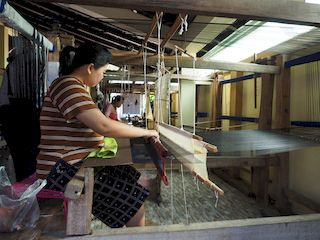
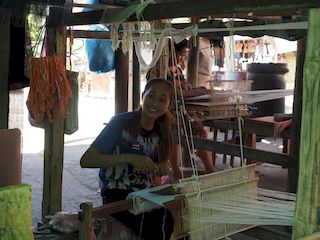
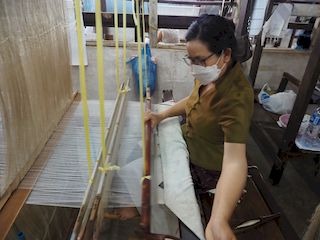
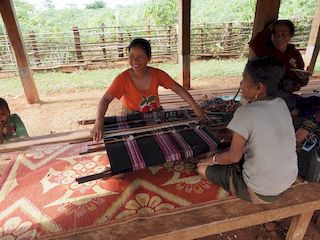
 00:00 • intro | 00:24 • Luang Prabang: weaving workshop | 02:58 • Vientiane: weaving workshop | 04:52 • Ban Xang Hai (also known as 'Whiskey Village') | 07:52 • Ban Xang Hai, embroiderers | 08:47 • Phou Khoun, traditional clothes | 10:13 • Kok Phung Kai, tribal village
Personal creation from visual material collected during my trip Laos and Bangkok (2022)
• Use the markers to explore the content •
Laos Textile Arts: Weaving Traditions from Cities to Villages
A Craft at the Heart of Lao Cultural Life
In Laos, textile production is far more than a decorative craft. Weaving, embroidery and traditional dress are closely linked to family life, regional identity, ceremonial customs and the transmission of skills across generations. Throughout the country, fabrics are used in everyday clothing, religious offerings, festive garments and household objects. Patterns, colours and techniques often reveal local origins or ethnic affiliations, making textiles an important cultural language.
This video follows that living heritage through several places: the former royal city of Luang Prabang, the capital Vientiane, the riverside settlement of Ban Xang Hai, the upland area of Phou Khoun and the tribal village of Kok Phung Kai. Together, these locations show how one artistic tradition can take different forms according to geography, economy and community history.
Workshops, Embroidery and Traditional Dress
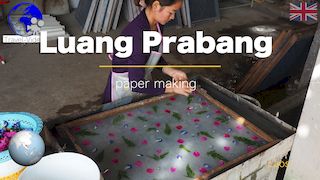
Luang Prabang is one of the most respected centres of Lao craftsmanship. Its historical role as a royal and religious capital encouraged refined artistic production, including silk weaving and ceremonial textiles. Workshops in the city often preserve intricate methods involving careful thread preparation, complex motifs and harmonious colour combinations. Fabrics produced here may be linked to temple offerings, family ceremonies or formal dress.
In Vientiane, weaving traditions continue in a more urban setting. As the modern capital, the city connects heritage skills with contemporary markets. Workshops may produce traditional garments alongside scarves, decorative textiles and updated designs intended for present-day use. This combination of continuity and adaptation reflects the changing role of craft in a growing city.
Ban Xang Hai, widely known for rice alcohol production, also reveals the diversity of village economies. Alongside other local activities, textile work remains an important expression of domestic skill. The presence of embroiderers highlights another major aspect of Lao fabric culture. Embroidery can enrich garments with borders, floral forms, geometric decoration or symbolic details added by hand.
At Phou Khoun, traditional clothing illustrates how dress remains connected to upland identities. In many mountain areas, garments can indicate regional background, social status or community belonging through cut, colour and ornament.
Kok Phung Kai presents a village context where weaving remains closely tied to everyday life. Here, textiles may still be produced for household use, family exchange or local ceremonial needs rather than for large commercial markets.
Historical and Cultural Background
Laos has long stood at the crossroads of mainland Southeast Asia. Exchanges with neighbouring Thai, Khmer, Vietnamese and Chinese worlds influenced materials, trade routes and artistic forms, while local traditions remained strong. The kingdom of Lan Xang and later regional courts helped encourage textile prestige, especially in ceremonial clothing and elite gift culture.
Beyond courts and cities, village weaving was historically essential. Families often produced their own cloth for practical and social needs. Cotton growing, silk raising in some regions, dye preparation and loom work formed part of domestic economies. Women in particular played a central role in preserving and transmitting these techniques.
The ethnic diversity of Laos added exceptional richness to textile culture. Numerous communities developed distinctive motifs, weaving structures and decorative styles. As a result, Lao textiles are not a single tradition but a wide mosaic of local expressions.
Continuity, Change and Preservation
Today, Lao textile arts face both opportunities and pressures. Industrial fabrics, migration, changing lifestyles and reduced time for household production can weaken older practices. At the same time, renewed appreciation for heritage crafts has helped support workshops, cooperatives and training initiatives.
Tourism, museum interest and fair-trade networks have also created new markets for handmade fabrics. Some artisans adapt traditional knowledge into products suited to contemporary use, such as bags, runners or modern clothing. When done carefully, such adaptation can help sustain techniques that might otherwise disappear.
The challenge is to balance economic usefulness with fidelity to materials, patterns and methods that carry historical meaning.
What the Videos on This Site Make Especially Clear
Videos built largely from carefully selected and animated photographs are particularly effective for textile subjects. They allow viewers to study thread structure, loom arrangement, hand positions and repeated gestures that may be missed in rapid moving footage. A slow visual transition across a woven surface can reveal texture and complexity with unusual clarity.
This format also helps compare places. The viewer can move from Luang Prabang to Vientiane, from riverside villages to upland settlements, and understand how environment influences production. Urban workshops, household spaces, traditional clothing and village settings become easier to read when presented through progressive framing and controlled visual rhythm.
Details such as colour contrasts, embroidery density, garment folds and weaving tools gain greater visibility, turning fabric into a readable historical object rather than a simple souvenir item.
A Living Heritage of Laos
The textile arts of Laos unite beauty, labour, memory and identity. From respected city workshops to remote villages, they express the country’s diversity and the endurance of skilled handwork. This video offers an accessible introduction to that world, while the related detailed pages provide a deeper look at weaving centres, embroidery traditions and regional textile cultures across Laos.









Audio Commentary Transcript
In Laos, traditional weaving is an important pillar of cultural identity and economic resilience. In Luang Prabang as elswhere, weaving workshops perpetuate this ancestral art, weaving not only fabrics but also the narrative of a nation. This know-how, passed down from generation to generation, mainly by women, is a living tribute to the Laotian heritage. Each thread represents a part of history, and every pattern symbolizes a belief, thus illustrating the cultural and spiritual diversity of Laos through the fabric.
The importance of weaving in Laotian culture goes beyond aesthetics to deeply root in traditions and rites of passage. It is the expression of a community, a silent language of colors and shapes that celebrates the country's ethnic diversity. Economically, these workshops are the beating heart of rural communities, providing weavers with a livelihood, while propelling Laotian craftsmanship onto the international stage.
Luxury fabrics, crafted for weddings, religious ceremonies, and occasionally sought by passing tourists, are not exclusive to Luang Prabang. Vientiane also hosts renowned weaving workshops, showcasing Laotian artisanal refinement.
Laos celebrates the art of weaving both in its vibrant metropolises of Vientiane and Luang Prabang and within its tranquil tribal villages. In the cities, weaving symbolizes refinement and cultural diversity, attracting connoisseurs and enthusiasts alike. In contrast, in the villages, it takes on a more intimate dimension, being the main economic resource and a cornerstone of cultural identity. Thus, while the craft of weaving thrives throughout the country, its significance varies, reflecting the nuances of Laotian traditions and heritage.
The delicate art of weaving and embroidery is particularly manifested in the creation of traditional outfits, whose patterns and styles vary from one region to another. In Pho Khoun, several workshops specialize in crafting these costumes, thereby weaving a tangible link between the past and the present through the prism of local craftsmanship
As one moves away from the urban bustle and delves into the tranquility of the traditional countryside, the art of weaving becomes more deeply intertwined with local traditions, relying on techniques and materials of an eloquent simplicity.
Audio Commentary Transcript
In Laos, traditional weaving is an important pillar of cultural identity and economic resilience. In Luang Prabang as elswhere, weaving workshops perpetuate this ancestral art, weaving not only fabrics but also the narrative of a nation. This know-how, passed down from generation to generation, mainly by women, is a living tribute to the Laotian heritage. Each thread represents a part of history, and every pattern symbolizes a belief, thus illustrating the cultural and spiritual diversity of Laos through the fabric.
The importance of weaving in Laotian culture goes beyond aesthetics to deeply root in traditions and rites of passage. It is the expression of a community, a silent language of colors and shapes that celebrates the country's ethnic diversity. Economically, these workshops are the beating heart of rural communities, providing weavers with a livelihood, while propelling Laotian craftsmanship onto the international stage.
Luxury fabrics, crafted for weddings, religious ceremonies, and occasionally sought by passing tourists, are not exclusive to Luang Prabang. Vientiane also hosts renowned weaving workshops, showcasing Laotian artisanal refinement.
Laos celebrates the art of weaving both in its vibrant metropolises of Vientiane and Luang Prabang and within its tranquil tribal villages. In the cities, weaving symbolizes refinement and cultural diversity, attracting connoisseurs and enthusiasts alike. In contrast, in the villages, it takes on a more intimate dimension, being the main economic resource and a cornerstone of cultural identity. Thus, while the craft of weaving thrives throughout the country, its significance varies, reflecting the nuances of Laotian traditions and heritage.
The delicate art of weaving and embroidery is particularly manifested in the creation of traditional outfits, whose patterns and styles vary from one region to another. In Pho Khoun, several workshops specialize in crafting these costumes, thereby weaving a tangible link between the past and the present through the prism of local craftsmanship
As one moves away from the urban bustle and delves into the tranquility of the traditional countryside, the art of weaving becomes more deeply intertwined with local traditions, relying on techniques and materials of an eloquent simplicity.