Français (France)
  Nederlands (nl-NL)
 Embroidery in Phou Khoun, Laos, is a local craft practice closely connected to everyday life and the cultural identities of communities in the region. It is generally transmitted within families and relies on skills learned from an early age. The patterns, often geometric or symbolic, reflect social, aesthetic, or spiritual references. This activity plays a role in the making of traditional garments and textile items used for both daily purposes and special occasions. Today, it also contributes to the recognition of intangible heritage and supports forms of local economic activity.
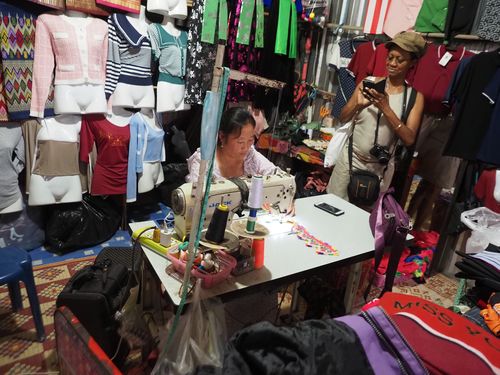
Laos • Embroidery in Phou Khoun
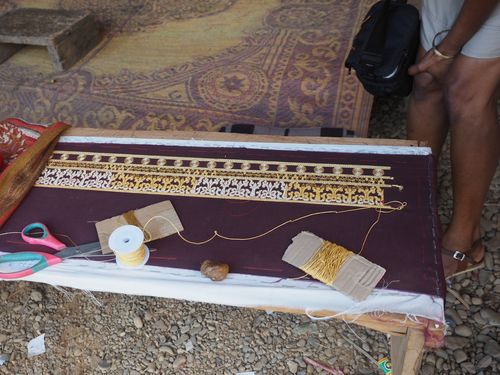
Laos • Embroidery in Phou Khoun
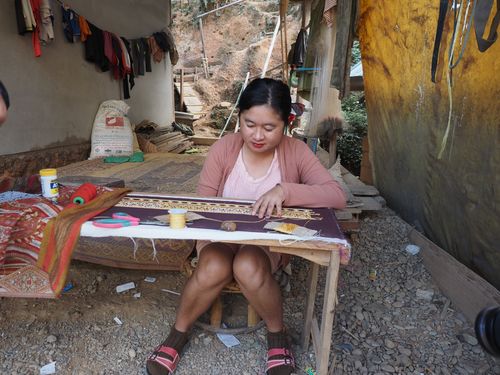
Laos • Embroidery in Phou Khoun
Tradition profile
Embroidery in Phou Khoun
Tradition category: Craftsmanship
Tradition family: Crafts and professions
Tradition genre: Trade and Local Creativity
Geographic location: Laos • Laos
• Links to •
• List of videos about Vientiane on this site •
Vientiane • Temples and Sacred Architecture of Laos
Laos • Fabric Arts
Vientiane, the Triumphal Arch Patuxay • Laos
Embroidery in Phou Khoun: Historical Development and Cultural Role in Laos
Origins and early development
Embroidery in the Phou Khoun region forms part of a broader textile tradition characteristic of rural Laos. Its origins are closely linked to the development of domestic weaving practices, which historically provided the basis for clothing and household textiles. Embroidery likely emerged as a complementary technique, allowing finished fabrics to be enhanced with additional patterns and symbolic elements. This practice developed within diverse ethnic communities, each contributing distinct stylistic features and technical approaches.
Historical evolution
Over time, embroidery became an established component of textile production, extending beyond purely functional purposes. While initially intended for personal and household use, embroidered textiles gradually acquired a social and economic dimension. They were exchanged within communities and, in some cases, traded in local markets. During periods of increased regional connectivity, particularly in the colonial and postcolonial eras, these products entered wider circulation, although production largely remained decentralized and family-based.
Despite external influences, the practice retained its artisanal character, with limited mechanization and a strong reliance on manual skills. This continuity allowed the preservation of local techniques, even as materials and patterns evolved.
Social and cultural significance
Embroidery in Phou Khoun plays a significant role in expressing cultural identity. The motifs used are not merely decorative but often carry symbolic meanings related to social status, community affiliation, or cultural values. In many cases, the ability to produce embroidered textiles is associated with knowledge transmission and social recognition, particularly among women, who are traditionally responsible for this activity.
The practice also contributes to the continuity of cultural knowledge, as patterns and techniques are transmitted across generations. This transmission reinforces collective identity and maintains links between past and present forms of expression.
Economic and community role
Although primarily a domestic activity, embroidery contributes to local economic systems. In rural areas, it provides supplementary income through the sale of textiles in local markets or through intermediaries. This role has gained importance with the increasing demand for handmade products, both within Laos and in external markets.
The organization of production remains informal, typically structured around family units or small groups. This limits large-scale expansion but allows for flexibility and the preservation of stylistic diversity. The integration of embroidery into local economies reflects a balance between subsistence practices and market-oriented production.
Transformations over time
Recent decades have seen notable changes in the practice of embroidery in Phou Khoun. The introduction of industrial threads and fabrics has influenced both materials and techniques. At the same time, shifts in economic conditions and patterns of migration have affected the availability of skilled practitioners.
These changes have led to adaptations in design and production, with some artisans modifying motifs or formats to meet evolving demand. While this has introduced new variations, it has also raised questions about the continuity of traditional forms and techniques.
Present-day relevance
Embroidery remains an important cultural marker in Phou Khoun. It continues to play a role in the production of textiles for both everyday use and specific social contexts. At a broader level, it contributes to the recognition of local craftsmanship within national frameworks that promote cultural heritage.
The persistence of this practice reflects its adaptability and its continued relevance within changing social and economic environments.
Transmission and contemporary challenges
The transmission of embroidery skills continues to rely primarily on informal learning within families. However, this system faces challenges related to generational change, economic pressures, and the availability of alternative livelihoods.
Efforts to support the preservation of these skills include initiatives aimed at strengthening training, improving access to markets, and promoting recognition of traditional craftsmanship. The long-term sustainability of embroidery in Phou Khoun depends on maintaining a balance between adaptation to contemporary conditions and the retention of core technical knowledge.
Embroidery in Phou Khoun: Techniques, Materials, and Practical Organization
General workflow of production
Embroidery in Phou Khoun follows a sequence that begins with the preparation of the textile base and continues through pattern planning and execution. The fabric, often woven locally or purchased in nearby markets, is first selected according to its intended use. Artisans then determine the placement of decorative elements, either by relying on memorized patterns or by marking light guidelines directly on the surface.
The embroidery itself progresses gradually, with sections completed over multiple sessions. Work is typically integrated into daily routines, carried out in intervals alongside other activities. The pace depends on the complexity of the design, with larger or denser compositions requiring extended periods of attention.
Tools, materials, and textile supports
The tools involved are limited in number but require precise handling. Needles of varying sizes are used according to the thickness of the fabric and thread. Threads may be made of cotton, silk, or synthetic fibers, depending on availability and cost. Color selection is deliberate, with strong contrasts often used to define shapes and enhance visibility.
Textile supports differ according to function. Heavier fabrics are used for garments or durable items, while lighter materials are chosen for decorative or supplementary elements. In some cases, simple frames are employed to maintain tension, although many artisans work without fixed supports, holding the fabric directly.
Technical gestures and execution
The embroidery process is defined by a series of controlled and repetitive movements. Each stitch requires consistent tension and alignment to maintain uniformity. Artisans alternate between dense filling stitches and more linear outlining techniques, depending on the structure of the motif.
The execution relies heavily on manual memory. Patterns are not typically recorded in written form but are retained through practice and observation. The precision of the work is visible in the regularity of stitches and the clarity of the design. Small variations occur between individuals, reflecting differences in technique and experience.
Motifs, composition, and visual organization
The embroidered motifs are organized according to structured visual principles. Geometric patterns are common, often arranged in repeating sequences or symmetrical layouts. Designs are adapted to the dimensions of the textile, with particular attention given to edges, borders, and central panels.
Color distribution plays a key role in the overall composition. Contrasts are used to separate elements and define the rhythm of the pattern. The arrangement of motifs can follow horizontal bands, vertical alignments, or radial structures, depending on the object being produced.
Participants and division of roles
Embroidery is primarily practiced within family settings, with women playing a central role in both production and transmission. Learning begins through observation, with younger members gradually participating in simpler tasks before moving to more complex designs.
Work may also take place in small informal groups, where participants share techniques and compare results. These interactions contribute to maintaining stylistic coherence while allowing for individual interpretation. The absence of formal specialization means that most practitioners are involved in multiple stages of the process.
Spaces of production and circulation
The activity is usually carried out in domestic environments, either inside the house or in shaded outdoor areas. The absence of dedicated workshops reflects the integration of embroidery into everyday life. Workspaces are arranged according to available light and comfort rather than fixed technical requirements.
Finished items circulate through several channels. They may be used within the household, exchanged within the community, or sold in local markets. Market spaces provide a point of contact between producers and buyers, influencing the types of objects made and the selection of motifs.
Visual and auditory environment
The production environment is generally quiet, characterized by a steady rhythm of hand movements. The passage of the needle through the fabric creates a subtle, repetitive sound, accompanied by occasional conversation among participants.
Visually, the process is defined by the gradual emergence of patterns on the textile surface. The contrast between the base fabric and the thread highlights the progression of the work, making each stage immediately perceptible. Light conditions play an important role, as precision depends on the clear visibility of fine details.
Distinctive characteristics of the practice
Embroidery in Phou Khoun is marked by the combination of manual production and consistent visual codes. Despite the absence of standardized templates, the motifs display recognizable features that reflect shared conventions within the community.
At the same time, the practice shows adaptability in the choice of materials and the scale of production. Artisans adjust their work to available resources and market demand while maintaining the essential structure of their techniques. This balance between continuity and flexibility is one of the defining aspects of embroidery in the region.
 Links to the main sections of the site