Français (France)
  Nederlands (nl-NL)
 00:00 • intro | 00:25 • Patuxay Monument | 02:00 • Decorative details of the Patuxai monument
Personal creation from visual material collected during my trip Laos and Bangkok (2022)
Map of places or practices in Vientiane on this site
• Use the markers to explore the content •
Vientiane and Patuxay: The Triumphal Arch of Laos
A landmark at the heart of the capital
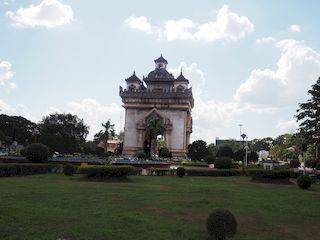
In Vientiane, broad avenues and open urban perspectives lead toward one of the best-known monuments in Laos: Patuxay. Often described as a triumphal arch, this imposing structure occupies a central place in the modern image of the capital. It is not simply a local version of a foreign model, but an original creation in which international monumental forms are combined with Lao artistic identity.
This video offers a close look at the monument, from its overall silhouette to its decorative details. It shows how Patuxay has become both an urban landmark and a national symbol linked to the modern history of Laos. In a city often associated with Buddhist temples and sacred architecture, it represents another important dimension of Vientiane’s heritage: civic memory and twentieth-century public design.
Monumental form and distinctive decoration
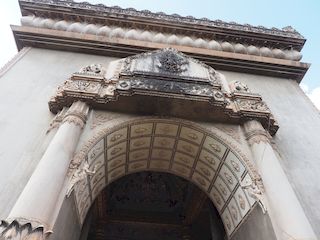
Seen from outside, Patuxay impresses through its balanced proportions, open arches and elevated towers. Its position at the center of a ceremonial axis strengthens its symbolic presence. Gardens and surrounding avenues frame the monument, creating a spacious civic setting that emphasizes visibility and scale.
Although its commemorative role recalls triumphal arches elsewhere, its decorative language is distinctly Lao. Roof-like upper elements, ornamental forms and local motifs distance the monument from purely European precedents. The result is a hybrid architecture that transforms an international concept into something rooted in local culture.
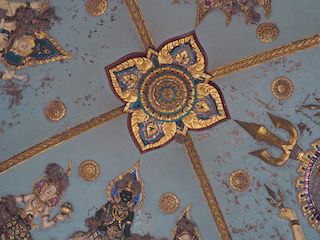
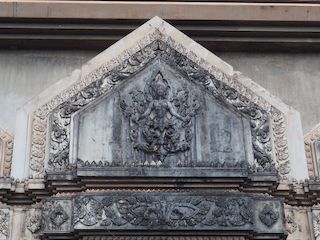
Decorative details are essential to understanding Patuxay. Relief patterns, floral motifs, geometric elements and stylized figures soften the mass of the structure and add visual richness. Where many classical arches rely on restrained surfaces, Patuxay introduces a more elaborate ornamental vocabulary closer to Southeast Asian traditions.
Historical meaning and national identity
Patuxay was built during the second half of the twentieth century, in a period when Laos was seeking to affirm its national identity after the colonial era and amid major political changes in the region. The monument is generally dedicated to those who fought for the country’s independence and sovereignty.
Its name is often translated as “Victory Gate,” clearly expressing its commemorative purpose. More than a memorial, it represents an effort to give the Lao nation a visible and prestigious civic monument in the center of its capital. Through architecture, memory was placed into the urban landscape.
Within Vientiane, where religious monuments dominate much of the historic identity of the city, Patuxay introduces a different register: that of public remembrance, modern statehood and national symbolism.
What the videos on this site make especially clear
Videos built largely from carefully selected and animated photographs are especially effective for a monument such as Patuxay. They allow viewers to appreciate the overall proportions of the structure, something often difficult when standing directly beneath it. Slow visual movement reveals symmetry, layered volumes and the relationship between the monument and the surrounding cityscape.
This approach is equally valuable for decorative details. Sculpted surfaces, cornices, ornamental transitions and symbolic motifs become easier to observe than during a brief visit. Viewers can clearly see how Lao forms were integrated into a modern monumental composition.
The progression of images also helps explain Patuxay’s urban role. It appears not as an isolated object, but as a focal point within Vientiane, linking architecture, open space and civic identity.
A symbol of modern Laos
Patuxay embodies an important chapter of Lao history: independence, collective memory and the search for a national architectural expression. As a civic monument in a capital renowned for its temples, it broadens the understanding of Vientiane’s heritage. Visitors wishing to explore further can continue with the detailed page dedicated to the monument, its architecture and its historical significance.
Links to related pages







Audio Commentary Transcript
The Patuxay Monument, located at the heart of Vientiane, is a major emblem of Laos' independence. Erected in the 1960s, this monument is dedicated to the Laotian heroes who fought to free their country from French domination. Merging traditional Laotian architecture with influences from the Arc de Triomphe in Paris, Patuxay stands as a testament to the resilience and autonomy of the Laotian people, celebrating both their heroic past and aspirations for a sovereign future.

Music:
- - YouTube video library - For Originz, (© For Originz by Kevin MacLeod is licensed under a Creative Commons Attribution 4.0 license. https://creativecommons.org/licenses/by/4.0/
- Source: http://incompetech.com/music/royalty-free/index.html?isrc=USUAN1100700
- Artist: http://incompetech.com/)
Disclaimer: Despite its appropriateness, copyright issues prevent the use of laotian traditional music in "Vientiane • Patuxay, the Triumphal Arch • Laos", hence the use of royalty-free music. Despite our careful selection, some might regret this decision, which is necessary to avoid potential lawsuits. Although difficult, this decision is the only viable solution.
Due to Vimeo's copyright control system, which does not correctly filter content, and their rigid policy, we have decided to transfer all our videos to YouTube. While we have appreciated our collaboration with Vimeo for many years, this decision is necessary to ensure the continuous and uninterrupted availability of our content. Thank you for your understanding and continued support.