Français (France)
  Nederlands (nl-NL)
 00:00 • intro | 00:14 • Morning market | 04:54 • Night market | 07:09 • Phosy Market
Personal creation from visual material collected during my trip Laos and Bangkok (2022)
Map of places or practices in Luang Prabang on this site
• Use the markers to explore the content •
Luang Prabang: Markets and the Rhythms of Daily Exchange
A town where trade structures everyday life
In Luang Prabang, markets are not peripheral features but central components of urban life. Beyond its well-known religious heritage and preserved architecture, the town reveals its social and economic dynamics through spaces of exchange that operate at different times of day. These markets form a network that connects rural production, local consumption, and evolving commercial practices.
The video explores this diversity by following several key moments, from early morning activity to evening trade. Each setting reflects a specific function, whether linked to daily provisioning, local craftsmanship, or broader interactions influenced by tourism. Together, they offer a coherent view of how commerce contributes to the organization of the town and to the continuity of its traditions.
Distinct markets, complementary roles
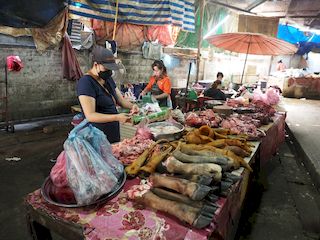
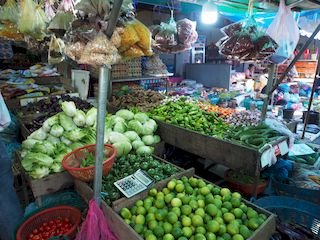
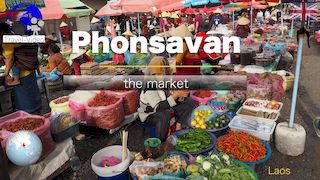
The morning market represents one of the most traditional forms of exchange. Taking place at the start of the day, it brings together producers from nearby rural areas and residents seeking fresh goods. Fruits, vegetables, herbs, fish, and meat are displayed in a direct and practical manner, often without elaborate infrastructure. This market illustrates a short supply chain in which transactions occur face to face, reinforcing social ties as much as economic ones.
The night market introduces a different atmosphere, shaped by a more structured layout and a distinct visual identity. Installed along central streets, it is characterized by rows of stalls illuminated after sunset. The products on display tend to emphasize textiles, handcrafted items, and decorative objects. While it responds in part to the presence of visitors, it remains rooted in local production and skills. It reflects an adaptation of traditional commerce to new audiences, without completely abandoning its cultural foundations.
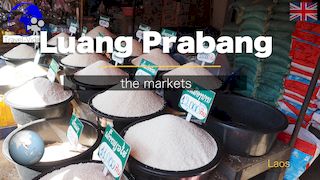
Phosy Market, by contrast, functions as a larger and more permanent hub. It plays a key role in the daily supply of the population, offering a wide range of food products and everyday goods. Its organization is more functional, less oriented toward presentation, and more focused on efficiency. Regularly frequented by local residents, it embodies a stable and essential component of the town’s economic structure.
Historical continuity and local adaptation
The presence of multiple types of markets in Luang Prabang reflects a long-standing tradition of exchange closely linked to rural production systems. The proximity of agricultural areas allows for a constant flow of fresh goods into the town, maintaining a direct relationship between producers and consumers. This structure, largely based on small-scale and family-run activities, has shown a strong capacity for continuity.
The historical role of Luang Prabang as a political and religious center has also influenced the spatial distribution of these markets. They are generally located near areas of circulation and daily activity, integrating naturally into the urban fabric. Although the colonial period introduced new forms of urban organization, it did not fundamentally alter these commercial practices, which have remained flexible and responsive to local needs.
Environmental conditions further shape these activities. The early schedule of the morning market reflects the need to operate before the heat intensifies, while the temporary nature of many stalls allows for quick adaptation to changing conditions. These elements demonstrate how trade practices are closely aligned with both climate and spatial constraints.
What the visual structure makes particularly clear
The video’s construction, based largely on carefully selected and animated photographs, enhances the readability of these different market environments. By isolating specific moments and gestures, it becomes possible to observe details that might otherwise be overlooked in continuous motion footage.
Textures of produce, arrangements of goods, and interactions between vendors and customers are presented with clarity. The transitions between markets highlight variations in atmosphere, lighting, and spatial organization, making it easier to understand their respective roles within the town.
This visual approach slows down perception and encourages a more analytical reading of the scene. It reveals how each market operates within a broader system, allowing the viewer to grasp both differences and connections between them.
Markets as a reflection of a living urban system
The markets of Luang Prabang illustrate how a historic town can maintain continuity while adapting to contemporary realities. They are places where economic exchange, social interaction, and cultural expression converge, forming an essential part of the urban landscape.
Rather than presenting isolated scenes, the video offers a structured insight into how these markets function collectively. For those wishing to deepen their understanding, the related pages provide more detailed perspectives on each market and the practices associated with them, extending the exploration of this fundamental aspect of life in Laos.
Links to related pages







Audio Commentary Transcript
Markets in Asia, particularly in Luang Prabang, Laos, are hubs of activity where tradition and modernity meet. These markets are not just places of commerce, but are vibrant hearts of popular culture, where one can discover local agricultural products, unique crafts, and authentic flavors. Each market in Luang Prabang presents a living tableau of daily life, reflecting the history and customs of the Lao people through its colors, sounds, and scents. This film takes you on an exploration of three iconic markets in this historic city, where each visit is a new discovery, a journey through the very essence of the Lao community.
The most popular market in Luang Prabang is the daily morning market, which comes alive at dawn. Here, locals gather to purchase fresh products for preparing their meals throughout the day. It's also a vital meeting place where local news and gossip from the previous day are exchanged, away from the mass tourism.
After a visit to the morning market, where locals rush for their daily purchases, the days in Luang Prabang stretch out quietly until dusk. Once the sun has set, the night market comes to life, a captivating contrast to the morning hustle. Here, under dimmed lights, local crafts take center stage, drawing visitors and tourists in search of unique treasures and authentic experiences.
In Luang Prabang, the Phosy Market stands out from both the morning and the night markets due to its lack of tourist appeal. It serves as a vital center for locals. Here, unlike the ephemeral stalls or crafts for visitors, one finds a true economic hub for daily life. The residents buy everything from fresh produce to household items in an authentic setting where negotiations and exchanges blend seamlessly. More than just a market, Phosy is the beating heart of the city, offering a deep insight into local culture and economy. A must-visit to grasp the real essence of Luang Prabang.

Music:
- - YouTube video library - Allegro - Emmit Fenn
- - YouTube video library - Mi Dispiace - The Mini Vandals
- - YouTube video library - No.4 Piano Journey - Esther Abrami
- - YouTube video library - Requiem In Cello - Hanu Dixit
Disclaimer: Despite its appropriateness, copyright issues prevent the use of laotian traditional music in "Luang Prabang, the markets • Laos", hence the use of royalty-free music. Despite our careful selection, some might regret this decision, which is necessary to avoid potential lawsuits. Although difficult, this decision is the only viable solution.