Français (France)
  Nederlands (nl-NL)
 The Night Market of Luang Prabang is one of the city’s most recognizable public spaces, bringing together residents, artisans, and visitors every evening along the main street of the historic center. It offers a wide range of items, including local handicrafts, textiles, decorative objects, paintings, and traditional food. The lively and friendly atmosphere encourages exchanges between locals and travelers, making it both a commercial and cultural meeting point. The market plays an important role in supporting the local economy and in safeguarding artisanal skills that have been passed down through generations. Its steady popularity among residents and tourists alike gives it an authentic and welcoming character that reflects the social and creative dynamism of Luang Prabang.
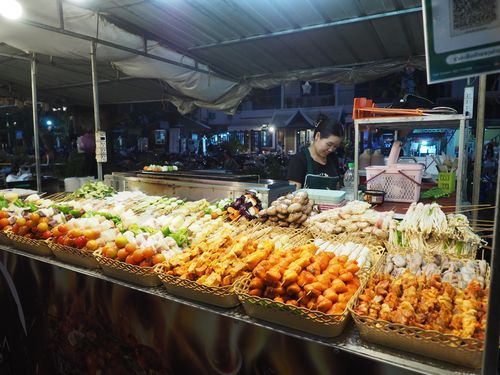
Luang Prabang • Night Market

Luang Prabang • Night Market
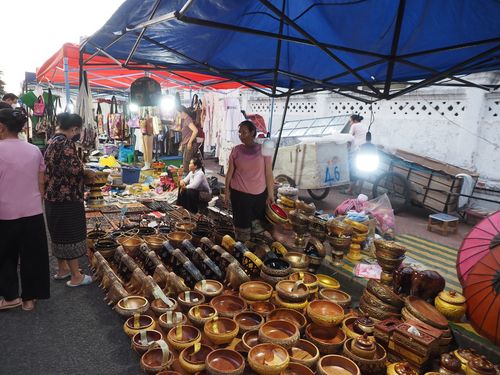
Luang Prabang • Night Market
Tradition profile
Night Market
Tradition category: Local market
Tradition family: Traditional markets and fairs
Tradition genre: Trade and Local Creativity
Geographic location: Luang Prabang • Laos
• Links to •
• List of videos about Luang Prabang on this site •
Luang Prabang, Royal Palace • Laos
Luang Prabang, the markets • Laos
Luang Prabang, Wat Sensoukharam temple • Laos
Luang Prabang, Sunset on Mount Phou Si • Laos
Luang Prabang, Wat Xieng Thong temple • Laos
Luang Prabang, paper making workshop • Laos
Laos • Fabric Arts
Luang Prabang, a City in the Countryside • Laos
Luang Prabang, some temples • Laos
The History of the Night Market Tradition in Luang Prabang
Political and Social Context of its Formation
The tradition of the Night Market in Luang Prabang emerged from a broader social transformation that reshaped Laos at the end of the twentieth century. After the proclamation of the Lao People’s Democratic Republic in 1975, the country entered a long period of centralised governance and economic isolation. During the 1980s, new political orientations encouraged a gradual reopening of the nation and the revitalisation of local economies. Within this context, Luang Prabang—former royal capital and a major centre of Theravāda Buddhism—became a showcase of national cultural identity.
The creation of a nightly market stemmed from the convergence of economic need and cultural revival. Local authorities sought to promote small-scale craft production while offering rural communities access to a wider market. The Hmong and Khmu minorities, whose weaving, embroidery, and metalwork traditions were well known, played a decisive role in this process. For them, the market provided not only a source of income but also a space for cultural recognition. The initiative received government support, particularly from tourism and heritage institutions, as part of a policy designed to link economic recovery with cultural pride. The Night Market thus became a tangible expression of Laos’s post-socialist identity: modest, peaceful, and rooted in craftsmanship.
Historical Events Shaping the Tradition
The market’s development coincided with the most decisive event in Luang Prabang’s modern history: its inscription on the UNESCO World Heritage List in 1995. This designation transformed the city into a centre for cultural tourism and created conditions favourable to the institutionalisation of local practices. The Night Market, which began as a small informal gathering of artisans during festive periods, became a regulated, permanent event at the end of the 1990s.
The decision to close Sisavangvong Street each evening to cars marked the transition from a spontaneous market to a civic institution. Municipal authorities established rules regarding stall placement, lighting, and product types. By integrating the Night Market into the city’s urban planning, they turned it into both a symbol of heritage preservation and an economic lifeline for residents.
The evolution of the market also reflects the wider history of commerce in Laos. During the colonial period, daytime markets dominated urban life, while the war years and the socialist period restricted private trade. The reforms of the late 1980s reopened the path for community-based initiatives. The Night Market became one of the most visible manifestations of this liberalisation, balancing state control with grassroots entrepreneurship.
Global Context and Regional Influences
The appearance of the Night Market in Luang Prabang corresponds to a regional phenomenon. Throughout Southeast Asia in the 1990s, urban centres such as Chiang Mai, Hoi An, and Siem Reap established similar markets to showcase crafts and promote tourism. These venues were part of a wider global trend celebrating “authentic” local cultures in response to mass industrialisation.
Luang Prabang, however, adopted a distinctive approach. The city avoided the exuberant commercialism of its neighbours, favouring an atmosphere of calm and order consistent with its monastic heritage. The market retained a community-oriented structure, where vendors—often from the same families for generations—maintained a relationship of trust with visitors. This quiet and structured ambiance differentiated Luang Prabang from the larger, entertainment-focused night markets of Thailand or Vietnam.
The global tourism industry of the late twentieth century sought “living heritage,” and Luang Prabang’s market offered precisely that: a space where artisans, rather than performers, were the protagonists. The Night Market thus mirrored worldwide cultural shifts while preserving a uniquely Lao rhythm and philosophy.
Transformations Over Time
Since its establishment, the Night Market has evolved in both scale and organisation. Originally limited to a few dozen vendors, it now hosts several hundred stalls each evening. Infrastructure improvements, such as electric lighting and pedestrian zoning, have changed its material appearance, while its cultural function remains largely intact.
The composition of participants has also broadened. Initially dominated by Hmong and Khmu communities, the market now includes urban Lao artisans, cooperatives, and even small food producers. The introduction of new materials and patterns reflects adaptation to global demand, but the underlying emphasis on handmade quality persists. Municipal regulation limits industrial imports, attempting to maintain authenticity.
The market’s evolution also mirrors shifts in Lao society. It reflects a gradual empowerment of women, who constitute the majority of stallholders and often manage family workshops. It embodies a redefinition of labour, where traditional knowledge becomes a means of social mobility. Even during periods of reduced tourism—such as during the global pandemic—the market’s structure has shown resilience, quickly reviving with the return of visitors.
The Role of the Tradition in Contemporary Society
Today, the Night Market is a cornerstone of Luang Prabang’s social and economic life. Beyond its function as a trading space, it is a site of daily interaction between communities and cultures. Residents view it as part of their city’s identity, a visible link between heritage and livelihood. For artisans, it represents both economic survival and cultural affirmation; for visitors, it offers a direct experience of local traditions.
Its significance also lies in its moral and aesthetic values. The serenity of the night, the politeness of exchanges, and the emphasis on harmony all reflect the Buddhist ethics underlying Lao society. The act of selling and buying takes on a ritual quality: the gestures, the tone of voice, and the respectful distance between vendor and visitor mirror the principles of moderation and compassion.
Nationally, the market contributes to the image of Laos as a land of calm cultural continuity. It demonstrates how a practice born from economic necessity has acquired symbolic weight as a representation of national identity.
Current Preservation and Modern Challenges
Despite its vitality, the Night Market faces challenges. Urbanisation and mass tourism threaten its authenticity by encouraging the proliferation of imported goods. Younger generations, drawn to urban employment, risk abandoning artisanal trades. Without continued transmission of skills, the market could lose the diversity that made it emblematic.
Efforts to safeguard it have multiplied. Local associations provide training in traditional crafts and promote quality certification for genuine handmade products. Municipal regulations restrict non-artisan stalls and encourage the participation of minority groups. Although not listed as intangible cultural heritage by UNESCO, the market benefits from the visibility associated with Luang Prabang’s world heritage status.
International cooperation also plays a role: partnerships with development agencies and NGOs support craft education and sustainable tourism practices. These initiatives aim to preserve not only the economic viability of the market but also its symbolic function as a living space of exchange.
The Night Market of Luang Prabang thus represents a rare equilibrium between tradition and adaptation. Emerging from a historical process of recovery and negotiation, it continues to express the city’s capacity to transform heritage into a daily ritual of coexistence. Each evening, under the subdued lights and measured gestures of its vendors, the market renews the dialogue between memory and modernity that defines the enduring identity of Luang Prabang.
The Characteristics of the Night Market Tradition in Luang Prabang
Origins and Cultural Context
The Night Market of Luang Prabang is more than a commercial event—it is a living expression of Lao cultural identity shaped by the intersection of religion, craftsmanship, and social exchange. Emerging in the late twentieth century, it developed within a period of economic opening and cultural renewal in Laos. After decades of isolation, the state sought new ways to promote development while preserving traditional values. Luang Prabang, the former royal capital and spiritual centre of Theravāda Buddhism, provided the ideal setting for this experiment.
The origins of the Night Market can be traced to the convergence of multiple factors: the need to sustain artisanal livelihoods, the rise of cultural tourism, and the rediscovery of community-based commerce. For centuries, the people of Luang Prabang had practised small-scale trading linked to temple fairs and agricultural cycles. As tourism increased in the 1990s, these practices were reinterpreted to fit an urban, evening format. Local authorities encouraged the initiative, providing structure and visibility, while artisans from the Hmong, Khmu and Lao Loum communities adapted their ancestral crafts to meet new expectations. The market became a bridge between tradition and modernity—a social ritual where the act of selling retained the dignity of a cultural exchange.
Structure, Practices and Craftsmanship
Every evening, as daylight fades, the transformation of the city centre begins. Sisavangvong Street, closed to vehicles, is lined with hundreds of mats and low tables where artisans arrange their wares in a meticulous order. The preparation follows a habitual rhythm: unrolling woven carpets, lighting small lamps, aligning fabrics, ornaments and paintings by colour and size. The visual harmony of this sequence creates a sense of order and continuity that echoes the ritual precision of Buddhist ceremonies.
The products on display are varied yet united by a shared aesthetic of craftsmanship. Textiles dyed with natural indigo, hand-embroidered bags, wooden carvings and silver jewellery all reflect techniques passed down through generations. These skills are transmitted within families, particularly among women, who dominate both production and sales. The gestures associated with weaving, knotting, or engraving are more than technical routines; they embody patience, concentration and balance—virtues deeply valued in Lao culture.
The market’s auditory and visual environment reinforces its distinct atmosphere. Music from traditional instruments occasionally drifts through the crowd, while the subdued light of red and amber lamps gives the place a calm, meditative tone. Unlike many Southeast Asian markets defined by noise and bargaining, Luang Prabang’s Night Market operates through quiet negotiation, mutual respect and subtle gestures—a reflection of the Buddhist principle of moderation.
Symbolism and Meanings
The Night Market carries a strong symbolic charge. Its nocturnal setting is not accidental: in Lao thought, night represents introspection, rest and social harmony. Conducting trade in this calm environment expresses the ideal of balance between material needs and spiritual tranquillity. The market’s atmosphere mirrors the Buddhist value of upekkhā—equanimity—where commerce is not about competition but about coexistence.
Colours and forms also hold meaning. Red signifies vitality and prosperity, gold evokes enlightenment, blue stands for wisdom, and white for purity. The orderly layout of the stalls symbolises the social harmony of Luang Prabang, where each participant finds their place within a collective rhythm. Even the interactions between vendors and visitors—polite greetings, measured exchanges, smiles offered without insistence—become a moral performance reaffirming cultural identity.
During major Buddhist festivals or national holidays, the market assumes a more ceremonial dimension. Lanterns, floral offerings and decorative fabrics transform it into a festive landscape where spirituality and community life blend. In these moments, the market functions as both a space of devotion and a celebration of craftsmanship.
Evolution and External Influences
Over time, the Night Market has evolved while retaining its essential characteristics. From its modest beginnings with a few dozen vendors, it has grown into a structured event involving hundreds of participants. This expansion brought improvements in organisation—lighting, sanitation, stall allocation—but also challenges linked to authenticity. The introduction of imported goods and the adaptation of designs to suit foreign tastes reflect the dual influence of global tourism and local resilience.
Regional models have played a role. The success of night markets in Thailand and Vietnam inspired certain adjustments, yet Luang Prabang maintained its distinctive restraint. Its market prioritises calm over spectacle, craft over consumption. Such moderation has preserved its reputation for authenticity and contributed to the city’s identity as a “living museum.”
Technological and social changes have also influenced the practice. Mobile payments, social media promotion and the arrival of younger entrepreneurs have modernised the logistics, while the essence of the tradition—the communal rhythm of nightly setup and dismantling—remains intact. In this continuity lies the market’s strength: it evolves without losing its ritual dimension.
Social Organisation and Community Impact
The Night Market is not only an economic system but also a social institution. It brings together people from diverse ethnic and geographic backgrounds in a space of cooperation rather than competition. The vendors form an informal yet cohesive community where trust, mutual aid and shared responsibility ensure stability. The market’s management, involving municipal authorities and artisans’ associations, guarantees fair distribution of spaces and encourages the participation of women and minority groups.
Its social impact is considerable. For many families, the market represents the main source of income, enabling education and health improvements. It also provides a platform for women’s empowerment: through economic independence, they acquire recognition within both household and community. On a broader scale, the market acts as a cultural interface, linking urban residents and rural artisans while reinforcing the image of Luang Prabang as a city of harmony.
Notable Figures and Collective Memory
Behind the continuity of the Night Market are the stories of individual artisans and families. Some have sold their work there for more than twenty years, preserving techniques of natural dyeing or embroidery once at risk of extinction. Oral accounts recall how, in the early days, vendors lit kerosene lamps and laid out their textiles directly on the pavement. These anecdotes, transmitted from generation to generation, feed the collective memory of the city and strengthen the feeling of belonging to a shared tradition.
Recognition and Preservation Challenges
Although the Night Market itself is not formally registered as intangible cultural heritage, it benefits from Luang Prabang’s World Heritage status, which protects its broader environment. Nevertheless, the tradition faces persistent threats: the influx of imported goods, the standardisation of designs, and the declining interest of younger generations in artisanal work. Urban development and rising tourism risks could gradually alter its authenticity.
Efforts to counter these trends have intensified. Local cooperatives promote fair-trade principles and certify handmade products; vocational programmes encourage the learning of traditional crafts; and municipal regulations limit non-artisan vendors. International organisations collaborate with local authorities to sustain the market’s cultural and economic role.
Today, the Night Market stands as a symbol of Laos’s ability to blend continuity and adaptation. Through the daily renewal of its practices, it transforms an ordinary act of trade into a collective ritual of resilience and identity. Each evening, under the calm glow of its lights, Luang Prabang reaffirms the vitality of its living heritage—an enduring dialogue between tradition, community and change.
 Links to the main sections of the site