Français (France)
  Nederlands (nl-NL)
 Traditional paper-making in Luang Prabang remains a widespread craft, practiced by numerous small workshops and families who preserve techniques passed down through generations. Rooted in ancient East Asian methods, the process involves manually transforming natural fibers — especially from the paper mulberry tree — into sheets used for writing, decoration, or ceremonial purposes. Each step, from fiber preparation to drying in the sun, reflects a balance of skill and patience. More than a utilitarian activity, this craft embodies the connection between humans, nature, and creative expression. Despite competition from industrial production, handmade paper continues to symbolize cultural identity and contributes to the local economy of Luang Prabang.
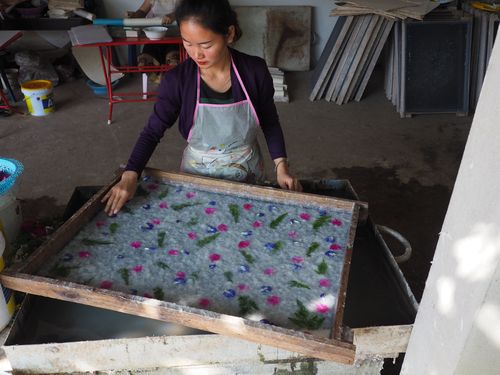
Luang Prabang • Paper Crafting Workshop
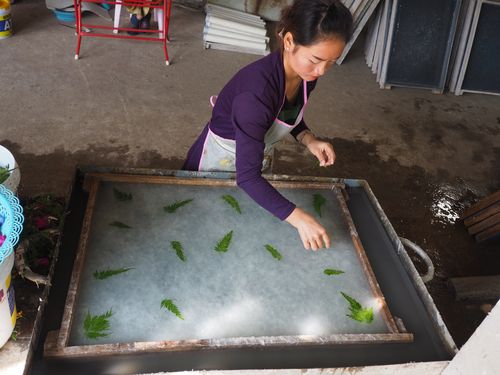
Luang Prabang • Paper Crafting Workshop

Luang Prabang • Paper Crafting Workshop
Tradition profile
Paper Crafting Workshop
Tradition category: Craftsmanship
Tradition family: Crafts and professions
Tradition genre: Trade and Local Creativity
Geographic location: Luang Prabang • Laos
• Links to •
• List of videos about Luang Prabang on this site •
Luang Prabang • Royal Palace and Haw Pha Bang Temple
Luang Prabang, the markets • Laos
Luang Prabang, Wat Sensoukharam temple • Laos
Luang Prabang, Sunset on Mount Phou Si • Laos
Luang Prabang, Wat Xieng Thong temple • Laos
Luang Prabang, paper making workshop • Laos
Laos • Fabric Arts
Luang Prabang, a City in the Countryside • Laos
Luang Prabang, some temples • Laos
The Paper-Making Tradition of Luang Prabang — Historical Roots, Evolution, and Cultural Continuity
The handmade paper tradition of Luang Prabang represents one of the most enduring artisanal practices in Laos, combining technical skill, religious purpose, and community cohesion. Known locally as saa paper, this craft reflects centuries of interaction between regional Buddhist culture and trans-Asian trade networks. More than a utilitarian activity, paper-making embodies a social and spiritual continuity deeply rooted in the history of the Lan Xang kingdom and the monastic life that shaped the region’s cultural identity.
Political and Social Context of Emergence
The origins of handmade paper production in Luang Prabang trace back to the early period of the Lan Xang kingdom (14th–17th centuries), when Buddhism became both the spiritual foundation and the political ideology of the Lao state. The consolidation of religious institutions under royal patronage fostered a need for local materials used in monastic education and ritual practice. Paper-making emerged within this framework, initially practiced by monks and lay artisans who supplied monasteries with materials for copying sacred texts and creating ritual objects.
The availability of the paper mulberry tree (Broussonetia papyrifera), native to the humid valleys surrounding Luang Prabang, was decisive. Its bark, rich in long, flexible fibers, provided an ideal base for durable, smooth paper suited to calligraphy and illumination. The proximity of this natural resource, coupled with the city’s strategic position on the Mekong River, encouraged the establishment of small-scale workshops connected to religious communities.
Politically, the Lan Xang court supported paper-making as part of its broader strategy to legitimize authority through Buddhist symbolism. Manuscripts, banners, and prayer scrolls served as instruments of devotion and royal propaganda alike, reinforcing the moral and cosmological order promoted by the monarchy. Socially, this artisan activity allowed the integration of lower-status groups—particularly women and novices—into the monastic economy through specialized labor, while also sustaining local networks of trade and exchange.
Major Historical Developments
Over the centuries, the paper-making tradition underwent several transformations influenced by regional instability and external contact. The decline of Lan Xang in the 18th century, followed by the fragmentation of its territory and repeated conflicts with Siam, weakened monastic institutions. Nevertheless, the continuity of village-based production ensured that paper-making did not disappear. Artisans adapted to changing demands, supplying monasteries for local rituals even when royal patronage waned.
During the French colonial period (1893–1954), traditional crafts were overshadowed by imported industrial products. Colonial administrators documented Lao paper-making primarily for ethnographic purposes but made little effort to support its practice. Nonetheless, the tradition persisted at the margins, primarily within the temple economy. The mid-20th century brought new challenges: political upheavals, war, and the socialist reorganization of the Lao People’s Democratic Republic led to a partial disconnection between craft production and religious life.
It was only in the late 20th century, following the political normalization of the 1980s and the inscription of Luang Prabang as a UNESCO World Heritage Site in 1995, that the craft regained prominence. The recognition of cultural heritage became an explicit state policy, encouraging the revival of traditional crafts as a means of economic development and cultural affirmation. Paper-making workshops reappeared throughout the region, often with the dual purpose of preservation and tourism.
Global Context and Comparative Practices
The emergence of handmade paper in Luang Prabang cannot be understood in isolation. Its technical and conceptual roots reach back to ancient Chinese paper-making, invented during the Han dynasty and disseminated across East and Southeast Asia through trade and Buddhism. Similar traditions developed in northern Thailand, Myanmar, and Vietnam, each adapting the technique to local materials and spiritual needs.
While paper production in China and Japan evolved into a highly specialized art form with imperial patronage, the Lao version retained a modest, communal dimension. Its function was primarily religious rather than bureaucratic or literary, distinguishing it from the Western paper tradition that flourished after the medieval period in Europe. In that global context, Luang Prabang’s craft exemplifies a distinct model of cultural adaptation: it demonstrates how technologies of writing and representation were localized to serve ritual and symbolic purposes within Buddhist societies.
Transformations and Adaptations
Though its technical foundation has remained stable for centuries, the social and economic framework of paper-making has evolved considerably. The basic process — soaking, boiling, pounding, filtering, and sun-drying mulberry bark pulp on wooden frames — is unchanged. Yet, the motivations behind the craft have diversified. Where once paper served exclusively religious purposes, it is now used for decorative and commercial products such as lamps, envelopes, and notebooks.
These adaptations reflect both economic pragmatism and cultural resilience. Artisans, primarily women, have taken on leading roles in the workshops, transforming the tradition into a viable livelihood in the post-socialist economy. Cooperative networks have formed to standardize quality and promote sustainable harvesting of mulberry trees. In this sense, the tradition has shifted from a monastic dependence to a model of community entrepreneurship rooted in heritage.
At the same time, the symbolic dimension of the paper remains intact. The purification of fibers through water and sunlight is still viewed as an act of spiritual cleansing. Many artisans begin production periods with offerings to local spirits, reflecting the enduring syncretism of Lao Buddhism and animist cosmologies.
Cultural Role and Contemporary Significance
Today, handmade paper production is both an economic activity and a form of cultural expression. In Luang Prabang, workshops operate as spaces of intergenerational transmission, where elders instruct younger artisans through practice rather than formal teaching. The rhythm of work follows natural cycles — harvesting in the dry season, drying in sunlight, resting during the monsoon — reinforcing an ecological awareness embedded in the craft.
The products themselves continue to carry symbolic value. Saa paper is used during New Year festivals (Pi Mai), for writing prayers or wrapping sacred objects. Within Buddhist monasteries, monks still employ it for recording scriptures, creating decorative offerings, or producing ritual banners. Beyond its practical utility, the paper embodies a form of cultural memory, linking daily life with spiritual continuity.
On a regional scale, the craft contributes to Luang Prabang’s identity as a center of traditional knowledge. It exemplifies how material culture and intangible heritage intertwine, bridging economic necessity with moral values such as patience, humility, and respect for nature.
Preservation and Modern Challenges
Despite its revival, the tradition faces significant challenges. Urbanization and deforestation threaten access to raw materials, while industrial paper imports continue to dominate the market. The increasing commercialization of saa products for tourists risks diluting their cultural authenticity, reducing ritual objects to souvenirs. Furthermore, younger generations are less inclined to pursue the labor-intensive craft, favoring education or migration to urban centers.
In response, local and international initiatives have sought to safeguard the practice. Training programs supported by UNESCO and NGOs encourage young artisans to learn traditional methods while exploring new designs compatible with modern demands. Cooperative systems promote fair trade and sustainable forestry, ensuring the ecological balance of mulberry cultivation.
Although not yet listed as an independent element of UNESCO’s Intangible Cultural Heritage, handmade paper production is frequently highlighted in reports concerning Luang Prabang’s heritage management. Its survival depends on the delicate balance between economic adaptation and cultural integrity.
Conclusion
The paper-making workshops of Luang Prabang stand as living archives of Lao cultural history. They embody the intersection of religion, craftsmanship, and ecology — a triad that has shaped the region’s identity for centuries. From royal workshops serving the Lan Xang court to family cooperatives producing eco-friendly paper for a global market, the tradition has navigated profound political and social changes without losing its essence.
In the rhythm of soaking, pounding, and drying, one perceives the continuity of a worldview that values harmony between human labor and natural cycles. Handmade paper, once the silent medium of sacred texts, now speaks as a tangible expression of cultural resilience and creative renewal.
The Characteristics of the Handmade Paper Tradition in Luang Prabang
Origin and Context of Emergence
The handmade paper craft of Luang Prabang, locally called saa paper, represents a living tradition that bridges spirituality, environment, and community life. Its emergence is closely linked to the introduction and consolidation of Theravāda Buddhism in northern Laos during the Lan Xang kingdom. The need for durable writing materials for religious texts and ritual objects gave rise to the development of this craft, using the bark of the paper mulberry tree (Broussonetia papyrifera). The abundance of this plant in the tropical valleys of the region made it an ideal and renewable raw material. Initially practiced in the monastic context, the making of saa paper served the dual purpose of religious devotion and practical necessity. It symbolized merit-making, as monks and laypeople contributed labor and skill in service of the spiritual community. Over time, this sacred craft extended beyond the temples and became part of daily life, integrating itself into the local economy and artistic expression while preserving its spiritual dimension.
Elements and Practical Aspects
The making of saa paper is a meticulous, manual process that requires patience and precision. Artisans strip the bark from mulberry branches, soak and boil it to remove impurities, then beat it into a soft, fibrous pulp. This pulp is mixed with clean water and spread over framed bamboo screens covered with fine cloth. The even distribution of fibers ensures uniform thickness, and the frames are left to dry naturally under the sun. Once the water has evaporated, the paper sheets are carefully lifted, revealing a texture that bears the subtle imprint of the fabric and the touch of the artisan’s hand. The entire process reflects a close relationship with nature: sunlight, water, and air are all part of the production cycle. The craft is still performed largely without mechanization, preserving its ecological balance. While originally intended for religious manuscripts and temple ornaments, the technique now produces a wide variety of items such as notebooks, lamps, decorative panels, and greeting cards. Some workshops have introduced creative innovations, embedding flowers, leaves, or colored threads into the pulp, demonstrating that the craft continues to evolve while remaining rooted in ancestral knowledge.
Symbolism and Meanings
The symbolism of saa paper goes beyond its material aspect. In Buddhist thought, the transformation of coarse bark into smooth, luminous paper is a metaphor for spiritual purification—the passage from ignorance to enlightenment. Each stage of the process—boiling, pounding, filtering, and drying—represents a moral and mental discipline. The act of crafting paper is both meditative and devotional, aligning with the Buddhist concept of mindfulness. The elements involved also carry symbolic meanings: water represents clarity and the continuous flow of existence, sunlight evokes the illumination of wisdom, and the tree itself symbolizes resilience and renewal. When used in temples, the paper becomes a bearer of sacred energy through prayer flags, lanterns, and manuscripts. Even outside the religious sphere, saa paper retains this aura of purity and authenticity, valued for its natural texture and symbolic connection to the land.
Evolution and External Influences
Throughout its history, saa paper-making has adapted to changing social and economic conditions. After the decline of the Lan Xang kingdom, production persisted in small village settings, particularly near monasteries. French colonization introduced industrial paper, which temporarily reduced local demand for the handmade variety. Yet, the artisanal form endured as a household activity, maintained by women and elders for local religious needs. In the late twentieth century, as Luang Prabang gained recognition for its cultural heritage and was designated a UNESCO World Heritage Site in 1995, interest in traditional crafts revived. Paper-making workshops reappeared, often supported by cultural preservation programs and fair-trade initiatives. The craft found a new audience among travelers seeking authentic, sustainable products. While tourism inevitably brought commercialization, it also offered artisans renewed visibility and income, ensuring the survival of this ancient skill.
Social Organization and Community Role
The handmade paper tradition occupies an essential place within Luang Prabang’s social structure. It is an activity deeply embedded in community cooperation and gender balance, often led by women’s groups or family-based enterprises. Workshops function as collective spaces of transmission, where techniques, tools, and stories are shared across generations. They also act as economic stabilizers in rural areas by offering seasonal employment. The social impact extends to education and identity formation, as young artisans learn not only the technical process but also the ethical values linked to Buddhist philosophy—patience, humility, and respect for nature. In many cases, the workshops are situated near monasteries, maintaining a symbolic continuity between manual work and religious merit. The community perceives the craft as both a livelihood and a moral duty, reinforcing the cohesion that defines Lao rural culture.
Anecdotes and Observations
In Luang Prabang and its surroundings, dozens of workshops operate today, varying in size from small family ateliers to community cooperatives employing several dozen artisans. Production typically peaks during the dry season, when the weather favors rapid drying and clear water sources. Visitors often describe the serene rhythm of the work: the sound of water flowing over the bamboo screens, the rustle of bark fibers, and the soft murmur of artisans conversing while they work. These sensory impressions evoke an atmosphere of meditation and continuity, making each workshop both a workplace and a cultural experience. Certain families trace their involvement in paper-making back several generations, preserving distinctive methods of fiber preparation or decoration that give each product a local signature.
Recognition and Preservation Challenges
Despite its renewed visibility, saa paper-making faces numerous challenges. The availability of paper mulberry trees is increasingly limited due to deforestation and land conversion. Younger generations often prefer urban professions, which threatens the transmission of the craft. Mass-produced imitations and imported decorative papers also compete with local products, sometimes reducing the perceived value of authentic handmade paper. However, several initiatives work to protect and promote the tradition. Local NGOs encourage reforestation of mulberry trees, while educational projects introduce children to the craft through school workshops. International fair-trade networks help artisans access sustainable markets, ensuring fair compensation and cultural respect. Although saa paper has not yet been officially recognized by UNESCO as Intangible Cultural Heritage, it is widely considered an essential element of Luang Prabang’s living culture and an emblem of Lao craftsmanship.
Conclusion
The handmade paper craft of Luang Prabang illustrates how a simple material can become the bearer of complex cultural meanings. Through centuries of adaptation, it has remained both a spiritual act and a form of artistic expression. Its survival depends on the delicate balance between innovation and fidelity to tradition. Beyond its economic value, saa paper reflects an entire worldview—one that honors nature, community, and the harmony between body and mind. In each sheet, the viewer perceives the subtle trace of time, labor, and belief that connects contemporary artisans to their ancestors. The persistence of this tradition ensures that the gentle art of paper-making continues to tell the story of Luang Prabang’s enduring relationship between craftsmanship, spirituality, and cultural identity.
 Links to the main sections of the site