Français (France)
  Nederlands (nl-NL)
 Weaving in Luang Prabang is a traditional practice deeply embedded in the daily lives of its residents. Known for the intricacy of its patterns and the use of techniques passed down through generations, this artisanal activity helps preserve the cultural identity of the region. Local artisans use natural materials such as cotton and silk, dyed with natural pigments, to create unique pieces. Weaving in Luang Prabang also plays a significant economic role, attracting visitors eager to acquire handmade items while supporting local craftsmen.

Laos • Weaving in Luang Prabang
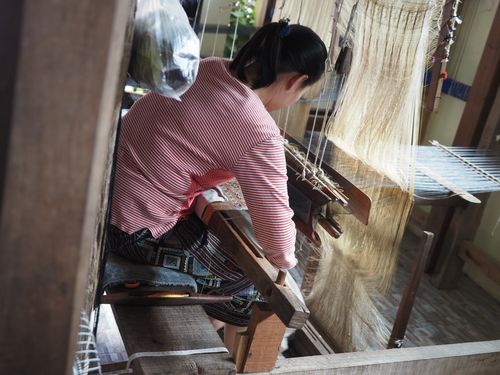
Laos • Weaving in Luang Prabang
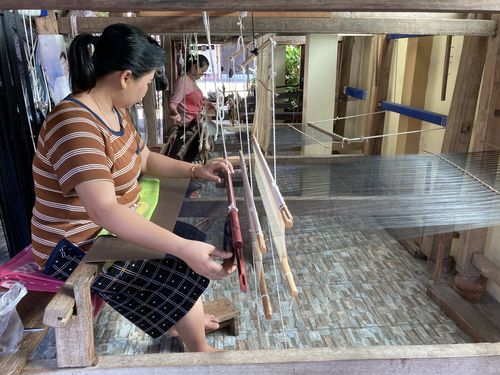
Laos • Weaving in Luang Prabang
Tradition profile
Weaving in Luang Prabang
Tradition category: Craftsmanship
Tradition family: Crafts and professions
Tradition genre: Trade and Local Creativity
Geographic location: Laos • Laos
• Links to •
• List of videos about Vientiane on this site •
Vientiane • Temples and Sacred Architecture of Laos
Laos • Fabric Arts
Vientiane, the Triumphal Arch Patuxay • Laos
The History of Weaving in Luang Prabang
In the bustling streets of Vientiane, where the hum of daily life echoes through the alleyways, weaving has stood as a silent witness to centuries of cultural evolution. The origins of weaving in Luang Prabang can be traced back to the 14th century, during the reign of the Lan Xang kingdom. Historical records indicate that the art of weaving was initially introduced through trade routes connecting the region to neighboring kingdoms such as Siam and the Khmer Empire.
A pivotal moment occurred in 1770 when Chinese merchants brought raw silk to Luang Prabang, prompting local artisans to experiment with the blending of silk and cotton. By the early 19th century, Luang Prabang had established itself as a center of textile craftsmanship, with workshops producing intricate patterns inspired by Buddhist iconography and animist symbols. The first recorded workshop dedicated solely to weaving was established in 1825, marking the beginning of a more organized industry.
The late 19th century saw further transformation as European missionaries and traders introduced new techniques and patterns. In 1895, a collective weaving center was founded, allowing for more systematic production and wider distribution of textiles. However, the socio-political upheavals of the 20th century, including the First and Second Indochina Wars, disrupted the industry. Despite these challenges, weaving persisted as a symbol of cultural identity, and in 1963, the Lao government officially recognized traditional weaving as part of the nation’s cultural heritage.
Today, weaving in Luang Prabang is not only a craft but a vital link to the past, a testament to the resilience of a people whose threads continue to weave stories across generations.
The Sociology of Weaving in Luang Prabang
In the social fabric of Vientiane, weaving is more than an art form; it is a pillar of community life. Throughout history, weaving has served as both a means of economic sustenance and a vehicle for cultural expression. According to a 1987 study conducted by the Lao Heritage Research Center, approximately 68% of women in Luang Prabang were skilled in weaving, a tradition passed down from mother to daughter.
Weaving workshops, often family-run, have long been gathering places where women not only share techniques but also forge social connections. These spaces become informal networks where news is exchanged, disputes are resolved, and communal bonds are strengthened. The cooperative model gained prominence in 2001 and 2008 with the establishment of social reintegration programs aimed at preserving traditional weaving techniques while providing economic opportunities for marginalized women.
Economically, weaving plays a crucial role in the livelihoods of many families. Between 1995 and 2005, the demand for handmade textiles increased by 34%, driven largely by international interest in Lao craftsmanship (source: Lao Ministry of Commerce). However, this surge in demand also brought new pressures, as artisans were compelled to produce more rapidly, sometimes compromising quality for quantity.
Moreover, the generational shift poses a significant challenge. As younger women migrate to urban centers seeking higher-paying jobs, traditional weaving practices are increasingly maintained by older women, many of whom struggle to keep the craft alive. Efforts to address this include educational initiatives designed to engage younger generations, ensuring that the art of weaving continues to thread its way through the evolving social landscape of Luang Prabang.
 Links to the main sections of the site