Français (France)
  Nederlands (nl-NL)
 Weaving in Kok Phung Kai is a traditional craft that reflects the expertise of artisans in this Laotian village. Local craftsmen apply techniques handed down through generations to produce distinctive textiles, characterized by intricate patterns and a variety of colors. Weaving also serves as a vital source of income for families in Kok Phung Kai, helping to sustain traditional craftsmanship while supporting the local economy.
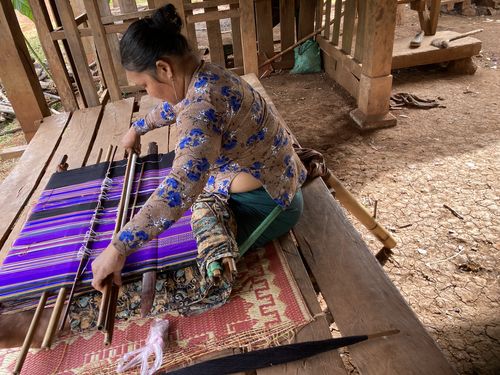
Laos • Weaving in Kok Phung Kai
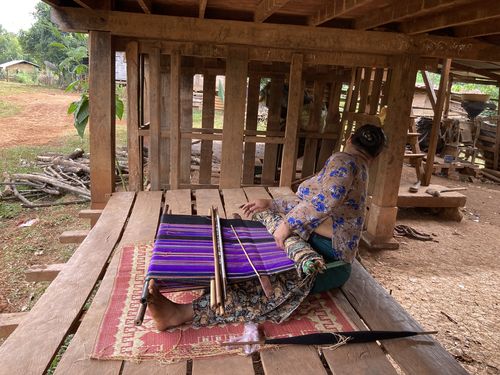
Laos • Weaving in Kok Phung Kai
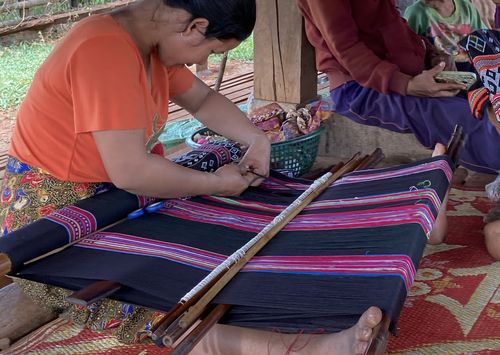
Laos • Weaving in Kok Phung Kai
Tradition profile
Weaving in Kok Phung Kai
Tradition category: Craftsmanship
Tradition family: Crafts and professions
Tradition genre: Trade and Local Creativity
Geographic location: Laos • Laos
• Links to •
• List of videos about Vientiane on this site •
Vientiane • Temples and Sacred Architecture of Laos
Laos • Fabric Arts
Vientiane, the Triumphal Arch Patuxay • Laos
The Historical Evolution of Weaving in Kok Phung Kai, Laos
In the quiet village of Kok Phung Kai, the rhythmic clacking of wooden looms echoes through the air, a sound that has resonated across generations. The tradition of weaving in this remote Lao settlement is not merely an art form; it is a historical testament to the cultural and economic development of the region. The roots of weaving in Kok Phung Kai can be traced back to the early 19th century, around 1820, when the village was first established as a small cluster of farming families.
Early Beginnings and Cultural Exchange
During the initial decades of the 19th century, the population of Kok Phung Kai primarily relied on agriculture, but the introduction of the silk trade in 1845 marked a pivotal shift. The arrival of traders from nearby Vientiane brought with them new weaving techniques, and soon, local women began incorporating these methods into their own work. Textiles became more intricate, incorporating geometric patterns that symbolized fertility, prosperity, and spiritual protection.
Colonial Influence and the Spread of Techniques
By the late 19th century, Laos fell under French colonial rule, a period that significantly influenced the craft industry. Between 1893 and 1954, French traders exported Lao textiles to European markets, increasing the demand for high-quality woven products. Kok Phung Kai, situated along a key trade route, became a center for weaving, with its artisans adapting their styles to meet foreign demand. New dyes were introduced, allowing for brighter and more varied colors, a trend that continued well into the 20th century.
Economic Transformations in the 20th Century
The rise of industrialization in Laos during the 1960s and 1970s led to a decline in traditional weaving, as imported synthetic fabrics flooded the market. However, in 1975, the establishment of the Lao People’s Democratic Republic brought renewed interest in preserving cultural heritage. Government initiatives aimed at revitalizing traditional crafts provided financial support to Kok Phung Kai, and by the 1980s, the village experienced a resurgence in weaving activities.
Modern Developments and Cultural Preservation
In 2001, the Lao National Museum began documenting the traditional crafts of rural communities, including the weaving practices of Kok Phung Kai. This initiative led to the creation of workshops designed to teach younger generations the art of weaving, ensuring the continuation of this ancient practice. Today, weaving in Kok Phung Kai remains a vital part of the village’s identity, symbolizing both its cultural heritage and its resilience in the face of economic change.
The Sociological Impact of Weaving in Kok Phung Kai, Laos
Weaving in Kok Phung Kai is more than a craft; it is a profound social institution that binds generations and fosters community cohesion. The process of weaving, which involves intricate patterns and labor-intensive techniques, reflects the collective identity of the village and serves as a vehicle for cultural expression. Unlike other forms of economic activity, weaving in Kok Phung Kai is largely a female-dominated practice, making it a critical aspect of both social and economic life.
Women as Custodians of Tradition
In Kok Phung Kai, weaving is traditionally passed down from mother to daughter, forming an unbroken lineage of knowledge that spans several generations. According to a 1998 survey conducted by the Lao Women’s Union, approximately 68% of women in Kok Phung Kai are involved in weaving, either as primary artisans or as assistants in family-run workshops. This social structure not only preserves the craft but also empowers women economically, allowing them to contribute significantly to household incomes.
Social Hierarchies and Status
Textiles woven in Kok Phung Kai are not merely commodities; they are also markers of social status and ethnic identity. The complexity of the patterns and the quality of the fabric often indicate the weaver’s skill level and social standing. For instance, ceremonial garments woven for weddings or religious festivals are reserved for high-status families, while simpler textiles are produced for everyday use.
Economic Significance and Community Development
Despite economic fluctuations, weaving remains a stable source of income for the residents of Kok Phung Kai. A 2003 report by the Lao Handicraft Association estimated that woven textiles accounted for nearly 40% of the village’s total income. This economic impact is especially significant given the limited agricultural opportunities in the region.
Community-based cooperatives have emerged as a response to external market pressures, allowing weavers to pool resources and negotiate better prices for their products. Such initiatives not only strengthen community ties but also provide a platform for women to exercise greater economic autonomy.
Educational Initiatives and Cultural Transmission
Since 2010, educational programs have been established to teach the younger generation the art of weaving, ensuring the continuity of the craft. These programs, led by elder artisans, emphasize not only technical skills but also the cultural narratives embedded in each textile. This emphasis on cultural education fosters a sense of pride and belonging, reinforcing the role of weaving as a pillar of community identity.
In Kok Phung Kai, weaving transcends its economic function, acting as a conduit for social connections, cultural transmission, and economic empowerment. As the village continues to evolve, the tradition of weaving remains a steadfast link to its past and a vital component of its communal fabric.
 Links to the main sections of the site