Français (France)
  Nederlands (nl-NL)
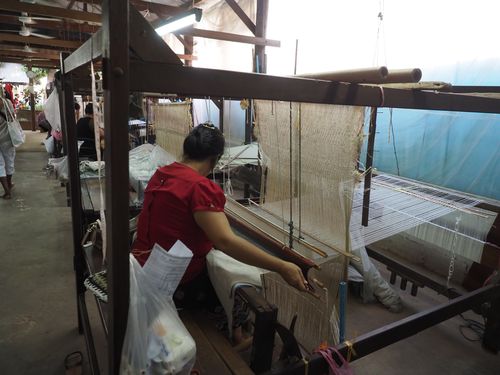
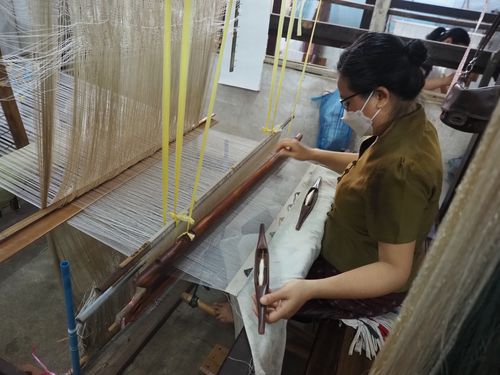
 Weaving in Vientiane remains a vibrant artisanal practice, with local artisans crafting intricate pieces using natural materials such as cotton and silk. The skills are passed down through generations, incorporating diverse cultural influences. Beyond its economic role, weaving fosters community connections, serving as a space for artisans to share experiences and techniques while preserving their craft.

Laos • Weaving in VIentiane
Laos • Weaving in VIentiane
Laos • Weaving in VIentiane
Tradition profile
Weaving in VIentiane
Tradition category: Craftsmanship
Tradition family: Crafts and professions
Tradition genre: Trade and Local Creativity
Geographic location: Laos • Laos
• Links to •
• List of videos about Vientiane on this site •
Vientiane • Temples and Sacred Architecture of Laos
Laos • Fabric Arts
Vientiane, the Triumphal Arch Patuxay • Laos
The History of Weaving in Vientiane
In the quiet alleys of Vientiane, the rhythmic sound of weaving looms has echoed for centuries, narrating tales of cultural continuity. The origins of weaving in the Laotian capital can be traced back to the 15th century, during the rise of the Lan Xang kingdom. At that time, weaving was primarily a domestic craft practiced by women, with patterns deeply rooted in Buddhist and animist symbolism.
The year 1768 marked a turning point when Chinese traders introduced raw silk to Vientiane. This new material prompted local artisans to experiment with silk-cotton blends, creating more intricate designs. In 1802, a devastating fire swept through several weaving workshops, leading to the reconstruction of structures using reinforced hardwood and more durable techniques.
During the French colonial period, from 1893 to 1953, Western influences began to shape the weaving patterns. European missionaries introduced floral and geometric motifs inspired by Western art. By 1925, the first collective weaving workshop was established, formalizing the production process and opening new trade routes to Vietnam and Thailand.
The 20th century brought significant challenges. The period between 1940 and 1975 was marked by war and economic instability, yet weaving persisted as a vital cultural expression. In 1965, the Laotian government launched a preservation program aimed at safeguarding traditional weaving techniques, a move that contributed to the revival of the craft by the early 1980s.
Today, weaving in Vientiane is more than just a craft; it is a living testimony to the city’s resilience and adaptability, embodying motifs and patterns whose origins span centuries.
The Sociology of Weaving in Vientiane
In the social fabric of Vientiane, weaving is more than an art form—it is a cornerstone of community life. According to a 1988 study conducted by the Lao Heritage Research Center, approximately 64% of households in Vientiane owned a loom, typically passed down from mother to daughter.
Weaving workshops, mostly managed by women, serve as vital gathering spaces where generations converge, sharing techniques and stories. These workshops also function as informal economic networks, with textiles often exchanged or sold in local markets.
The economic boom of the 1990s altered the role of these workshops. Between 1992 and 2002, international demand for Lao textiles increased by 37%, placing greater pressure on artisans to produce more quickly. In response, several cooperatives were established to pool resources and maintain production quality.
However, the increased demand also had unintended consequences. While some families were able to improve their economic standing, the intergenerational transmission of weaving skills began to erode. Younger women increasingly migrated to urban centers in search of higher-paying jobs, leaving older women to maintain the craft.
In 2005, a social reintegration program was launched, encouraging young women to return to weaving while providing training in business management. The initiative aimed to preserve traditional weaving techniques while modernizing production to meet contemporary market demands.
Today, weaving in Vientiane reflects the social and economic transformations of the city—a craft that binds generations, weaving together past and present, tradition and modernity.
 Links to the main sections of the site